CROSSFISH: human impacts on fish assemblages in European and North American rivers
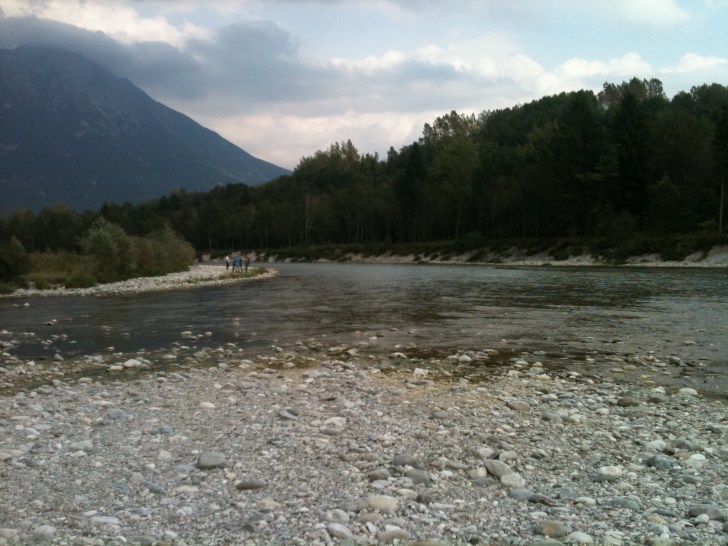
River Piave, Belluno, Italy. Image: Rafaela Schinegger
Earlier in the year, MARS scientist Dr. Rafaela Schinegger from the University of Natural Resources and Life Sciences, Vienna (BOKU) travelled to the United States to begin a collaboration with the Aquatic Landscape Ecology (ALE) Laboratory led by Dr. Dana Infante and others from the Center for Systems Integration and Sustainability, Department of Fisheries and Wildlife at Michigan State University (MSU).
Funded by a Fulbright Austria research scholarship, Rafaela has been working on a collaboration named CROSSFISH, which focuses on the influence of human stressors on river fish assemblages in Europe and the United States. Here, Rafaela tells us more about her research and this transatlantic collaboration.
***
River ecosystems around the world are vulnerable to various stressors (also referred to as pressures) caused by human activities. These include agricultural production, urbanisation, hydropower generation and commercial water use amongst many others.
Such activities don’t only affect water quality and quantity, but also impact the ecological integrity and health of rivers, and the ecosystem services they can provide. Fish have complex ecological requirements and are generally highly sensitive to habitat degradation. This means that stresses on river ecosystems are likely to particularly impact fish assemblages. The term ‘assemblage’ describes populations of two or more different species occupying the same geographical area at a particular time
European waters: assessment of ecological status and pressures
There is strong European Union environmental legislation designed to help improve and protect the continent’s river ecosystems. In particular, the European Commission’s Water Framework Directive (WFD) requires member states to ensure that all water bodies to reach ‘good ecological status / potential’. The WFD is implemented in 6-year planning phases (with the most recent phase ending this year) and relies on the use of multiple Biological Quality Elements (BQEs) for status assessments. As outlined above, fishes are sensitive indicators of water quality and ecological integrity in rivers, which makes them an excellent indicator species for assessment.
56% of European rivers fail to achieve good ecological status or potential, as they are affected by a complex set of human-driven stressors, according to WFD River Basin Management Plans and a related 2012 report by the European Environment Agency. While working on projects that focused on understanding multiple human stressors on rivers and their impacts on freshwater fish assemblages, I have gained expertise on these topics over the last few years and in my work as senior scientist and lecturer at BOKU (see here and here), and have focused on related aquatic ecosystem management responses.
For example, working with scientists from 15 countries in the EU funded project EFI+ Improvement and Spatial Extension of the European Fish Index, we identified and collected stressor data for fish at sampling sites across Europe.
Based on these data, we showed that:
(1) degradation of European rivers is widespread;
(2) single water quality pressures were not dominant, but;
(3) many European rivers are affected by hydromorphological pressures or a combination of pressure types;
(4) and that stressor and stressor combinations vary across ecoregions and river types.

Large rivers (>1000km2 catchment size) in Europe.

Large rivers (>1000km2 catchment size) in the USA.
National Assessment of the Status of Fish Habitats in the United States
Just as in Europe, human-induced stressors on fish assemblages in rivers are widespread in the United States and have caused predictable declines in the condition of fish habitat and led to changes in fish biodiversity. Fish community indicators of habitat condition have been identified for the entire U.S. and are used in a national river fish habitat condition assessment for the National Fish Habitat Partnership (NFHP).
The NFHP’s mission is to protect, restore and enhance the USA’s fish and aquatic communities through partnerships that foster habitat conservation. NFHP works nationwide, leveraging federal, state and private funding sources and expertise to ensure productive and sustainable fish populations through conservation projects. This is currently implemented through 18 regional grassroots partner organisations.
In 2010, Dr. Dana Infante’s Aquatic Landscape Ecology lab completed a condition assessment of the nation’s rivers for the NFHP. Researchers at the lab are now working on an updated assessment for 2015 to describe current river conditions and the changes that have occurred in the last five years. Dr. Infante is an Associate Professor at Michigan State University and her research expertise includes studying landscape factors that influence physical and biological features of river systems, river catchment hydrology and ecological assessment.

US National Fish Habitat Assessment map showing best (blue) to poorest (red) ecological condition.
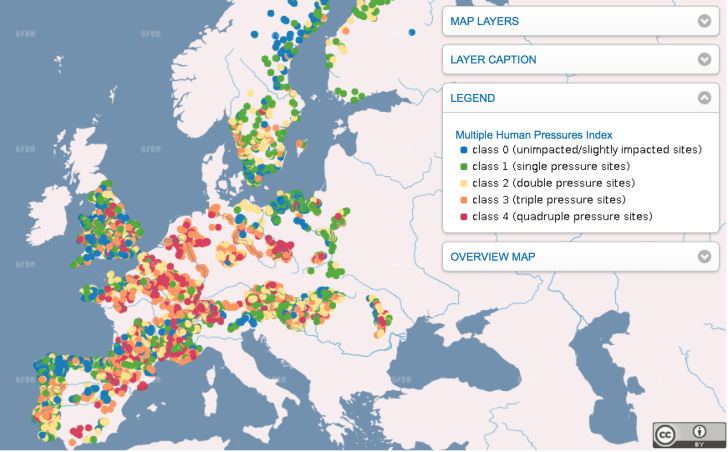
Multiple Human Pressures and Their Spatial Patterns in European Running Waters. Click the image to explore the map on the Global Freshwater Biodiversity Atlas.
Cross-continental collaboration through CROSSFISH
My work shares similarities with Dr. Infante’s, focusing on similar freshwater topics at a range of spatial extents across the world. As a result, we began working together on the CROSSFISH cross-continental collaboration in 2015 during my Fulbright scholarship.
With CROSSFISH, we want to highlight similarities and differences in the status of fish habitats and assemblages in Europe and the United States, and the threats they face. Our work examines data quality as well as the forces and policies that impact the ecology of river ecosystems and their fish assemblages.
The first step now is to describe regional and continental differences of large-scale stressor patterns based on existing data and try to characterise current ecological conditions of fish assemblages and habitats in a common way for both continents. This research uses landscape variables (e.g. land-use, road density) as surrogates for human stressor data.
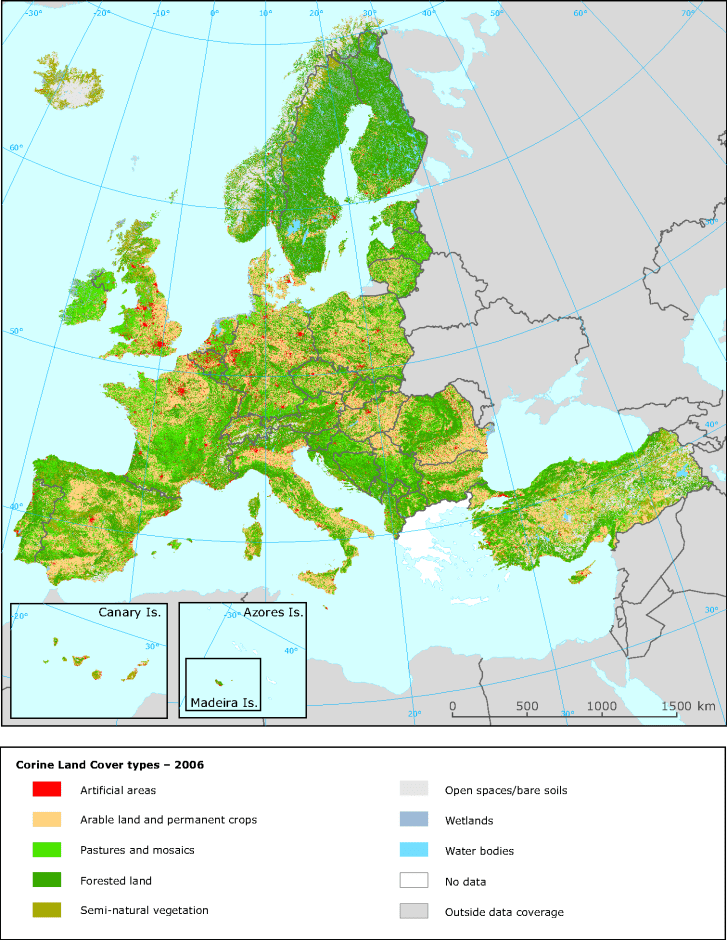
Land-use in Europe. Corine Land Cover types, 2006
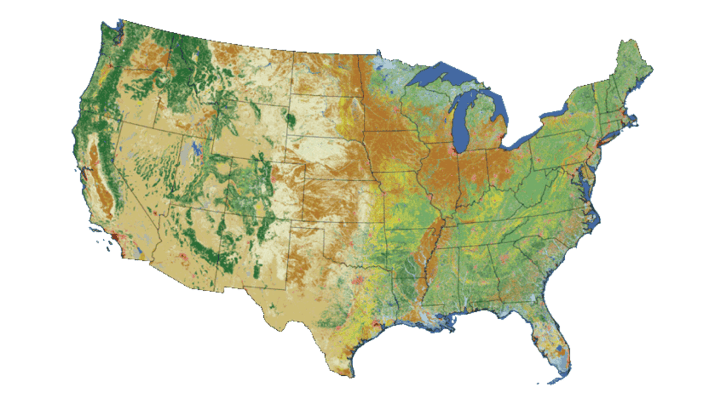
Land-use in Europe. National Land Cover Database, 2006. Click image for classification key.
Using a common research format, uncertainties in existing datasets will be identified and stressor patterns guided by mechanistic principles will be described. We aim to gain insights on both future data needs and ways to improve aquatic ecosystem management on both continents. In this regard, the elements of the USA’s National Fish Habitat Action Plan (pdf), (an outcome of the NFHP assessments) can serve as a best-practice example, with implementation potential in Europe and elsewhere.
This Action Plan sets an ambitious agenda for the National Fish Habitat Partnership, planning for the first-ever national assessment of fish habitats in the USA, and the development and support of voluntary regional Fish Habitat Partnerships with high standards of science-based conservation.
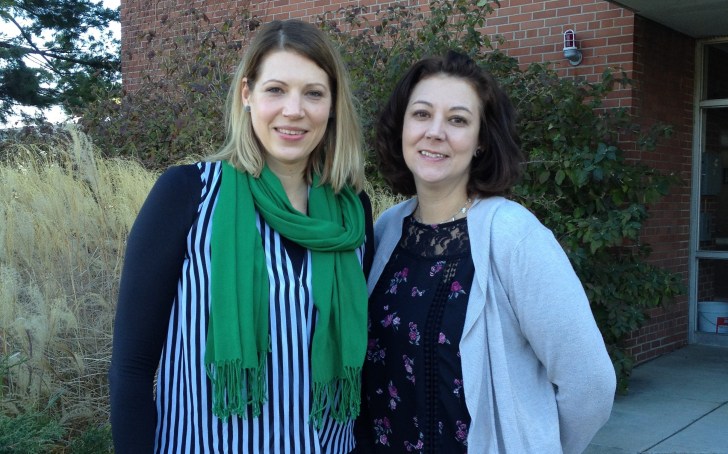
Rafaela Schinegger (left) and Dana Infante (right).
Can CROSSFISH contribute to future global inland fisheries assessment?
At Michigan State Universities’ Center for Systems Integration and Sustainability in the Department of Fisheries and Wildlife, Professor William W. Taylor and his group are looking at how fish habitat and fish production are directly linked to human systems, both locally and globally. From the Great Lakes to the Nile River, their studies involve global change issues such as climate, evaluation of governance, policies on the impact of fish community dynamics and their sustainability on food security and ecosystem integrity.
MSU and the Food and Agriculture Organization of the United Nations (FAO) established close cooperation on global inland fisheries in early 2015, with the aims of elevating the global profile of inland fisheries and aquaculture in respect to: (1) food and economic security; and (2) sustainable land development and water management.
The CROSSFISH approach may prove highly relevant for such assessments as the actual data on global inland capture fisheries production are generally incomplete and inaccurate and do not include interactions with associated fish habitat conditions. To facilitate these global discussions, an abstract on CROSSFISH has been submitted for the 7th World Fisheries Congress, taking place from 23rd to 27th of May 2016 in Busan, Korea.
We want to encourage scientists and policy makers to attend this event, especially session 6 – Moving Toward a Global Status of Inland Fisheries: First Steps – hosted by U.S. Geological Survey, Carlton University (Canada) and MSU. This will enable parties interested in CROSSFISH and related large-scale assessments of river fish assemblages to share interests and discuss potential future solutions that may enhance the sustainability and value of the world’s river ecosystems.
***
Below are two slideshows of Rafaela’s photographs taken in the field across Europe and the U.S.A.
Who says scientists aren’t creative!
Find out more about Rafaela’s research here.
Tales of two rivers
To start this festive week, we’re sharing clips of films about two rivers with rich ecological and cultural histories, from the western and eastern edges of the UK. ‘The Chalk Streams of Norfolk‘ is narrated by celebrated actor Stephen Fry and provides a vivid depiction of the biodiverse and unique, yet increasingly threatened chalk streams of East Anglia.
‘A River‘ charts the history of the River Afon in south-west Wales and its ongoing ecological recovery from the impacts of centuries of mining in surrounding landscapes. Narrated by actor Michael Sheen and told through voices from local communities, the film reflects on the uncertain futures of the river as a result of extractive gas and oil industries potentially returning the area.
SOLUTIONS Technologies 2030 workshop: trends and consequences of future chemical pollution

Guest post by Dirk Bunke, Susanne Moritz, Werner Brack and David López Herráez.
Can changes in the availability and use of water resources, population demography, technology, economy and climate alter the pattern of chemical substances released into the environment? Is it possible – at least to a certain degree – to predict future emerging pollutants?
The EU SOLUTIONS project address these questions based on scenarios impacting on freshwater chemical pollution. The project’s underlying objective is to suggest assessment tools and abatement options for emerging water pollution challenges.
SOLUTIONS workshop – Technologies 2030
The project’s first task on this ‘topic of tomorrow’ was to identify and examine patterns and trends in current chemical pollution. Following this initial analysis, SOLUTIONS scientists are now working with external experts in dedicated workshops to discuss economic, technological and demographic trends in society.
Last month, the SOLUTIONS project held a workshop titled ‘Technologies 2030’, which brought together a team of researchers and stakeholders to discuss the challenges of new and emerging chemical pollutants.
Innovations in technologies play a central role in enhancing the efficiency of processes and products. New materials are constantly being developed, and form the basis of the majority of new product innovations. Printable electronics, metallic matrix composites, technical textiles and switchable shading systems are only some examples. Does this automatically mean that we can expect parallel releases of new substances into the environment?
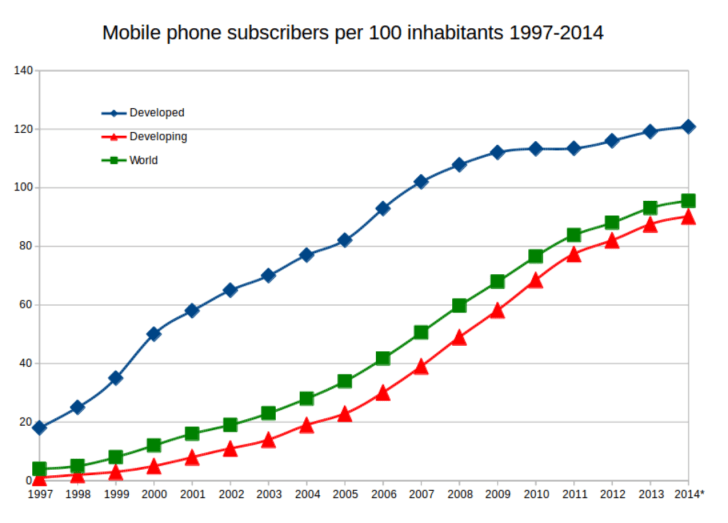
Mobile phone subscribers per 100 inhabitants distinguishing developed and developing countries. Figures for 2005-2014 taken from International Telecommunication Union – ITU. Source: Wikimedia Commons.
The future of chemical pollution in freshwaters
The workshop’s systematic search for incipient trends, opportunities, challenges and constraints that might affect societal goals and objectives began with a “horizon scanning” presented by Michael Depledge. What is the future of chemical pollution in freshwaters? What will be the new and emerging pollutants, and where will they come from?
All predictions of future developments show a degree of uncertainty, nevertheless Depledge gave an overview about practical experience in scanning for global environmental issues. The Massachusetts Institute of Technology identified in a similar approach the following candidates as important new technological trends: Nano-Architecture, Car-to-Car Communication, Project Loon (connecting billions of people to the Internet), Liquid Biopsy, Megascale Desalination, Brain Organoids, Supercharged Photosynthesis and Internet of DNA.
Regarding future chemicals and potential pollutants, the key questions are: What kind of chemicals will we need in future worlds? In what amounts? In which regions of the world? From 1940 up to today, the amount of chemicals produced has increased several hundred folds. In part, consumption of chemicals can be directly predicted from product sales – for example, the trace elements needed for smartphones.

Existing chemicals
It is estimated that two-thirds of future chemical production growth will be as a result of already-existing chemicals. Parallel to the projected growth in chemical production, new approaches to reduce emissions come up. For example: automated agricultural vehicles in Precision Agriculture minimizing wastage of fertilizers, pesticides and other agrochemicals. However, at present, precise long-term visions about how the future in Europe and the world will look like with respect to new products and chemicals are still lacking.
New material developments
Approximately 70% of all product innovations in Europe are based on new material developments. Wolfgang Luther from the VDI Technology Center, Germany, presented an overview on the early identification of chemical aspects for innovative materials and technologies. Materials innovations comprise new substances, substance and material modifications (e.g. surface functionalization), new material combinations (e.g. multi-material systems, composites) and new application context of established substances.
A key driver for material innovations are substitutions. Substitutions may take place for different reasons: rare or cost intensive raw materials, hazardous and toxic substances, change to more sustainable technologies, change to better technical performance and/or cost reduction.
The VDI Technology Center has identified more than a hundred innovative technologies and materials, selecting 20 of them for a deeper analysis. They belong to the following six groups: new production technologies (such as 3D printing), electronics (such as OLEDs and printable electronics), construction and lightweight engineering, energy and environmental engineering (as organic photovoltaics), textile technologies and functional materials and coatings (as polymeric foals). Many of the 470 substances compiled for these new technologies were polymers, a class of compounds, which is not registered under REACH.
Energy supplies
One of the major developments in the near future addresses technologies for energy supply. As discussed by Andreas Müller from chromgruen and Jonas Bartsch from the Fraunhofer Institute for Solar Energy Systems ISE, Germany, all technologies of energy transition, including energy production, storage and saving, come along with their specific chemical footprints, which require careful assessment.
Hydraulic fracturing (i.e. Fracking) might be the technology with the largest diversity of chemicals used involving more than a thousand individual compounds. Solar heat requires isocyanates for PU (polyurethane) foams and adhesives, organohalogen and organophosphorous flame retardants, and a range of metals and other inorganic materials.
Bisphenol A-based epoxy resins are used for rotor blades and might be emitted during manufacturing, use and dismission. Hydropower plants can be considered as stocks for legacy chemicals such as asbestos and polychlorinated biphenyls, which may be released to the environment as and when these plants are refurbished.
Photovoltaics
One of the key technologies of future energy production is photovoltaic (PV). A wide variety of designs have been developed to save the energy of excited electrons using a range of (mostly silicon-based) semiconductors. Apart from silicon semiconductors, organic solar cells using compounds of complex structure, such as fullerenes and hexalthiophene, dye-sensitized solar cells and mixed types are available but are not expected to replace silicon based PV within the next decade.
During use, the current technology shows only limited risk due to a low release potential. Recycling is desirable – for economic savings and pollution prevention. During production, typically hazardous substances are used. However, this takes place under “clean room conditions” with the aim of closed material cycles.
Nanotechnologies
Nanotechnology is another key enabling technology with potentially high benefits for social and economic development, yet which at the same time poses risks to the environment and human health. Both technological development and risk assessment have been interlinked in the Dutch project Nanonext (as presented by Annemarie van Wezel).
The project developed a specific method for Risk Analysis and Technology Assessment – termed RATA – including a specific tool set to check new business ideas for risks – really at the beginning. This “Golden-egg check” may be seen as an example for other novel technologies and is publicly available. Checking for risks in advance and minimizing them from the very beginning may become a selling point for novel technologies.
Horizon scanning at Technologies 2030
The SOLUTIONS workshop on “Technologies 2030” and their impact on future pollution highlighted the strongly chemical-related nature of many novel technologies including electronics, energy, nanotechnology and many more.
New compounds for novel technologies such as dye sensitized solar cells will come up but at the same time many already existing chemicals will be used. Thus, future patterns of pollution – in 2030 and onwards – will be a complex mixture of legacy chemicals, “forgotten” old chemicals which are released decades after their use, and new emerging substances.
It will be SOLUTIONS’s task to translate this finding into strategies for future environmental modelling and monitoring as well as for sustainable use of chemicals minimizing risks to freshwater ecosystems and human health.
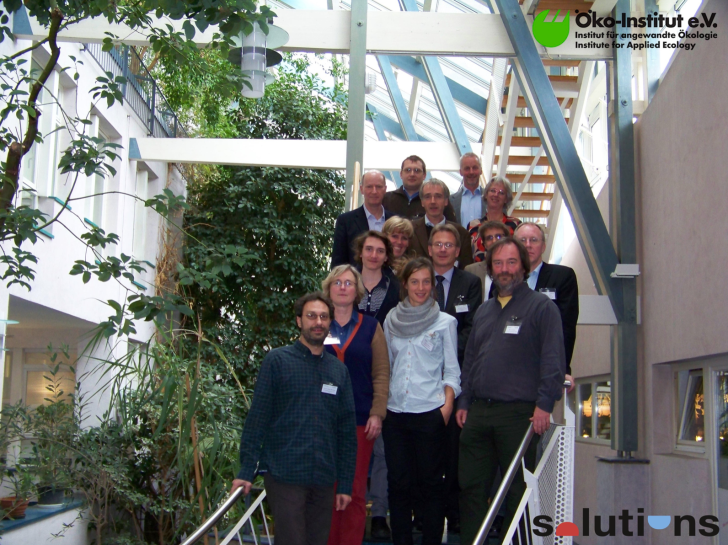
Participants
Attendees from following institutions participated in SOLUTIONS “Technologies 2030”
Dirk Bunke, Susanne Moritz and Anton Biljan from Öko-Institut (Institute for Applied Ecology – Germany); Werner Brack, Rolf Altenburger and David López Herráez from the Helmholtz Center for Environmental Research – UFZ; Michael Depledge from University of Exeter Medical School; Frank Sleeuwaert from the Flemish Institute for Technological Research – VITO, Annemarie van Wezel from Watercycle Research Institute/University Utrecht – The Netherlands; Andreas Müller from chromgruen – Germany, Wolfgang Luther from VDI Technology Center, Germany, Jonas Bartsch from Fraunhofer Institute for Solar Energy Systems – ISE, Christiane Heiss from the German Federal Environment Agency, and Valeria Dulio from L’Institut National de l’Environnement Industriel et des Risques – INERIS, France.
Extreme events in running waters
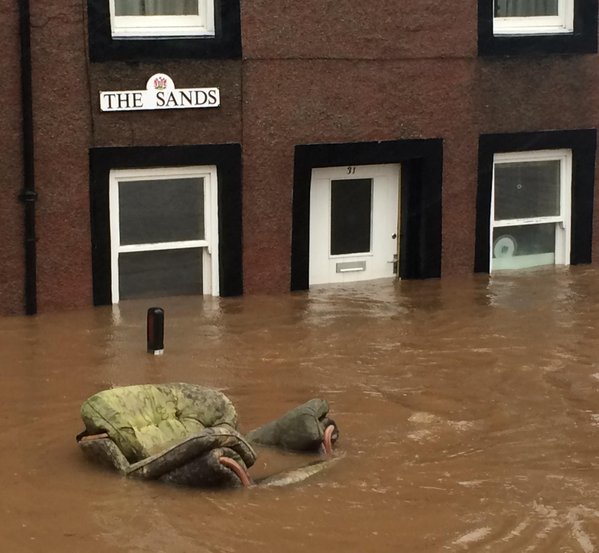
A flooded street in Appleby, Cumbria. Image: Fiona Trott / Twitter.
Over the weekend, heavy rainfall in the north of England caused major flooding in Cumbrian and Northumbrian towns and villages. A Met Office rainfall gauge at Honister Pass in the Lake District recorded 341.4mm of rainfall between 1800 on the 4th and 5th of December, a new UK record for a 24 hour period. The heavy rainfall was partly caused by a persistent flow of warm, wet air from the West Atlantic Ocean, which is currently experiencing high sea-surface temperatures.
The floods have left homes and businesses flooded and without power, cut-off roads and train lines, and brought down trees and bridges. There are also likely to be significant ecological effects which may only be evident over time, for example if salmon redds in the upper reaches of the flooded rivers have been been destroyed. Responding to the floods, some commentators have called for better flood defences to be constructed, whilst others advocate the reforestation of the surrounding hills as a means of intercepting and buffering heavy rainfalls.
Commenting on the floods in Northern England, Professor Dame Julia Slingo, Met Office Chief Scientist, said:
“It’s too early to say definitively whether climate change has made a contribution to the exceptional rainfall. We anticipated a wet, stormy start to winter in our three-month outlooks, associated with the strong El Niño and other factors.
However, just as with the stormy winter of two years ago, all the evidence from fundamental physics, and our understanding of our weather systems, suggests there may be a link between climate change and record-breaking winter rainfall. Last month, we published a paper showing that for the same weather pattern, an extended period of extreme UK winter rainfall is now seven times more likely than in a world without human emissions of greenhouse gases.”
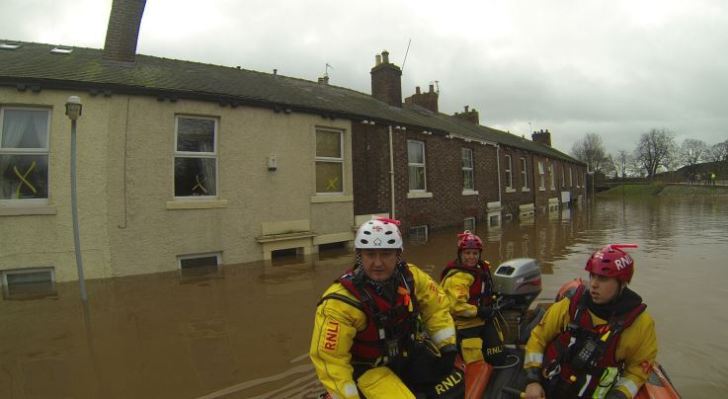
RNLI volunteers rescue stranded residents from flooded streets in Carlisle. Image: RNLI
Such extreme weather events are a natural feature of climate variability, and help shape the forms and functions of freshwater ecosystems, according to ecologists Mark Ledger and Alexander Milner from the University of Birmingham, UK. However, climate change is shifting the magnitude and occurrence of extreme weather events, and understanding their consequences for river and stream ecosystems is an key research priority.
In a newly published special issue of the journal Freshwater Biology, editors Ledger and Milner have compiled 14 articles which examine extreme events affecting river and stream ecosystems across the world, including heat waves, fires, droughts, heavy rainfall and floods, tropical cyclones, storm surges and coastal flooding.
The open-access issue contains reviews of existing scientific literature and observational and experimental case studies which synthesise knowledge of extreme events and their ecological effects on freshwaters, as a means of guiding future research and management.
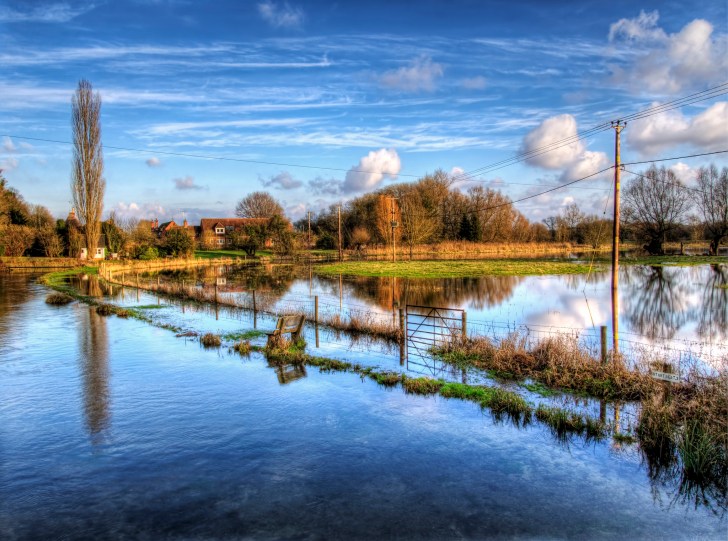
Flooded fields around the River Test, UK in 2013. Image: Neil Howard | Creative Commons | Flickr
The collected papers suggest that the ecological impacts of single events such as catastrophic floods, droughts and heat waves are highly context dependent. Impacts can be both positive or negative, and are dependent on the magnitude and extent of extreme events and their timing relative to life cycles of the affected species (e.g. spawning salmon).
Not all extreme events generate extreme ecological impacts, but combinations of events that cause multiple stresses are likely to have the most adverse ecological consequences. Ledger and Milner suggest that long-term monitoring programmes and sensor networks are essential in describing rare and unusual events. Similarly, ongoing experiments (see the MARS experiments on Alpine streams, for example) are important in understanding the mechanisms of extreme events which are likely to get stronger and more frequent in the future.
Water and Climate Change at COP21 in Paris

Delegates at the Water Resilience Focus event organised by the Lima to Paris Action Agenda. Image: UNFCCC
This week and next, governments, policy makers and NGOs from around the world are meeting in Paris to work towards a new international agreement on climate change intended to keep future global warming below 2°C. The 21st Conference of the Parties to the United Nations Framework Convention on Climate Change (or COP21) takes place in a year declared the hottest on record by the World Meteorological Organisation.
Water is an key medium through which climate change affects human and non-human lives. Climatically-altered precipitation patterns, extreme weather events (and ensuing floods and droughts), and shifting water temperatures all contribute to alterations in the quality and quantity of freshwater available to humans, plants and animals in ecosystems around the world.
In particular, water scarcity is already posing threats to human livelihoods and freshwater biodiversity. The effects of such water stresses are often uneven, and disproportionately affect poor communities in developing countries with already arid climates (see this UN report, for example, pdf). As such, the interactions of climate change and water have important implications for human poverty alleviation and sustainable development.
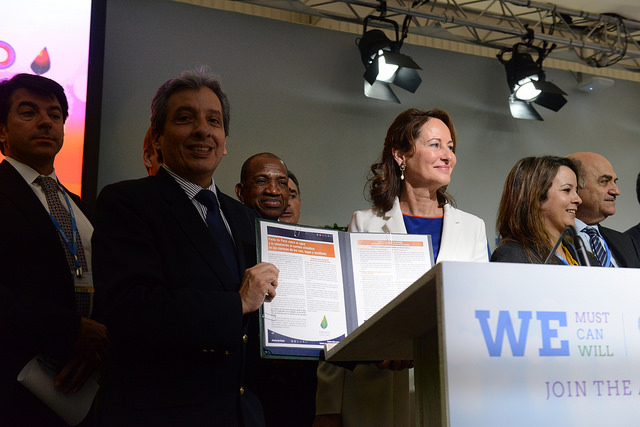
The Paris Pact on Water and Climate Change Adaptation. Image: UNFCCC
Whilst some commentators suggested in the run-up to the Paris COP that water would be largely absent from negotiating tables, there have been some encouraging signs. This week, a coalition of national governments, river basin organisations, businesses and civil society groups announced the creation of the Paris Pact on Water and Climate Change Adaptation, intended to make global water systems more resilient to climate impacts.
Announced at a Water Resilience Focus COP event organised by the Lima to Paris Action Agenda on climate change, the Pact represents US$ 20 million in technical assistance and potentially over US$ 1 billion in funding for water and climate change adaptation. It will finance a coalition of almost 290 water basin organisations to implement adaptation plans, strengthen water monitoring and measurement systems in river basins and promote financial sustainability and new investment in water systems management.
The Pact is intended to improve water resources management as a means of making progress towards poverty reduction targets, and achieving sustainable development, for example through Sustainable Development Goals.
Negotiations at the Paris COP are ongoing, and early indications are that there is broad cross-governmental support for significant cuts to carbon emissions. However, UN analysis (pdf) of pre-COP governmental pledges suggests that projected emission cuts may not go far enough to limit increases in global temperatures to 2°C targets by 2100.
For MARS leader Daniel Hering, strong governmental commitments to limiting future climate change in Paris are important for ensuring the health and diversity of global freshwater ecosystems:
“The Intended Nationally Determined Contributions are unlikely to be sufficient for the 2°C target. Any further step in this direction would be a success. However, it is quite obvious that we will have to live with global warming of more 2°C that will greatly affect freshwater quality and quantity.
A bundle of measures to minimise the effects of climate change on freshwater ecosystems are required. In particular, this concerns agricultural practices. For instance, nutrients affect warmer freshwater ecosystems more strongly, so nutrient standards will need to be stronger. River water temperature can effectively be mitigated with woody riparian vegetation, so buffer strips are a key to enhance freshwater ecosystem quality in a warmer world. And agricultural practices saving water will be crucial in arid areas.”
Similarly, MARS scientist Steve Ormerod emphasises the importance of tackling linked climate and water systems during the Paris negotiations. Ormerod, Professor of Ecology at Cardiff University and Chair of Council of the RSPB, describes that whilst encouraging steps are being made, the negotiations face key challenges in promoting resilient and adaptive ecosystems under climate change:
“All the evidence we have is that freshwater ecosystems are among the most sensitive of all to climate change: we know that they are warming, that their patterns of floods and droughts are changing, and that their organisms are being affected. In the end, this is bad news for people – because freshwaters are the ecosystems that we depend on more than any other.
I’m very glad there is at least some emphasis on freshwater at #COP21 – for example the Paris Pact on Water and Climate Change Adaptation focused on making our freshwater ecosystems more resilient across very large areas of the world.
Conservation organisations such as the IUCN are pushing for the protection of “natural infrastructure” in river catchments and riparian zones as a means of making freshwaters more resilient. These concepts are supported by our own evidence – for example showing how riparian woodlands in temperate areas can ‘climate-proof’ rivers against future change.
But we should have no illusions about the magnitude of the challenge ahead. We are entering an epoch where pressures on freshwaters for water supply and for food production have never been greater. Sound, science-based management will become more critical here than anywhere, and we can only prevent catastrophe if scientists, policy makers and stakeholder engage fully in solving the problems of water – potentially our greatest problems of all.”
We’ll continue to follow the negotiations at the Paris COP and report back at the end of next week with their outcomes.

A Mediterranean river: the Fango Valley in Corsica. Image: Ole Reidar Johansen (Flickr | Creative Commons)
Rivers are often receptacles for substances used and emitted by humans living across their watersheds. Fertilisers, pesticides, pharmaceuticals and new substances such as microplastics and nanomaterials may be carried through drains and outflow pipes, along roads, pavements and fields, and through rock and soil to reach a river.
Here, pollutants can impair the health and functioning of the river ecosystem in a number of ways. Such effects are complex, and may occur in interaction with other stressors on the river ecosystem such as alterations of water flow and temperature, habitat loss, climate change and invasive species (see the recent MARS video on the subject).
The interactions and effects of such multiple stressor ‘cocktails’ on river ecosystems are still only partially understood by freshwater scientists. In this context, a new issue of the journal Science of the Total Environment features 44 scientific papers on multiple stressor effects on rivers, particularly focused on Mediterranean river basins and water scarcity.
The special issue, titled “River Conservation under Multiple stressors: Integration of ecological status, pollution and hydrological variability” is edited by Marta Schuhmacher from the Universitat Rovira i Virgili and Alicia Navarro-Ortega, Laia Sabater and Damià Barceló from the Spanish Council for Scientific Research Institute of Environmental Assessment and Water Research.
Between 2009-14, the editorial team were members of the Spanish government-funded SCARCE project, which assessed and predicted the effects of global environmental change on water quantity and quality in Iberian rivers.
The final SCARCE conference, held in October 2014 in Tarragona, was attended by many partners of the European Union funded GLOBAQUA project. Both projects have common interests in considering water scarcity as the main stressor in river systems. The Tarragona conference integrated many of the findings and data from the SCARCE project with ongoing GLOBAQUA activities, which in turn have been translated into journal articles in the new special issue.
There is a rich variety of articles in the issue, covering numerous different multiple stressors scenarios in ecosystems across the world, and assessing strategies for their experimental study and management. Earlier in the year, we covered a study published in the special issue by MARS scientists led by Peeter Nõges on biotic and abiotic responses to multiple stress.
You can read the special issue of Science of the Total Environment online here
UK Government taken to court over freshwater pollution

Crop spraying at Swaffham Lock, Cambridgeshire. Image: Hugh Venables, Creative Commons, from Geograph.
Today the Angling Trust, Fish Legal and WWF-UK have joined together in the High Court in London to challenge “a governmental failure” to prevent agricultural pollution in UK freshwaters.
The organisations have tabled a judicial review that argues that the UK government has failed to stop agricultural pollution from degrading 44 rivers, lakes and estuaries.
They argue that under the EU Water Framework Directive, the UK government is required to ensure that these freshwaters are in good health by the end of 2015. However, this deadline is unlikely to be met.
Campaigners are using the legal action as a means of pressuring the government to implement stronger environmental policies which promote the health and diversity of UK freshwaters.
Writing on the Angling Trust blog, Chief Executive Mark Lloyd attributes the poor health of many UK freshwaters (where, for example, only 17% of rivers are in ‘good health’) to a governmental failure to regulate agricultural practices:
“Rain landing on wet, compacted fields runs off the surface of the soil and into rivers, carrying with it slurry, soil, pesticides and fertilisers, all of which are lethal to fish and the invertebrates they eat. Badly maintained gutters allow rainwater from roofs to wash farmyard muck into drains. Broken pipes divert filthy water into streams. All these trickles add up to a mighty load of pollution. Just because it doesn’t come out of a big pipe doesn’t make it any more deadly to our aquatic wildlife. It’s often referred to as causing death by a thousand cuts.”
In particular, the coalition of organisations argue that the government has failed to implement any Water Protection Zones (pdf), the locally-specific policy approaches designed in 2009 to tackle agricultural pollution as part of River Basin Management Plans.
David Nussbaum, Chief Executive of WWF-UK argues that such decisions have overlooked the importance of freshwater ecosystems, which has prompted today’s legal action:
“This was an ideologically driven decision, taken behind closed doors, which contravened the Government’s public position. It also flies in the face of Defra’s own analysis which has repeatedly shown that relying on voluntary action by farmers alone will not solve the problem of agricultural pollution.
We believe the use of this ‘last resort’ doctrine to evade installing Water Protection Zones has not only been devastating for our protected rivers and wetlands but is also unlawful.
Worse still, with these specially protected sites continuing to be polluted it is baffling that Water Protection Zones are still not being used as we approach the December 2015 deadline – if this doesn’t count as a time of ‘last resort’, what does?”
Responding to the judicial review, a Defra spokesperson told The Guardian that:
“Rivers in England are the healthiest they have been for 20 years and we are committed to working closely with the farming community and environmental groups to further improve water quality. Over the next five years, we are investing more than ever to promote environmentally friendly farming practices to protect our rivers and lakes and support wildlife.”
In October 2015, the European Commission issued legal guidance that warned the UK government of its failures to implement EU water legislation, which could potentially lead to fines of millions of pounds a year.
Update 20.11.15: High Court rules that the UK government must evaluate the use of mandatory Water Protection Zones. Read more on the WWF website.
New film tells the story of Devon’s wild beavers
We wrote last year about the population of beavers found living on the River Otter in Devon in south-west England. These were the first wild communities of beavers found since hunting drove the animal to extinction in the UK in the 1700s. Earlier this year, the first baby beavers – known as kits – were born on the river (watch footage of them here).
The Devon Wildlife Trust, who monitor the beaver population, have recently released a short film documenting their work and the impacts of the animals on the local environment and communities. The film outlines how the Devon beavers are valuable ‘ecosystem engineers’ of new habitats in and around the river, have become a draw for ecotourists, and a focal point for local environmental education schemes.

A Swedish boreal lake. Image: Erik Jeppesen
The world’s lakes, rivers and reservoirs naturally emit carbon dioxide as part of the global carbon cycle. Recent scientific studies suggest that annual carbon dioxide emissions from inland freshwaters roughly equate to the total uptake of carbon by the world’s oceans.
However, a new study using extensive ecological data from 5,000 Swedish lakes suggests that ongoing changes in land use and climate are causing increased levels of dissolved inorganic carbon in northern boreal lakes, which in turn is causing the lakes to emit increasing amounts of carbon dioxide into the atmosphere.
Writing in Nature Geoscience, Gesa Weyhenmeyer from Uppsala University and colleagues observed that small lakes in southern Sweden emitted twice as much carbon dioxide as equivalent small lakes further north. The team documented that carbon dioxide emissions were highest in lakes with a significant number of ice-free days each year and high dissolved oxygen and nutrient concentrations (often as a result of agricultural runoff).
Co-author, and MARS partner, Erik Jeppesen from Aarhus University explains,
“Our work indicates that the release of carbon dioxide from lakes in Sweden will increase as the climate gets warmer, and as areas adjacent to lakes is used for agriculture in the place of forests.”
The burning of fossil fuels releases carbon dioxide, and scientific consensus is that the resulting increase in atmospheric CO2 concentrations is causing increased global temperatures and other ongoing climatic changes.
The new study by Weyhenmeyer and colleagues shows that dissolved carbon from such emissions can travel through a watershed and ‘supersaturate’ lakes, which in turn causes them to emit carbon dioxide into the atmosphere. They suggest that carbon emissions from some of the boreal lakes in southern Sweden have reached levels comparable to lakes in tropical regions. In effect, this is a climatic feedback loop, where climate change drives further increases in CO2 emissions from freshwaters.
As a result, boreal lakes in northern latitudes of the world may become increasing sources of atmospheric carbon dioxide, a prospect that has consequences for global climate change, as Erik Jeppesen outlines,
“The findings worry us. There is great risk that as the climate warms in coming years, carbon dioxide emissions from lakes will increase significantly in the northern parts of Scandinavia, Russia and Canada. And, of course, these regions are where the vast majority of the world’s lakes are.”
For lead author Gesa Weyhenmeyer, the team’s findings have important implications for how we understand, and manage, boreal freshwater ecosystems as part of increasingly human-altered global climate systems,
“When we assess future emissions of carbon dioxide to the atmosphere, it is important to know where the carbon dioxide comes from. Only with this knowledge can we find ways to reduce the release.”
Weyhenmeyer, G. A., Kosten, S., Wallin, M. B., Tranvik, L. J., Jeppesen, E., & Roland, F. (2015). Significant fraction of CO2 emissions from boreal lakes derived from hydrologic inorganic carbon inputs. Nature Geoscience, advance online publication.
SOLUTIONS for open-data publishing

Guest post by Steffen Neumann, David López Herráez and Werner Brack.
Since the earliest days of science, journal articles have been the centre of scientific communication. They are the source of information in which academics, policy makers and businesses know what is happening in – and can build upon – the important research in their field. With online publishing, scientists can now collaborate more than ever before, sharing not just brief overviews of their methodology and results in print articles, but also their full results, primary datasets and even interactive graphics, all as “supplemental data”.
Supplemental data may help make scientific research more reliable (as experiments can be easily and properly replicated and fact-checked), efficient (as similar datasets are shared across different users, rather than having to be created multiple times from scratch), and democratic and transparent (as expert statements are open to public scrutiny). Despite this, it can sometimes seem like authors, editors and reviewers currently neglect the huge promise of supplemental data.
This was one of the topics under discussion at last month’s second annual general assembly of the SOLUTIONS project. This EU funded project is an international collaboration of academics, policy makers and businesses, all working to solve the problems of chemical pollution in European rivers and lakes. Getting the most out of the relevant science is a hugely important aspect of SOLUTIONS’ work, and one in which good supplemental data could play a vital role.
After discussion at the recent general assembly, SOLUTIONS members Maria König, Miren López de Alda, Bozo Zonja, Francesco Falciani, Steffen Neumann and Tobias Schulze created a report entitled “What makes good Supplemental Data and how to get there?” The report gives the following advice to scientists on using supplemental data to create better science that can be used more effectively to support environmental protection.
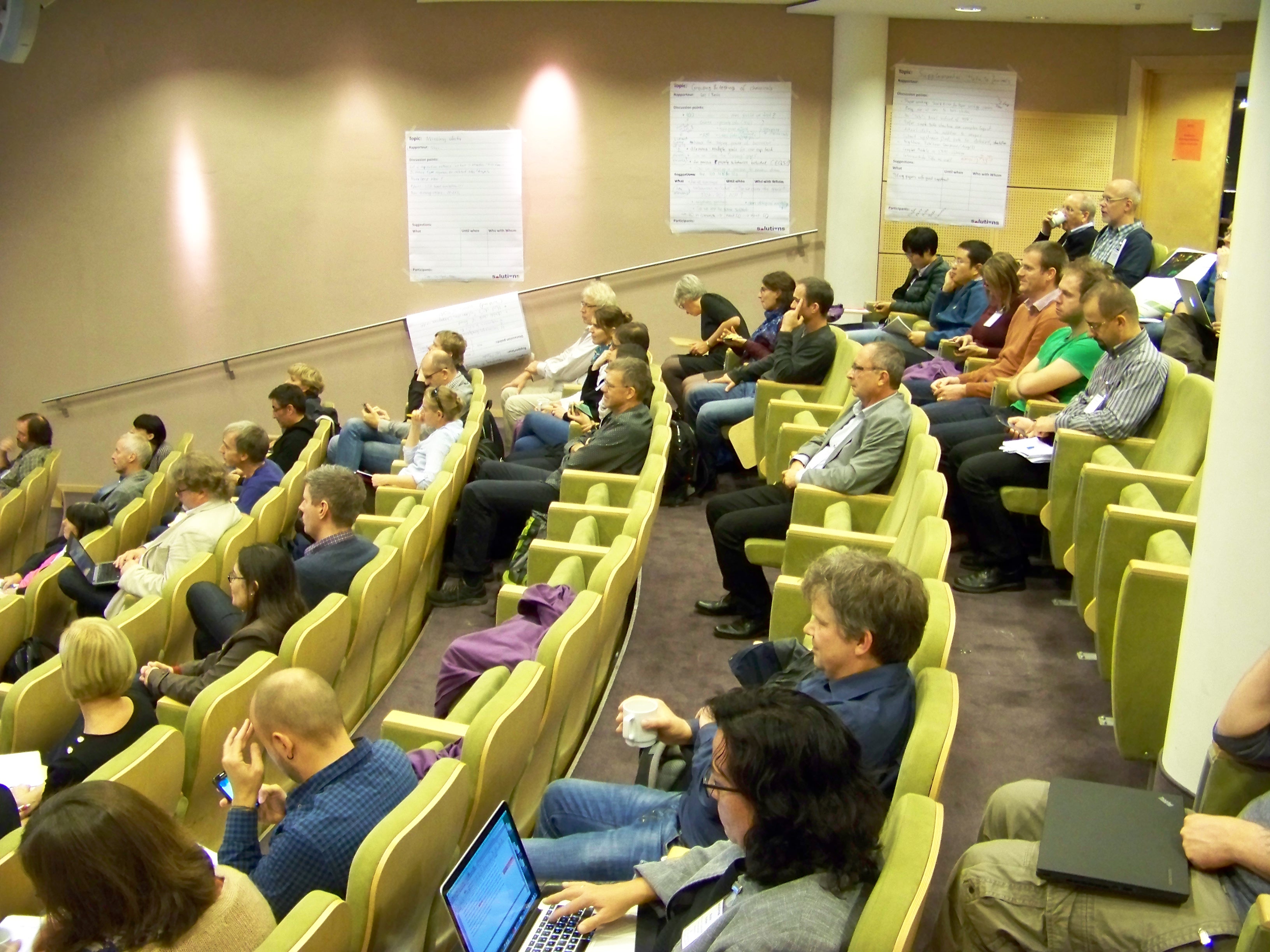
Attendees at the SOLUTIONS general assembly. Image: SOLUTIONS
Who uses supplemental data, and for what?
Perhaps one of the original aims of supplemental data was to add supplemental information that would not fit into the prescribed, say, eight pages of the main manuscript. In essence, these types of supplemental information are like an extension to the paper.
An important example of an area where supplemental data can really shine is meta-studies. These syntheses rely on being able to extract information from scientific studies in an efficient way. This could mean a lengthy process of contacting dozens of authors to obtain the required data. With good supplemental data, however, access can be instantaneous – making meta-studies not only better scientifically, but also cheaper and more efficient.
Another example is people searching for the best available method for a new study. Very often, journal papers report that some method performs this-and-that better than another method, or is faster, or cheaper, or all of these. Good supplemental information allows potential users to be able to make an informed, unbiased comparison of potential research methods.
Supplementary information can also allow a scientific finding to reach relevant audiences beyond the authors’ immediate peer group. A bioinformatics specialist, say, might be able to use the findings of a new chemistry study to create a better model of watershed pollution. However, he/she may not have the actual knowledge of chemistry necessary to make immediate sense of the article. Good supplementary information can provide the background information necessary for interdisciplinary (or even within-discipline) translation.
What is good practice for the use of supplemental data?
If you have any graphs or diagrams in your article, one of the first things you should have in your supplemental data is the actual data your figures are based on. This means someone else can reproduce the same graphics (even if this is only because they want it in another colour!) Spreadsheets or plain CSV files are the best format for this “real data”. Some useful recommendations for suitable archive formats can be found here.
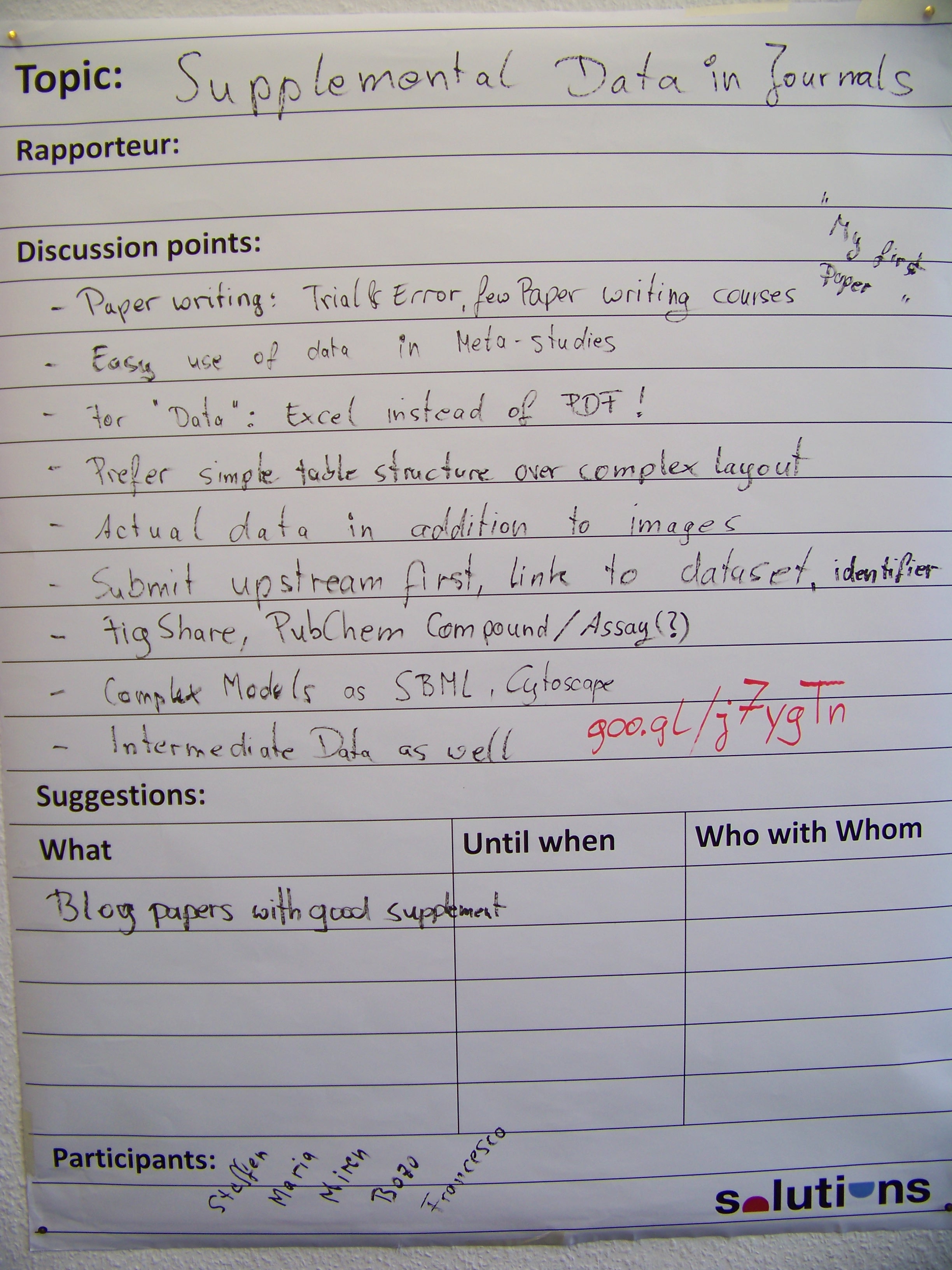 If you’re reporting chemical compounds, you should provide an identifier – not only the name or CAS number. Deriving further chemical and physical properties from a name can be extremely tedious (or impossible) to do it unambiguously. Instead, you can use more detailed identifiers like PubChem CID or ChemSpider CSID, or descriptors like SMILES, InChI, InChIKey. If your datasets are too large for the publishing journal’s supplemental section, there are community-accepted repositories you can use, such as FigShare, Dryad and others.
The new SOLUTIONS report suggests that journal guidelines often give submitters little to no information about what to include in the supplemental data. So how do scientists learn to create good supplemental data?
The report suggests taking note of what works – and what doesn’t – in existing journal articles, and using in-house or departmental peer-review processes to check not just the proposed article, but its supplemental data too. Likewise, based on these recommendations, community advocacy could persuade journals to offer guidelines regarding minimum requirements and/or format their supplemental data should have. As a user-oriented, interdisciplinary project covering a huge range of chemical pollutants across the entire European Union, SOLUTIONS will be working hard to provide best practice examples of how supplementary data can be used to help science work better and faster to protect the environment.