Why stream mayflies can reproduce without males but remain bisexual: a case of lost genetic variation

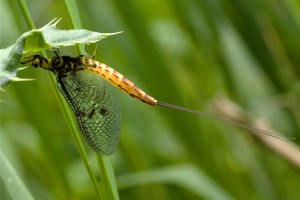
Ephemerella dorothea mayfly dun (image: David Funk)
Continuing our day of fascinating new scientific research on the mayfly, Dr David Funk, insect biologist at the Stroud Water Centre, USA and nature photographer reports on his recent paper “Why stream mayflies can reproduce without males but remain bisexual: a case of lost genetic variation” from the Journal of the North American Benthological Society, explaining the idea of ‘parthenogenesis’…
—
Mayflies spend months to years in the water as aquatic larvae, but they are best known for their highly synchronous and often spectacular adult emergences and their extremely short adult lives. For example, individuals of the North American species Dolania americana spend 2 years in the water (8 months as eggs followed by 28 months as larvae) before emerging about an hour before sunrise on one of only about 4 days spread over a two week period in May. In a desperate rush against time hoards of adults mate and lay eggs. Thousands of spent individuals lie dead on the water surface by the time the sun comes up.
Not all mayfly species are quite this extreme, but the adult life of a mayfly is always brief. Adult mayflies emerge from the water with their eggs ready to be fertilized and laid and, because adults cannot feed (their mouth parts are atrophied), they have a finite amount of energy available with which to accomplish this. Mating typically occurs at highly specific locations and times of day, so females face a very narrow window of opportunity to find a mate. Read more…
Wrapping bridges for mayfly conservation?!

© Kenny Crooks, Specially Commended National Insect Week 2008
Guest author: BioFresh partner Szabolcs Lengyel (Assistant Professor of Ecology, University of Debrecen, Hungary) takes inspiration from the art world to suggest a novel solution to an unusual ecological problem for mayfly populations.
—
What’s a mayfly to do when she meets a bridge?
One would assume that she flies over it. Or under it.
Still, according to a new study published in Journal of Insect Conservation, eighty-six percent of long-tailed mayflies (Palingenia longicauda) approaching a bridge never cross and turn back from it. To uncover the background of this peculiar behaviour, scientists from the University of Debrecen and Eötvös University from Budapest teamed up to study the flight of female mayflies on river Tisza in NE-Hungary.
The mayfly’s life is a fascinating one. Larvae develop in the riverbank for three years, then in one early summer afternoon they swim from their burrows to the water surface. Males come up first, moult on the water surface and fly to the riverbank for another, final moult. By the time they finish their second moult, female larvae emerge and undergo their own moult on the water surface. After mating with the males or escaping from them, female mayflies fly upstream. This flight presumably compensates for river flow and ensures that eggs deposited upstream reach the bottom where the egg-laying females had lived as larvae.
It is this compensatory flight which is interrupted by bridges. Because mayflies never actually touch the bridge, researchers focused on the optical properties of the bridge. It had been previously discovered that mayflies use a special signal of polarized light to identify water as such. Thus, the team performed measurements of polarized light at the bridge, enabling scientists to see with the eyes of the mayflies. Read more…
Mayfly in the Classroom: the potential to use the mayfly in engaging education and citizen science projects
Guest author: Paul Gaskell, Trout in the Town Project Manager with the Wild Trout Trust, UK
As programme manager for the Wild Trout Trust’s “Trout in the Town” project, a significant proportion of my role involves generating public interest and a sense of custodianship within local communities for their urban river corridors. Soon after the 2008 inception of the project, it became apparent that a cheap and simple educational tool would be a valuable means of engaging children, their families and teaching staff with the needs and reciprocal benefits of healthy urban watercourses. The “Trout/Salmon in the Classroom” initiatives developed in North America (e.g. Trout in the Classroom) and used so successfully in some UK settings (e.g. Wandle Trust and Clyde River Trust) have been brilliantly successful where sufficient funding and technical resources are available. However, in many schools – both rural and urban – the financial means and high degrees of specialised technical support may be scarce. Drawing on my background in laboratory and field studies of freshwater invertebrates, I wondered whether a more simple and cheap option could be found for invertebrate indicator species, whilst still retaining the vital messages relating to ecosystem health. I particularly liked the idea of using the mayfly’s iconic status (amongst writers as well as anglers!) and incorporating the very Shakespearian sex and death overtones to their lifecycle to make an impression. Read more…
Mayfly week: A brief history of fishing flies
Mayfly: © Stan Maddams, Specially Commended National Insect Week 2008
Guest author: Dr Peter Barnard, formerly an entomologist from The Natural History Museum, London, examines the fascinating historical links between natural flies (including the mayfly) and fisherman’s artificial imitations, and wonders just how good the imitations have to be (article first published in 2004 in the British Journal of Entomology and Natural History, vol. 17, pp 1-9).
—
As a professional entomologist with a lifetime’s interest in freshwater insects I have always been fascinated by those species that are imitated by the artificial flies of anglers. Recently I became interested in the history of these fishing flies and, having begun to investigate how much we know of early artificial flies, I wondered just how good these imitations really need to be. It soon became clear that this question has exercised fishermen for a long time, and that the debate continues today!
Ancient Egyptian tomb paintings include several pictures of people fishing with rod and line, though it is not clear what bait they may be using. One such picture has a fly hovering over the water next to the fisherman, but its presence may be accidental. The first written record of flyfishing seems to be by the Roman author Claudius Aelianus (known as Aelian) in his work On The Nature of Animals, ca 200 AD, where he describes speckled fish (which must be native trout) in Macedonian streams feeding on flies that hover above the river, said to be the colour of a wasp and humming like a bee! These sound most like hoverflies, but later authors have speculated on whether they could have been some kind of mayflies. But the local Greek fishermen were said to have made artificial flies by tying red wool round a hook and attaching two red feathers, and these are described as irresistible to the trout.
The St Albans Treatyse

Fig 1: First page of The Treatyse of Fysshynge wyth an Angle (1496)
Although we have to assume that flyfishing continued in some form in several European countries there is the usual gap in the written word until the Middle Ages. But in 1496 a book called The Treatyse of Fysshynge wyth an Angle (i.e. with a hook) was published in St Albans, of which an original manuscript exists. The first page of the printed book shows a remarkably modern-looking fisherman (Fig. 1) but sadly there are very few illustrations, one notable exception being a drawing of many different sizes of hooks which, in the days before tackle-shops appeared, had to be hand-made.
But most important from our point of view is that the Treatyse contains the descriptions of twelve patterns of artificial flies, including details of how to tie them using different colours of wool, feathers and silk thread. Unfortunately the flies are not illustrated and it is difficult to follow the tying instructions, though several modern fishermen have made intelligent reconstructions. All are what would be considered as simple patterns nowadays, and some of their names such as “Stone Fly” and “Dun Fly” are similar to those of modern forms, but from an entomological viewpoint it is frustrating that we cannot be sure which natural flies they were imitating. The book was so popular that it was reprinted many times over the next century, and was later combined with other works to form the Book of Hawking, Hunting and Fishing Read more…

© John Slader Mayfly. Commended Riverfly Partnership / National Insect Week 2010
Guest author: Craig Macadam, Riverflies partnership, Buglife and Ephemeroptera Recording Scheme
—
The mayfly’s lifecycle is one of the most fascinating and fleeting stories in the natural world. One of the many characteristics that makes mayflies the unique insects they are is the potential for two different winged adult forms in their life cycle. The nymph emerges from the water as a dull-coloured sub-imago (or dun) that seeks shelter in bankside vegetation and trees. After a period of a couple of hours or more, the sub-imago once again sheds its skin to transform into the brightly coloured imago (or spinner). It is not clear why mayflies have retained this unique step in their lifecycle, however it is thought that they may not be able to achieve the change from nymph to sexually mature adult in one step.
A mayfly’s life cycle starts with the males forming a swarm above the water and the females flying into the swarm to mate. The male grabs a passing female with its elongated front legs and the pair mate in flight. After copulation, the male releases the female, which then descends to the surface of the water where she lays her eggs. Once mated she will fall, spent, onto the water surface to lie motionless, with her wings flat on the surface, where fish pick them off at their leisure. The male fly rarely returns to the water but instead he goes off to die on the nearby land.
The eggs fall to the bottom of the water where they stick to plants and stones. Flies of the Mayfly family Baetidae pull themselves under the water to attach their eggs directly to the bed before being drowned by the current. The nymphs take anything between a few days to a number of weeks to hatch depending on water conditions and the species, and the resultant nymphs will spend various lengths of time, up to two years, foraging on the bottom before emerging as an adult fly.
When it is time to emerge, the nymphs make their way to the surface where they pull themselves free of their nymphal shuck and emerge as a sub-imago. While they rest here to dry their newly exposed wings, they are at their most vulnerable to attack from fish.
Some species exhibit great synchronicity in their hatching. The North American species Hexagenia limbata hatches in huge numbers from the Mississippi every year. The total number of mayflies in this hatch are estimated to be around 18 trillion – more than 3,000 times the number of people on earth. The newly emerged insects are attracted to lights in riverside towns and villages and the local authorities deploy snow clearing vehicle to remove their rotting corpses. Ironically, what is seen as a nuisance in America is seen as a gift in Africa. Locals around Lake Victoria gather adults of the mayfly Povilla adusta together with Chironomid midges to make a type of patty called ‘Kungu’. This protein rich food stuff is an important part of their diet.
The curious history of the mayfly
 Guest author: Craig Macadam, Riverflies partnership and Ephemeroptera Recording Scheme
—
The recording of mayfly species has had a long history. The first written record of a mayfly is in one of the oldest written texts – the Epic of Gilgamesh, which describes the life of Gilgamesh, a Babylonian ruler from around 2,700BC. The Epic was written in around 2,000BC on clay tablets, one of which describes the briefness of Gilgamesh’s life: ‘Ever the river has risen and brought us the flood, the mayfly floating on the water. On the face of the sun its countenance gazes, then all of a sudden nothing is there.’ The passage refers to the briefness of the adult mayfly’s life and how our own lives are just as brief. Whilst we don’t know what species this passage referred to it is remarkable that we have a mayfly record from over 4,000 years ago!
Today there are around 3,050 species known from throughout the world. In the UK we have 51 species, although two of these Heptagenia longicauda and Arthroplea congener are thought to no longer occur here. The Ephemeroptera Recording Scheme (www.ephemeroptera.org.uk) was established in 2000 to promote the study and recording of mayflies throughout the UK. To date, the scheme dataset has around 185,000 records, the majority of which are of larvae. The dataset is available on the NBN Gateway (www.searchnbn.net).
Depending where you live and fish, the term mayfly will represent different things. In the north of England and most of Scotland the term mayfly is generally used for all species in the order Ephemeroptera. However, in the south of England if you use the term ‘mayfly’ to refer to anything but Ephemera danica you will be hung, drawn and quartered and fed to the trout!
The use of ‘mayfly’ to refer to all members of the Ephemeroptera is a relatively recent development. The name is quite misleading because this group of insects can appear throughout the year. In fact, at one point they were called dayflies due to some of the species having an adult life of a single day. The common name comes from the habit of one species, Ephemera danica, which emerge as adults when the Mayflower or Hawthorn is in bloom.
In 1834, the entomologist John Curtis published a paper ‘Description of some nondescript British species of mayflies of anglers’. This paper described not only Ephemeroptera, but also some Plecoptera (stoneflies) and Trichoptera (caddisflies), suggesting that the term ‘mayfly’ was not restricted to only the Ephemeroptera and was perhaps more akin to our newly coined term ‘Riverflies’.
The Reverend A.E. Eaton, leading expert of the time on the Ephemeroptera, makes no mention of the term ‘mayfly’ in his ‘Monograph on the Ephemeridae’ published in 1870. However, in 1883 he published ‘A revisional monograph of recent Ephemeridae or Mayflies’. This monumental work which remains the ‘bible’ of Ephemeroptera workers, is the first entomological publication to specifically call the whole Ephemeroptera order ‘Mayflies’.
BioFresh celebrates the mayfly

The mayfly (image: wikipedia)
The mayfly has become an iconic fixture in popular, literary and angling culture due to its curious, ephemeral lifecycle, prehistoric heritage and the stunning sight of clouds of swarming insects appearing during a hatch. To coincide with mayfly hatches across northern Europe, this week the blog will feature a special series of articles, photos and videos celebrating the importance of this incredible insect.
Oxford University’s Dr George McGavin (star of BBC’s “Lost Land of the Tiger”) contributed his support for BioFresh’s mayfly week, stating:
“Mayflies are a vital food source for freshwater fish and other species. Their aquatic lifecycle typically culminates in a mass emergence when all the mayflies in a population mature over one or two days. The advantage of this synchronised ‘hatch’ is that local predators feeding on the emerging adults with be quickly satiated. The adults, whose only purpose is to mate and lay eggs, do not feed and live for only a matter of hours.”
This fleeting, fascinating lifecycle has captured the imagination of many writers, artists, fishermen and others throughout history, and is celebrated in a diverse collection of articles beginning today.
Contributors to the week (16th-20th May) will include Malcolm Greenhalgh (author The Mayfly and the trout, prominent fishermen) on the importance of the mayfly to fisherman; Gaylord Schanilec (woodcut and letterpress artist, author of Mayflies of the Driftless Region) on the role of the mayfly in art and culture; Dr Michael Monaghan (IGB Berlin) on Madagascan mayfly hyper-diversity; Paul Gaskell (Wild Trout partnership) on the “Mayfly in the classroom” education and citizen science project; BioFresh scientist Dr Daniel Hering on the Palingenia longicauda – the curious case of the largest European mayfly and other cutting edge research from the BioFresh project on the insect.
All the posts will be archived here
Enjoy the week!

Photo: © Magnus Lundgren / © George Steinmetz. A beautiful freshwater plant species: European white water lily (Nymphaea alba), in a lake in Bohuslän, Sweden. Traditionally used for medicinal purposes. Many of other species are still unknown to science, with medical and scientific value. Image courtesy of Conservation International
This weeks post is by Dr Ian Harrison, Freshwater Species Assessment and Program Fundraising Manager at Conservation International, letting us know about the success of their recent book ‘Freshwater: the essence of life’.
For more reading, here’s a great article by Ian on the hair-raising experiences of a freshwater biologist working in conflict areas…who said the life of a scientist is dull?!
—
Estelle Balian mentioned on this blog (March 1, 2011) a book entitled ‘Freshwater: the essence of life’, published by Conservation International in conjunction with the International League of Conservation Photographers, and CEMEX. Estelle is one of several BioFresh partners who co-authored chapters in the book, which carries the message that freshwater ecosystems are the ultimate biodiversity hotspot.
As a co-editor of the book, I am pleased to tell you that it has won a 2011 SILVER Independent Publisher Book Award (IPPY award) in the category of Environment, Ecology and Nature.
More information on the award here (scroll down to no. 40).

Sunset at Iguaçu Falls National Park—an amazing system of waterfalls that spans the border between Argentina and Brazil and a UNESCO World Heritage Site. The surrounding forest is home to more than 2,000 species of plants and other wildlife. © Frans Lanting. All images courtesy of Conservation International
In the book, 44 authors from 28 academic and research institutions, and non-governmental and governmental organizations describe the diversity of freshwater ecosystems around the world, in terms of the species present and the physical diversity of these systems. The authors review the numerous and varied threats that impact these systems, and the conservation actions that are being implemented to sustainably manage them and the essential services they provide to human communities. The book discusses the importance of developing appropriate policy and governance to manage water flows and maintain resilient freshwater ecosystems.
The book is beautifully illustrated with dozens of photographs from the World’s top nature photographers.
Some additional news is that a travelling exhibit of many of these photographs has been developed to accompany the book. For more details see the web site of the International League of Conservation Photographers.
There is also a video on freshwater, which uses images from the book, available here.
Many thanks to all of you who contributed to the book.

River Hodder, Lancashire, England
“I make a very close link between our belonging here and the will to fish. There is no natural medium in which the sense of life on earth is more evident than in water . . . Most of the things which are least pleasant about life now are the things which are most antithetical to fishing.” – Bernard Venables.
For Bernard Venables (angler and author of Mr Crabtree Goes Fishing), anglers could be amongst the most knowledgeable and passionate conservation champions, a trend borne out of vast amounts of time spent immersed in the freshwater environment. It is perhaps only natural that Venables founded the Angler’s Conservation Association, a successful UK freshwater conservation charity run by anglers, which is now part of the Angling Trust.
With freshwater ecosystems facing continued threats such as pollution, climatic change, invasive species and water abstraction, there is a need for increased focus and effort on their conservation. How far can anglers play a part of this effort as effective freshwater conservationists?
When you look at the history of the conservation movement (a great book on this topic is Bill Adams’ 2004 Against Extinction), there are examples of groups and individuals involved in hunting becoming vocal and effective conservationists of the environments in which they hunt. In The Empire of Nature, a fascinating history of the role of colonialism, empire and big-game hunting in the conservation movement , John MacKenzie describes the formation of the Society for the Preservation of the Fauna of the Empire in 1903, a pressure group of hunters-turned-conservationists concerned with the preservation of Africa’s large mammals. This organisation evolved into the influential, global charity Flora and Fauna International. Whilst the transition from ‘poacher to gamekeeper’ in this example is marred by issues of colonial dispossession and enclosure of historic land rights and natural resources, the basic point remains: that there is a historic precedent for recreational hunters to become passionate conservation champions.
Anglers as conservation champions

Salmon at Stainforth Force, Yorkshire, England. (Image: Ribble Trust)
The Angling Trust is a UK charity which aims to reverse declining fish stocks (both freshwater and marine) and address pollution, water abstraction and invasive species issues in freshwater ecosystems. Speaking in The Guardian in 2009, Mark Lloyd outlined the value of uniting anglers for conservation as: “Anglers are not the usual woolly liberals you get in the WWF or the National Trust. They range across urban and rural areas and both working and upper class. Together they are very powerful”.
Freshwater angling is a phenomenally popular pastime – in the U.K. alone over 1 million licences are sold by the Environment Agency each year. When this large, varied supporter base is combined with anglers’ deep connection with the freshwater environment – as suggested by Venables – there is the potential for a large, vocal movement championing freshwater conservation issues. The Our Rivers initiative calls anglers “the curtain twitchers of the riverbanks“, providing a network of individuals who can give early warnings on potential environmental threats.
On a European scale, the European Angler’s Alliance brings together organisations like the Angling Trust with a mission to: “safeguard the fish stocks and fisheries of Europe and to protect the interests of all those who fish with rod and line for recreational purposes.”. A key stated aim of the EAA is to promote sustainable recreational fishing which actively helps conserve or restore the health of the freshwater environment. The size and structure of the EAA means that it has the leverage to effectively lobby European policy decisions on key freshwater conservation issues like the Water Framework Directive.
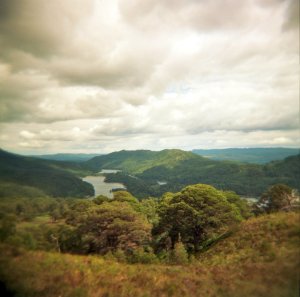
Loch Affric, Scotland
Crossed lines? Critiques of this support
With so many anglers lending vocal support to freshwater conservation issues, is it unnecessary to try to offer critiques or caveats to this successful movement? I feel that it is worth thinking critically – however briefly – about the forms angler-led conservation movement may take.
Whilst freshwater fish populations often provide excellent indicators of water quality and wider ecosystem health, such angler-led conservation initiatives must be careful not to only prioritise the fish species valuable to anglers (for example, brown trout, carp, salmon), and ignore those less pursued but important to ecosystem function (such as gudgeon, ruffe or minnow).
Similarly, how do the recreational and social benefits of angling – outlined in one form or another by many such organisations – balance against the environmental problems caused by overstocking (especially of sport fish like carp and rainbow trout) and non-native species introductions in certain fisheries run exclusively for recreational angling? And what about the threat to fish, birds (and humans…) posed by broken hooks, weights and monofilament line discarded in waterways? Finally, should a coarse fishing community which has campaigned for the right to continue fishing during spawning seasons in the spring months be taken seriously as an effective ally for conservation?
These are simply the environmental concerns. From a land rights perspective, could conservation become a new argument for wealthy, angling orientated, landowners to exclude other users (e.g. walkers, kayakers, wild swimmers) from gaining access to waterways? Perhaps this is too big a jump to make (and slightly reminiscent of the debates around the early hunters-turned-conservationists and resulting enclosure of protected areas for conservation) but it is worth bearing in mind.
From an ethical point of view, some may see a fundamental problem in anglers who cause harm or discomfort to animals purporting to be their effective conservation stewards (disclaimer: I’m writing this article as a lifelong fishermen). This is a debate that stretches back to the initial formation of groups such as the Society for the Preservation of the Fauna of the Empire in the early 20th century, and reflects some of the difficult decisions the conservation movement must make about choosing allies for the wider conservation goals.
Tying a knotty debate together
With this in mind, it should be celebrated that responsible, environmentally orientated anglers provide such widespread and vocal support for freshwater conservation. As I’ve discussed, the individual knowledge, understanding and affinity for the environment provided by long hours spent immersed in nature whilst fishing, coupled with the wide network of participants make angling groups a powerful ally for freshwater conservation. However, maybe we should keep in mind the potential issues discussed above when thinking about the form and effectiveness of this support.
A fascinating debate, and one we’re keen to hear your voice in. Let us know your thoughts, comments and critiques in the comment box below.
Rob St.John
Communications & Project Co-ordinator, BioFresh
Rivers on the Edge
Rivers on the Edge is a WWF initiative emphasising the need for sustainable water use in our homes, schools and businesses in order to better conserve and restore our river ecosystems. Initially focussed on three chalk stream rivers in southern England, its central message is that:
“We must waste less water if we are to save our precious freshwater environment and make sure it is resilient to the impacts of climate change. But how? Rivers on the Edge aims to help thousands of homes, schools and businesses cut water use, saving millions of litres of water for our rivers. We call on Government and regulators in England and Wales to meet the targets below in the next two years to ensure that we stop using water wastefully; that abstraction does not unacceptably damage our rivers now and in the future; that we adapt to the potential impacts of climate change; and that we protect the future security of our water supplies.”
Read the full report here and let us know your thoughts. Can you suggest any projects globally that take a similar approach to freshwater conservation?










 The Freshwater Blog