Tracking the ecological, social and economic benefits of freshwater restoration in Europe
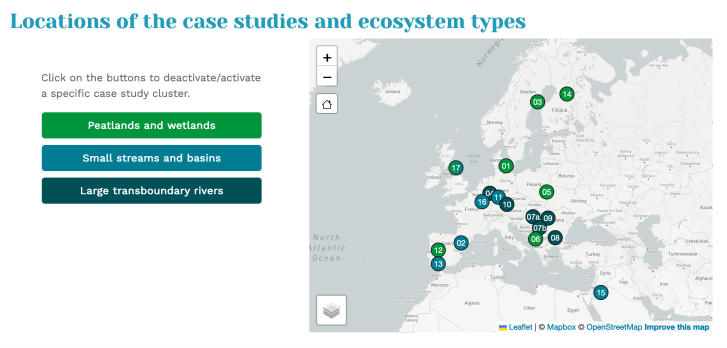
The MERLIN project has recently launched its online case study portal. The portal provides interactive access to the seventeen freshwater restoration sites supported by the project. These sites include small streams and basins, large transboundary rivers, and peatlands and wetlands.
The portal offers in-depth information on each case study, including details of restoration activities and key stakeholders involved in their implementation. It outlines innovative approaches to restoration management, governance and financing across each case study.
The portal will help illustrate how each restoration project progresses over the coming years. In so doing, it will show how restoration helps contribute to European Green Deal goals. Further, it will help track and evaluate how new nature-based solutions are applied across the restoration projects.
In order to monitor progress towards Green Deal goals, the MERLIN team have identified indicators relating to seven key goals. These include biodiversity gains, climate regulation, flood and drought resilience, sustainable food systems, participatory governance, restoration financing, and green growth.
A key theme is that these indicators are broader in scope than traditional ecosystem-focused approaches for evaluating restoration projects. Biodiversity is still a vital part of restoration ambitions: for example, MERLIN researchers monitor trends such as conservation status of threatened species and ecosystems.
However, the focus for restoration goals in MERLIN is much broader. Greenhouse gas emissions are monitored to assess the role of restoration projects in climate regulation, whilst the water storage capacity of rivers and wetlands indicates their role in mitigating floods and droughts.
This broader focus also extends into food production and governance. MERLIN researchers monitor how land is used in restoration catchments, as a means of assessing their role in sustainable food systems. They also track the participation of public and stakeholder groups in having a voice in the governance of the restoration projects.
Finally, the relationships between restoration and economics are increasingly at the forefront of environmental management and policy. MERLIN researchers document how innovative – and often private – streams of restoration financing may be mobilised, and their potential role in fostering green growth in the case study areas.
The intention is that case study portal will provide detailed insights into the real-world impacts of freshwater restoration projects across Europe. By highlighting the ecological, social and economic benefits of restoration activities, it is hoped that the portal will provide a beacon of inspiration for others seeking to undertake similar projects across the world.
+++
This article is supported by the MERLIN project.
Earlier this year, the European Commission published a proposal for a major new European Nature Restoration Law. The proposal outlines a series of binding targets to restore 20% of the EU’s land and sea by 2030, alongside deadlines for the restoration of important natural habitats. The draft suggests that all European ecosystems in need of restoration should be restored by 2050.
Two weeks ago, the draft Nature Restoration Law was analysed by five EU-funded environmental research projects, including the four Horizon 2020 Green Deal restoration partners. Discussions at a science-policy workshop in Brussels – organised by the Research Executive Agency of the European Commission and DG R&I – yielded six key recommendations for foregrounding freshwater ecosystems in the draft law.
+++
1. Increase the profile of freshwater ecosystem restoration
As we regularly cover on this blog, although freshwaters only cover a small percentage of the Earth’s surface, they are especially rich in biodiversity. However, they are significantly threatened by human pressures in many parts of the world.
The projects recommend that freshwaters should be more prominently recognised in the law. This means that freshwaters should always be mentioned alongside ‘terrestrial and marine’ ecosystems when setting restoration targets for European countries.
2. Urban blue spaces are important
The draft law repeatedly emphasises the importance of urban ‘green spaces’ as a means of bringing nature back to cities, and mitigating the effects of climate change and biodiversity loss. Urban green spaces – such as parks, meadows, green roofs and urban gardening schemes – have become an important part of European city planning in recent years.
However, the projects recommend that the Nature Restoration Law also needs to take into account the importance of urban ‘blue spaces’ such as lakes, wetlands and rivers. They highlight the benefits such urban blue spaces bring for biodiversity, climate mitigation and public recreation, and suggest that ‘urban green and blue spaces’ should be referred to when outlining targets for restoration.

3. Support the implementation of the Water Framework Directive
The Water Framework Directive is Europe’s long-standing policy mechanism for improving the health and status of freshwater ecosystems. The projects see great potential in the draft Nature Restoration Law in helping improve the implementation of the WFD which, as yet, has not reached many of its ambitious goals. They recommend that the WFD’s River Basin Management Plans are better integrated into the planning of the Nature Restoration Law.
4. Highlight the role of nature-based solutions
Nature-based solutions are becoming an increasingly central part of restoration projects, both in Europe and globally. Nature-based solutions aim to protect, sustainably manage or restore ecosystems in ways that address social challenges such as water security, flood protection and climate change.
The projects suggest that the draft Nature Restoration Law is largely focused on the restoration of habitats, and the population health of individual species. They state that nature-based solutions should be better highlighted in the law, as a means of making obvious the benefits that society will gain from restoration projects.

5. Improve and specify targets for restoration of rivers, floodplains and deltas
The draft Nature Restoration Law states that European countries should restore 25,000km of free-flowing rivers by 2030. This focus on improving the connectivity of river catchments, including their floodplains and deltas, is a key focus of many freshwater restoration projects, and often involves the removal of barriers such as dams and hydropower projects.
However, the projects suggest that these aims for river restoration (outlined in Article 7 of the draft law) are less ambitious, less stringent and less specific than those for other ecosystems. They state that river connectivity targets should be strengthened with time-bound and binding objectives to remove river barriers. Further, they suggest that this process should be closely monitored to measure the effectiveness of restoration actions.
6. Woody riparian vegetation as a key measure in agricultural landscapes
Riparian areas are the strips of land alongside rivers and streams in agricultural areas. In recent years there has been an increased focus on the value of restoring woodland and vegetation in riparian strips as a means of creating biodiversity habitat, buffering pollution and shading waters warmed by climate change.
The projects recommend that the Nature Restoration Law should include specific targets for the establishment of woody riparian buffer strips alongside streams and rivers. They suggest that the restoration of woody riparian vegetation is the most cost-effective measure for enhancing freshwater and riparian biodiversity and ecosystem services in agricultural landscapes.
+++
Read the European Nature Restoration Law recommendations in full.
This article is supported by the MERLIN project.
Looking for ‘needles in a haystack’: using eDNA to detect endangered sturgeon populations

Sturgeons are some of the most iconic fish species in the Danube River. However, their populations are in significant decline as a result of decades of pollution, habitat loss, overfishing and the fragmentation of migratory routes.
Often termed ‘living fossils’ due to their ancient lineages, sturgeons are often large and long-lived. Their migratory lifespans between freshwater and saltwater environments makes sturgeons particularly vulnerable to human pressures. The Danube River supports six native species of sturgeons, all of which are threatened by human activities.
Given the Danube’s vast length – spanning more than 2800km – it is vital that conservationists can monitor the size and location of sturgeon populations along the river in order to protect them. Two recently-published studies suggest that new environmental DNA (or eDNA) techniques offer significant potential for detecting sturgeon populations across large rivers like the Danube.
When an organism moves through an environment it constantly sheds tiny pieces of organic material such as dead skin cells, mucus and faeces. Scientists can test water samples for the DNA in this organic material. Such environmental DNA can point to the recent presence of a species, even if it cannot be otherwise detected or seen. As a result, eDNA approaches are increasingly valuable to scientists seeking to detect a host of elusive and tiny species across different ecosystems.
“Despite the need for a better understanding of the distribution and population status for many fish species in large rivers, the use of traditional sampling methods failed in the past, thereby hampering reliable assessments,” says Dr. Paul Meulenbroek, senior author of both studies, based at BOKU, Vienna. “Water samples can be used to identify those species that have recently been present in a local environment, with genetic material such as skin cells, intestinal cells, scales, or mucus being obtained directly from environmental samples.”

One study, published in Biodiversity and Conservation, developed an eDNA reference database for five native Danube sturgeons, and two non-native species. This allowed researchers to use eDNA techniques to search for the “needles in a haystack” sturgeon populations along the entire length of the Danube. This work provided the first large-scale snapshot of threatened sterlet populations along the river, with the species found in around half of all surveyed sites.
The partner study, published in Molecular Ecology Resources, explored the potential of eDNA techniques to estimate the abundance of sturgeon species. Researchers found that total fish eDNA concentrations and total fish abundance were highly correlated.
Together, the two studies suggest that sifting river water for microscopic pieces of organic eDNA material can help scientists determine both the location and abundance of sturgeon species along the vast Danube catchment.
“An in-depth understanding of species distribution and population dynamics is essential for developing adaptive conservation management plans, and in this regard, the benefits of an eDNA approach for conservation efforts, fisheries management, and scientific studies are numerous,” outlines Dr. Meulenbroek.
“eDNA metabarcoding is potentially more sensitive than traditional survey methods, as well as being more cost effective and non-invasive,” Dr. Meulenbroek continues. “It facilitates time-limited coverage of large geographical areas, thereby enabling the implementation of conservation measures within an ecologically and politically-actionable time scale.”
As the new studies suggest, eDNA approaches hold significant promise for conservationists seeking to strengthen their existing attempts to protect sturgeon populations across the Danube basin. “To facilitate sustainable conservation initiatives, it is of the utmost importance to gain a reliable understanding of the present status and development of remnant populations and sound study results providing evidence-based data for making water management decisions,” concludes Dr. Meulenbroek.
+++
This post is supported by the MEASURES project.
Restoring Europe’s ecosystems to reverse biodiversity loss and build resilience to climate change

Recent major reports on the state of the world’s climate and biodiversity clearly show the need for urgent, large-scale ecosystem restoration. Across the world, ecosystems are being degraded at rates faster than efforts to protect them, whilst ongoing climate change places increasing pressures on their health and functioning.
An awareness of the need to urgently restore healthy, resilient ecosystems underpins a partnership of major EU funded projects: WaterLANDS, SUPERB, REST-COAST, and MERLIN. Addressing the restoration of wetlands, forests, coastlines and freshwaters respectively, the projects have been funded to support the European Green Deal’s aspirations of a low-carbon, climate resilient future.
Each project aims to demonstrate how best-practice approaches for ecosystem restoration can be applied and upscaled across the continent. They are each developing innovative ways of implementing nature-based solutions in restoration to benefit ecosystems, societies, and even economies. Central to this work is the need to effectively monitor and share the results of ecosystem restoration to help wider global communities plan effective restoration strategies.
Together, the four projects address the overarching restoration of Europe’s varied ecosystems. “Rivers, forests and coasts are complementary environments to wetlands through ecosystem services, linked biodiversity and water flow and quality,” explains Craig Bullock, project coordinator of wetland restoration project WaterLANDS. “This means their enhancement and restoration has a direct connection with wetland functioning and restoration potential.”
WaterLANDS focuses on the restoration of six wetland sites across Europe, learning from existing sites where successful restoration has been undertaken. The project encourages community-led practices to design and implement restoration projects.
“Communities should remain part of the landscapes we are trying to protect and restore,” says Shane McGuinness, deputy project coordinator of WaterLANDS. “In many cases they have been using these areas for generations and it is unreasonable of us to presume that this will suddenly cease. We need to support communities to move away from the practices of the past and towards more sustainable practices of the future.”
The partnership of projects focused on interlinked ecosystems holds significant promise. “I see the potential for better landscape level planning of restoration activities,” says Elisabeth Pötzelsberger, project coordinator of SUPERB, which focuses on forest restoration. “For example, focus areas and restoration targets for specific ecosystems could create synergies across different ecosystem types.”
Drawing on projects across twelve countries, SUPERB aims to restore thousands of hectares of forest landscape across Europe. “We want to particularly highlight the importance of considering adaptation requirements in choosing restoration approaches and targets because climate change does already, or will soon, have dramatic impacts on the suitability and resilience of specific forest types,” explains Dr. Pötzelsberger. “We call this prestoration or forward-looking restoration.”

The restoration of ecosystems across land and freshwater is inherently linked to those along Europe’s coastlines. “River-delta-coast connectivity is an essential element to enhance the natural resilience of sediment starved coastal systems,” says Agustín Sánchez-Arcilla, project coordinator of REST-COAST, which focuses on the restoration of the continent’s coastal ecosystems.
Europe’s coastlines are some of the continent’s biodiverse environments, but are often subject to numerous human and climatic pressures, whilst poorly protected by environmental policy. REST-COAST focuses on nine case studies, from the eastern Mediterranean to the North Sea. “We hope to increase the scale and the speed of coastal restoration interventions, particularly for vulnerable hot spot locations,” outlines Prof. Sánchez-Arcilla.
The partnership of projects has the potential to develop how restoration projects interact with industry, policy and financiers. “Aside from the physical links between these ecosystems, there are also connections through commercial land uses such as agriculture and forestry and through governance to support restoration,” says WaterLANDS coordinator Craig Bullock. “There are also connections through landscape finance given that these biophysical linkages and ecosystem service outputs provide for a package of financial investment at a landscape level.”
The governance structures Dr. Bullock mentions are crucial to this project partnership. The four projects were funded to support European Green Deal objectives to foster climate resilience and nature recovery across the continent, alongside the aim of becoming net carbon-neutral by 2050. By promoting the widespread and innovative scaling-up of ecosystem restoration across Europe, the partnership offers a significant opportunity to amplify scientists’ voices in the development of the proposed European Nature Restoration Law.
“The four projects gather substantial expertise on nature restoration in Europe,” says Sebastian Birk, project coordinator at MERLIN. “All projects have a focus on specific ecosystems like forests, freshwaters and the coast. These specific views are now integrated by the clustering activity to find solutions at landscape-scale.
“This is indispensable when moving towards achieving the European Green Deal ambitions,” Dr. Birk continues. “Our activities affect all parts of the environment, and our remedies need to be integrative. This perspective allows the four projects to jointly act on the European Nature Restoration Law.”
+++
This article is supported by the MERLIN project.
Major new awards seek innovative solutions to restore Europe’s rivers, lakes and wetlands

As we regularly document on this blog, freshwaters are among the most globally threatened ecosystems. And, as the latest MERLIN podcast explored, while restoration projects are increasingly popular across the continent, there is an urgent need for new approaches which both benefit nature and are financially sustainable.
The new MERLIN Innovation Awards (MIA) 2023 aims to showcase cutting-edge products and services which help protect and restore increasingly threatened freshwater ecosystems. The awards seek submissions of innovative, widely applicable, and market-ready solutions from companies and organisations across the world.
Applications are open for companies across the world in two categories: MIA Product of the Year and MIA Service of the Year.
The MERLIN Innovation Awards offer companies a unique opportunity to pitch their innovative products and services to seventeen European freshwater restoration project managers, as well as other key decision makers and stakeholders. Selected companies will automatically be included in the MERLIN Marketplace, an online portal which features best-practice approaches to freshwater restoration, due for launch in 2023.
“Innovative solutions for inland water restoration are increasingly sought after. The MERLIN Innovation Awards will reach out to the vibrant community of solution providers and allow them to showcase their products and services to restoration practitioners across Europe. Let us grow together with this initiative,” says Dr. Sebastian Birk, co-coordinator of the MERLIN project at the University of Duisburg-Essen.
The MERLIN Innovation Awards aim to connect companies developing state-of-the-art approaches for ecosystem restoration to potential buyer organisations. The Awards provide a unique opportunity for companies to join the rapidly-growing global freshwater ecosystem restoration community, and to offer innovative solutions to help address pressing environmental issues and benefit nature and society.
The MERLIN Innovation Awards 2023 application deadline is 22nd December 2022 (17:00 CET). The independent MIA jury will comprise freshwater restoration managers from the MERLIN project and other related stakeholders with backgrounds in business, NGOs or administration.
For any additional questions, you can consult the Awards webpage and FAQs or contact info@connectology.eu.
+++

This article is supported by the MERLIN project.
MERLIN Podcast Episode 2 – Freshwater Restoration in Europe: Transformation, Disruption and Inspiration

This week we’re delighted to bring you the second episode of the MERLIN podcast.
The podcast follows the MERLIN project in its journey to mainstream freshwater restoration in Europe. It offers a behind the scenes look at some of the continent’s most ambitious freshwater restoration projects carried out through cutting-edge aquatic science and conservation.
This episode explores the big ideas that are shaping how major freshwater restoration projects are being carried out across Europe. From dam removal to floodplain restoration, the European Union funded MERLIN project is investing millions of euros to disrupt and transform existing ways of carrying out freshwater restoration.
But what do these keywords – transformation and disruption – actually mean in practice? And what are the underlying inspirations that motivate scientists and environmentalists to help bring Europe’s freshwaters back to life?
In September 2022 podcast host Rob St John travelled to Fulda, just outside Frankfurt in Germany, to attend the first MERLIN all-partner meeting. At the meeting Rob spoke to project partners from all over Europe to find out about how they’re working together to research, plan, finance and implement major freshwater restoration projects. The aim of this work is to encourage healthier European rivers, streams, peatlands and wetlands, which aren’t only good for nature, but also bring many social and economic benefits.
You can also listen and subscribe to the podcast on Spotify, Amazon, and Apple Podcasts. Stay tuned for the next episode soon!
+++
This article is supported by the MERLIN project.
Dambusters: new film documents dam removal across Europe
Dam removal has become one of the most important tools in modern river restoration. Removing dams and other barriers such as weirs is a vital step in shifting river systems back towards more natural states, allowing the free flow of water and migratory species such as salmon.
A major new film released this weekend documents dam removal projects across five European countries. Dambusters tells the stories of so-called ‘river heroes’ who are taking action to restore free-flowing rivers in Spain, France, Estonia, Lithuania and Finland. Presented by Pao Fernández Garrido from the World Fish Migration Foundation, Dambusters was supported by a range of environmental organisations including WWF, Wetlands International and The Nature Conservancy, and produced by Francisco Campos-Lopez Benyunes at Magen Entertainment.
In Estonia, the film focuses on the Pärnu River, where seven weir removals have opened up over 3,000km of river after 150 years of fragmentation. The film highlights the importance of public communication and support, stating that over 75% of Finnish citizens support dam removal, compared to around 10% of the public in other European countries.
“When I filmed the explosion, the moment it blew up was incredible,” Robert Epple says in the film. Epple, a pioneer of dam removal, and founder of the European Rivers Network, adds, “I understood in that moment it blew up, that there was not only a dam that disappeared, but that there were thousands of barriers also in people’s mind, so to say, which blew up simultaneously. Because I knew that if people see these images, they’d understand that a dam is not eternal, that we can undo what was done in the past, if it no longer serves its purpose and give it back to nature.”

“The ecosystem is functioning and the ecosystem’s resilience is getting back,” reflects Saija Koljonen, a researcher at SYKE, Finland, following a dam removal project. “The whole ecosystem, it’s a complex system from the catchment area and the riparian forest, and the species in the water. The whole complexity is working naturally afterwards. So, that is the aim of these kind of big restoration projects. I see the river continuity and connectivity is the key to the ecosystem resilience. So the ecosystems function normally or naturally if connectivity is taken care of. So, dam removal is the best option for connectivity.”
“I spoke with the construction guys and they said that there’s been tour buses with people, full of people just coming here to check out this dam removal site,” says Finnish actor and environmentalist Jasper Pääkkönen. “We’re actually reviving this local community, local economy, and everybody benefits. People benefit, nature benefits, the fishery, other animals, they all benefit from it.”
Dambusters was premiered at the recent European Rivers Summit in Brussels. It is released at a time when there is a renewed focus on river restoration. The proposed EU Nature Restoration Law strengthens the ambition to restore 25,000 kilometres of European rivers through the removal of obsolete barriers alongside the restoration of floodplains and wetlands. Recent research suggests that there are more than 1.2 million barriers fragmenting European rivers, and around 150,000 are obsolete.
+++
MERLIN: Bringing Europe’s freshwaters back to life
The MERLIN project held its first all-partner meeting last week in Fulda, Germany. Scientists, restoration managers and industry stakeholders all took part in valuable discussions over how best to mainstream freshwater restoration in Europe.
A new video exploring the key issues around the project was premiered at the meeting. A collaboration between the Schneeaufmoss creative agency and MERLIN partners, the video outlines five key challenges for contemporary freshwater restoration, and how the project is tackling them. Packed with beautiful footage of the continent’s waterways, the video is narrated by Christian Cummins of FM4 Radio.
The new video follows the recent launch of the first MERLIN podcast. A second podcast was recorded at the meeting, exploring ideas around transformation, disruption and inspiration as drivers of freshwater restoration. This second podcast will be released in the coming weeks.

MERLIN Questionnaire
MERLIN researchers also launched a new questionnaire seeking to better understand shared goals around river restoration.
“We want to identify landscape and policy interventions that can help practitioners across agriculture, hydropower, insurance, navigation, peat extraction and water supply sectors tackle their own challenges, while contributing to achieve EU Green Deal objectives,” says Dr. Alhassan Ibrahim from the James Hutton Institute. “These objectives include climate resilience, improved biodiversity, zero pollution, sustainable food systems, health and wellbeing.”
“The responses to the questionnaire will help us to understand Europe’s environmental and policy needs and opportunities for mainstreaming nature-based solutions in the sectors,” continues Dr. Ibrahim. “We will draw from the results and other data sources – such as policy interviews and roundtables – to develop strategies and a route map to overcome the challenges in the economic sectors and harness the opportunities for win-win solutions.”
You can complete the questionnaire here (updated 17.10.22: questionnaire now closed).
+++
This article is supported by the MERLIN project.
MERLIN Podcast Episode 1: introduction and floodplain restoration on the Rhine Delta
This week we’re delighted to bring you Episode 1 of the new MERLIN podcast. As we’ve covered in recent months, MERLIN is a major European Union funded project which is investing millions of Euros to help mainstream freshwater restoration across the continent over the coming years.
This podcast follows the MERLIN project in this journey. It offers a behind the scenes look at some of the continent’s most ambitious freshwater restoration projects carried out through cutting-edge aquatic science and conservation.
In July 2022 podcast host Rob St John travelled to the Netherlands to meet MERLIN practitioners working on the project’s large river restoration sites.
Over a number of hot, sunny days the team explored floodplains across the Rhine Delta which had been restored through a major project called Room for the River. Started in 1995, Room for the River worked to reconnect the Rhine with its floodplains, which had become isolated through the construction of dikes and levees. By making room for the river to periodically inundate its floodplains, new spaces for biodiversity habitat, carbon storage and recreation have been brought back to the Rhine catchment.
Walking along the banks of the Rhine, Rob speaks to restoration practitioners about their work, and catches up with MERLIN coordinator Sebastian Birk to hear about what the project hopes to achieve.
You can also listen and subscribe to the podcast on Spotify, Amazon, and Apple Podcasts. Stay tuned for Episode 2 in the coming weeks.
+++
This article is supported by the MERLIN project.

Freshwaters are some of the most biodiverse yet highly threatened ecosystems in the world. As conservationists have repeatedly highlighted recently, the freshwater biodiversity crisis receives significantly less attention and support than that on land, or in the seas.
Part of this shortfall in attention is due to the nature of freshwater environments. Rivers, lakes, streams and wetlands can often obscure the wildlife they support below the water’s surface. This can make it hard not only to notice their richness, but also any ecological declines.
As a result, highlighting important – but often overlooked – freshwater species has become a key advocacy approach for many conservationists in recent years. In some cases, this approach tallies with ecological theory, which suggests that the conservation of particular ‘umbrella species’ can benefit the health of the wider ecosystem.
A new series of illustrated cards highlights twenty freshwater species that deserve special conservation attention. Scientists from IGB, Berlin and the Alliance for Freshwater Life have curated the project to spotlight species which are often inconspicuous, or found in remote regions, but are vital for freshwater conservation efforts.

“We chose the twenty species for two reasons,” says project curator Dr. Fengzhi He from IGB. “First, some are considered charismatic and hold the potential to function as flagship umbrella species to enhance freshwater conservation. The selected freshwater megafauna species such as European sturgeon, arapaima, Amazon river dolphin, common hippopotamus, gharial, Chinese giant salamander fall under this category. These are also species targeted in the Freshwater Megafauna Futures project.
“Most of these freshwater megafauna species are threatened, and the Chinese paddlefish has been officially listed as Extinct by the IUCN Red List,” continues Dr. He. “Second, we included species that are closely studied by IGB researchers. Some of these species may be smaller but have important ecological roles in local ecosystems or are key model organisms in freshwater research.”
The Freshwater Fact Cards highlight fascinating information about each of the featured species. For example: How do arapaima breathe? How deep can Baikal seals dive? How fast are hippos? How long can freshwater pearl mussels live? And how do water fleas reproduce?


“We really hope that these fact cards will raise the fascination of people about freshwater life,” says project curator Prof. Sonja Jähnig from IGB. “We are very happy about the nice visualisations and illustrations done by Studio Adén. The cards not only show interesting facts on freshwater species and the research conducted at IGB, but they can be used as postcards or decorations.”
“Freshwater biodiversity is underrepresented in the information presented to the general public, often being out of sight, out of mind. We would like to use the Freshwater Fact Cards to highlight amazing freshwater life and promote public awareness and conservation actions for freshwater biodiversity,” says Dr. He.
“We will distribute the cards widely at outreach events, where visitors can take them as small souvenirs,” says Prof. Jähnig. “The fact cards also support the Alliance for Freshwater Life in their ambition to raise the profile of freshwater biodiversity and make people better understand, value, and safeguard freshwater biodiversity.”
The Freshwater Fact Cards project is still growing. “If you have an idea for which species we should add, or if there is an idea for a new set of species from a certain region, or including other artists, please reach out to us,” says Prof. Jähnig.








 The Freshwater Blog