Muddy waters: a guest post on the impact of recent Australian floods


Image: David Sinclair (ACF)
Ruchira Talukdar is a Healthy Ecosystems Campaigner with the Australian Conservation Foundation. Ruchira argues that an overlooked opportunity presented by the recent large scale flooding events in Australia is the potential for political reform promoting sustainable water use policies. Let us know your thoughts on Ruchira’s arguments, and what you see as the key issues resulting from the floods.
The recent floods in Queensland have affected lives, livelihoods, crops and stock. These damages will be felt for quite some time.
It is also true they will bring much needed water to the rivers, wetlands, floodplains and pastures in eastern and south eastern Australia.
Right now there is a lot of water in the Murray-Darling – Australia’s largest river system covering one-seventh of the continent and also our food-bowl growing forty percent of our agricultural produce.
And while 85,000 million litres of flood water continues to pour into the Murray in South Australia from the rivers and creeks of the upstream states of News South Wales and Victoria, the historical conflict of interests over water-sharing in the Basin continues.
Over the next few months, a lot more water is expected to travel down-stream and out through the mouth of the river near the internationally significant Coorong wetland in South Australia.
While scientists are still monitoring the ecological benefits from the January floods as well as the heavy rainfall across the Basin in 2010, we can already count some tangible benefits on our finger-tips:
– Each year two million tonnes of salt needs to be transported out of the Murray-Darling towards the sea. Chronic lack of flows near the mouth of the river in the past had deposited vast amounts of salt in the Coorong, making it more saline than the sea and degrading the environment. The floods have reconnected upstream Lakes Alexandrina and Albert – also Ramsar listed – with the Coorong and ongoing high flows at the mouth will continue to flush salts out of the river-basin.
– Sand dredging had been required to keep the Murray mouth open, at a cost of $36 million per year to the South Australian government. Recent floods have allowed the river to keep its own mouth open for the first time in eight years.
– The floods have intervened to bring native wild-life species in the Basin back from the brink of extinction. The Congolli fish native to the Lower Murray in South Australia and the Southern Bell Frog in New South Wales are two key examples.
The main reason for the lack of flows is the unsustainable use of water for irrigation in the Murray-Darling Basin – seventy percent of Australia’s irrigation occurs in the Basin which receives only 6% of Australia’s rainfall. In less than a century, water extraction from the rivers of the Murray-Darling Basin has increased by 500%. Last decades drought took its own toll on the environment. As much as ninety percent of the floodplain wetlands of the Murray-Darling Basin have been destroyed by now.
The Basin wetlands keep the river alive and provide valuable eco-system services like water-filtration and refuge for insects and animals for pollination and pest control absolutely free of cost. Out of the of 30,000 wetlands across the entire Murray-Darling Basin, 16 are Ramsar listed and provide an estimated $2.1 billion p.a worth of eco-system services (without considering other direct benefits such as tourism and recreational value).
The long-term fate of these Ramsar wetlands, as well as the industries and communities which rely on a healthy Basin now depend on the Murray-Darling Basin Plan.
In order to revive the Murray-Darling to moderate to good health – so that it can sustain agriculture and food production in the long-term – above 4000 billion litres (GL) of water needs to be returned to the Basin each year.
The controversy following the release of the Guide to the Basin Plan in October 2010 witnessed a fierce debate about the short-term impacts on regional economies from proposed cuts to water allocations – no consideration was given to the long-term consequences of continuing at the current level of water-extraction.
The real possibility of environmental failure now threatens the long term economic and social viability of many industries in the Basin. And, the current wet spell will be followed by drought – the Basin may be 10 percent drier than now by 2030. Yet the Guide failed to provide modelling and information to account for these inevitable changes; it only considered setting Sustainable Diversion Limits between 3000-4000 GL.
The draft Basin Plan is expected this July, and the Federal Water Minister Tony Burke remains committed to delivering a final Basin Plan in early 2012, within this term of government.
A crisis created by decades of unsustainable water-use cannot be fixed by one big flood. The urgent need for Murray-Darling reform still continues. By making a large volume of water available for the environment and farmers in the short-term, the floods have provided temporary relief from the pain of last decade’s drought and provided our governments with the opportunity to bring in much needed reform when it hurts the least.
Should we eat more freshwater fish?
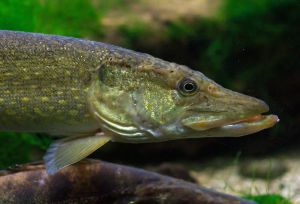
Pike (Esox lucius - Image: Wikipedia)
The growing success of campaigns by the Marine Conservation Society, fish2fork, and most recently FishFight in raising awareness of the need for sustainable consumption of marine fish species has led to a search for sustainable alternatives to the traditional cod, haddock, salmon and tuna consumed by many people in Western Europe. A recent blog post in the Guardian argues that a sustainable alternative may lie in the largely untapped culinary potential of freshwater species such as pike, perch, chub and carp.
It’s certainly an interesting idea – that in Britain we may overlook potentially plentiful, nutritious and tasty species due to cultural norms. Carp are traditionally a staple food in many Eastern European countries, as they were in medieval monasteries in Britain. In France, the perch is popular in fish markets and restaurants.
But how sustainable is the idea? Limiting the focus to Britain, you could raise questions of long-term sustainability on both an ecological and cultural basis.
Culturally, campaigns like Fishfight are demonstrating that encouraging ‘adventurous’ eating of marine fish such as dab, pollack and gurnard is difficult. As such, encouraging the consumption of freshwater fish which are often seen as muddy tasting and generally lacking from current cultural traditions is likely to prove difficult.
Similarly, many freshwater systems in Britain are artificially stocked with fish by angling associations. Whilst this keeps fish population levels high, it is extremely unlikely to be culturally acceptable to remove these fish on anything other than the smallest scale (if at all). The British angling press regularly posts articles bemoaning the loss of prize carp to anglers from countries where the fish is traditional eaten. This tension is only likely to escalate with increased removal of freshwater fish by wider groups of anglers.
Ecologically, it may be argued that many freshwater systems (in Europe, at least) may not hold the stock density of fish to withstand a long-term increase in catch removals. Indeed, in many smaller systems, the removal of large predators such as pike may potentially change the structure and function of the ecosystem.
This has been a very quick and shallow overview of the issue, but there are evidentially a number of interesting questions to ask.
Should we eat more freshwater fish? Is this sustainable? Or do we run the risk of transposing problems of overconsumption of marine species into freshwater systems?
Your comments, questions and ideas are very welcome.
A short animation: What is BioFresh?
We’re delighted to present a short animation produced by Paul Jepson and colleagues at Oxford University which outlines BioFresh’s work in helping improve the protection and management of global freshwater ecosystems. You can find out more about the European Union funded BioFresh project here, and explore our Cabinet of Freshwater Curiosities here.
Let us know your thoughts on the animation in the comments below.
Animation credits:
Producer – Paul Jepson
Design and Animation – Adam Arnot (Wild Lion Media)
Music and Sound – Lee Pritchard (Media Music Now)
Storyboard –
Paul Jepson
Rob St.John
Jon David
Muriel Bonjean
Reflections on the Oxford smartphone symposium: new technology and our engagement with nature
image: R St.John
The Oxford symposium on Mobile computing, citizen science and conservation recording presented a whole array of new and exciting ideas about how new technologies might enhance biodiversity conservation. Something that particularly struck me during the day was Simon Tokumine’s point that in the UK, the wide scale adoption of smartphones as citizen science recorders may currently be hindered by the fact that only around 18% of our national parks have the 3G coverage necessary for transmitting large quantities of data. To some, it may seem appropriate that national parks remain uncovered by such data networks – allowing users to engage with, and enjoy nature undistracted by technology.
For me, this is a major unanswered question in the debate (and one that was not discussed at the symposium) – what happens to our engagement with nature when our contact with it is in some way routed through technology like smartphones? The possibilities offered in terms of opening up the exchange of data, information and ideas about the natural world are patently grand. However, does this process necessarily entail (perhaps ironically?) some form of disengagement or detachment from nature?
Specifically, by treating the natural world as a game, or as a data source which can be fully described and catalogued, do we run the risk of forgetting or ignoring our motivations for venturing into nature in the first place? What does this mean for the conservation movement? Does prioritising data collection and technological gratification as outcomes from time spent in nature preclude the forging of a deeper, more values-led environmental ethic? In terms of positive conservation action, does this matter? These questions are all works in progress, and not meant to dampen the spirit of the day, instead to pose areas of thought that might be worth future work.
On balance, it could be argued that historical precedents for both data-led (e.g. the Victorian natural history movement) and values-led (e.g. the American wilderness movement in National Park formation) conservation movements have produced positive outcomes, and are unlikely to be mutually exclusive. Instead, as many of the symposium participants argued, we should be open to the exciting potential these new technologies offer conservation – opening up the field (and fields…) to those who otherwise may not get involved – especially younger generations – and to engage them in mutually beneficial ways.
—
Rob St.John
Communications & Project Co-ordinator, BioFresh
Oxford University Centre for the Environment
A smart future for conservation?

BirdGuides smartphone app (image: birdguides.com)
Visit the Digital Conservation website.
The increasing affordability and accessibility of new mobile and web technologies such as smartphones is opening up a host of new opportunities for conservation. We’ve already discussed citizen e-science projects such as Project NOAH on the blog, and the list of innovative ways that new technologies are being used to further conservation practice is increasing rapidly.
Last week, the Biodiversity Institute of the Oxford Martin School hosted a symposium entitled ‘Mobile computing, citizen science and conservation recording’ to explore these emerging trends. Convened by Paul Jepson from the School of Geography in conjunction with The British Trust for Ornithology and BirdGuides, the symposium represented a response to the growing adoption of smartphones in Europe and the resulting potential to link new forms of biological recording with biodiversity informatics, creating new data and enhancing public participation in science.
Four key questions were posed to participants:
1. What is the future of these new technologies – particularly mobile computing?
2. How can mobile computing and crowd sourcing technologies be deployed to improve upon current conservation practices?
3. How can these technologies transform biodiversity recording and monitoring?
4. How can these technologies be used to extend citizen science programs and nature appreciation in general?
Mobile computing technology may be used to enhance field identification of species – providing an interactive alternative to traditional field guides. For example, BirdGuides supplies detailed bird identification guides on mobile technology, enhanced by regularly updated information on the location and migration of populations. Whilst BirdGuides charges for this information, a free alternative for a range of taxa is provided by citizen science initiative iSpot (more on iSpot below). An exciting idea discussed at the symposium was the possibility of creating a smartphone app which could identify bird song from unseen individuals. Similarly, Richard Grenyer from Oxford University and Simon Tokumine discussed the potential of geo-located photographs (potentially in 3-D in the future) allowing rapid identification of species based on previously known data about the area in which they were observed through mobile technologies.

iSpot online identification process (image: ispot.org.uk)
Equally, these technologies are increasingly put to use in online data recording and collection projects such as Observado, BirdTrack and Project NOAH. Both Iain Downie from the British Trust for Ornithology and Kate Jones who from the Zoological Society of London (founder of citizen science initiative iBats) emphasised that smartphone-led citizen science programs should acknowledge the need for rigorous experimental design in underpinning data collection, in order to make the results scientifically valuable. Jonathan Silvertown from UK citizen science initiative iSpot offered a slightly different perspective, suggesting that the value of such programs isn’t only in the creation of data, it is also in encouraging people to engage with the natural world who otherwise might not. He stated that this engagement is likely to become increasingly important in years to come as the uptake of new naturalists from younger generations replaces the current, ageing generation.
iSpot provides an informal, community based learning environment in which users gain badges as they become more proficient at identifying, contributing and validating biodiversity data (the scout badge aesthetic echoing our work at Oxford on new technologies reinventing old practices). This idea of the rewards offered to citizen science contributors was a recurrent theme. Where iSpot rewards users with badges indicating reputation, other initiatives such as Galaxy Zoo design the data collection process as a game, in this case where users describe the characteristics of photographs of galaxies (another example of such a game is Pooter!). Current data is not the only focus of such projects – some initiatives like Old Weather are calling on contributors to help digitise historical Royal Navy weather patterns in order to help understand climatic histories. Open source online software like EpiCollect – designed by David Aanensen at Imperial College – has the potential to allow a wider range of individuals and institutions to easily design data recording forms for mobile technology – further increasing the scope of this collection process.

Classifying galaxies in Galaxy Zoo (image: galaxyzoo.org)
The ease with which collected data may be organised, stored and made accessible to the public, scientists, the media and policy makers was described by the representatives of Dutch data framework Observado. Driven by user-submitted data, Observado has been hugely successful, bringing together over 810,000 sightings by over 1,900 users. The question of how to validate submitted citizen science data for accuracy and reliability was another theme running throughout the symposium. Observado tackles potentially problematic data by organising a network of volunteer administrators with expertise in particular taxonomic groups to check submitted data.
Simon Tokumine from the UNEP-WCMC emphasised that whilst smartphone technology has much to offer the conservation movement, its scope in the UK is currently hindered by the fact that only around 18% of our national parks have the 3G data coverage necessary for transmitting large quantities of video and image data. Accordingly, he argued that any biodiversity recording app must be able to run without connectivity, and have the ability to store and delay the upload of data. You can read more on this at his blog post about the day.
The tone of the day was one of excitement and creativity – and regardless of the theoretical and methodological questions that come with the adoption of any such new practices, it is clear that there are productive new avenues for the conservation movement to explore.
Plenty to think about, and as ever we’re keen to hear your questions, comments and suggestions.
Links to symposium presenters:
- Conrad Wolfram, Wolfram Alpha
- Simon Tokumine, UNEP – WCMC
- Hugo Nieuwenhuys & Martijn de Jong – Observado
- Iain Downie, British Trust for Ornithology
- Fiona Barclay, Birdguides
- Kate Jones, ZSL – iBat
- Jonathan Silvertown, Open University –iSpot
- Arfon Smith, University of Oxford –Zooniverse
- David Aanensen, Imperial College – EpiCollect
- Richard Grenyer, University of Oxford
Other interesting links to new technologies in citizen science:
- Citizen Science Alliance
- Project NOAH (Networked Organisms and Habitats)
- Fold it
- Seti@home
- iBird
- Stardust at Home
- Harlequin Ladybird Survey
- Indicia: The OPAL Online Biological Recording Toolkit
- UK Field Studies Council identification apps
- Everytrail
- Wired article on using smartphones to map urban fruit trees
Welcome back: plans for the BioFresh blog in 2011

Frozen Port Meadow, Oxford. January 2011. (image R St.John)
Welcome back to the BioFresh blog – and a belated happy new year. Things have been quiet on the blog recently, due to a combination of the winter break and various admin changes. However, we’re back in the swing of things and excited about the prospect of a rejuvenated site in 2011.
We’ll be aiming to post at least once a week on a host of environmental issues – often focussing on (but not limited to) freshwater biodiversity conservation. We’ll be continuing to publish pieces on current and cutting edge issues like alien and invasive species; citizen science and the use of new technology in conservation and science communication; and aim to draw on the expertise of individuals within BioFresh (and beyond) to give insider expertise on a range of issues.
In February we will be live blogging from the BioFresh conference in Barcelona to give a live update of the discussion of important cutting edge issues in the conservation of our rivers and lakes. We will be continuing to develop and link in with the BioFresh website and Cabinet of Freshwater Curiosities to provide a range of ways of engaging with the project and the important issues.
We are always very keen to receive suggestions for topics or stories, and comments and criticism on anything we write – and can be reached through biofresh@ouce.ox.ac.uk
Blogs have the potential to really make scientific information and discussion more open, accessible and democratic – as Sarah Tomlin writes: “Blogs are windows into academic coffee room chatter of the sort the media is not normally privy to” (Tomlin 2007: 23).
We’re very keen to hear your voice in this debate.
Thanks,
Rob St John
Communications & Project Co-ordinator – BioFresh
Oxford University Centre for the Environment
An insider’s view of Convention on Biological Diversity Conference 10, Nagoya, Japan
 This week’s post is written by BioFresh partner Dr Hendrik Segers from the Royal Belgian Institute of Natural Sciences. Dr. Segers co-ordinates the Belgian Biodiversity Platform, which promotes effective collection and accessibility of global biodiversity data. Dr. Segers’ research interests surround the biodiversity and biogeography of freshwater systems, and has published more than 130 scientific papers, including 70+ in ISI journals, on the subject.
Dr Segers was present at the Convention on Biological Diversity Conference of Parties 10 in Nayoga, Japan held in October 2010. Here he offers a unique insider’s insight into the inner workings of the talks.
After the failure of the last UNFCCC Conference of the Parties in Copenhagen in 2009, many observers worried that this marked a general lack of confidence in the effectiveness of intergovernmental processes to deal with environmental issues. Moreover, the stakes for the 10th Conference of the Parties of the Convention on Biological Diversity were unusually high, which was neither an element that inspired much confidence. This 10th Conference of the Parties, or, short, Cop 10, had to consider a relatively large number of widely ranging subjects, going from household issues to a series of in-depth reviews of Programmes of Work, including such contentious ones as Protected Areas, Marine and Coastal biodiversity, and Biodiversity and Climate Change. On top of those regular ones, there were three more issues that could easily have gone awry.
First, an agreement had to be negotiated on a protocol to deal with Access to Genetic Resources and the Fair and Equitable Sharing of Benefits Arising from their Utilization, or the ABS protocol. After about seven years of painstaking negotiations, Parties (countries that have ratified the CBD) were hard pressed to conclude on a protocol that would regulate the access to genetic resources – mostly in the interest of developed countries – and the sharing of the benefits arising from their utilization – a concern for, mostly, developing countries. I can illustrate the complexity of the ABS negotiations by referring to the case of derivatives: to what extent should a molecule be considered a Genetic Resource under the terms of the protocol? Does changing a few atoms in a molecule that otherwise is found in bacteria dwelling the depths of a tropical swamp make it an artificial substance, that can therefore at leisure be commercialized by a pharmaceutical company?
A second heavily debated issue was the strategic plan for the post-2010 period implementation of the Convention. This plan includes some – more or less strictly circumscribed – targets and deadlines for the conservation and sustainable use of biodiversity. Goals on freshwater biodiversity are included in targets 111 and 142. That coming to such an agreement is a difficult process should not surprise anyone.
Last but not least, resources have to be made available to make all this possible. Bearing the global economic crisis in mind, arriving at a Strategy for Resource Mobilization that balances the interests of developed countries with those of the G77 and upcoming economies such as Brazil and China was no sinecure.
With all this in mind, it was clear that the Nagoya COP of CBD was not expected to be a walk in the park. The international press had so much as declared it a lost cause even before the start of the meeting, which of course did not inspire much confidence. Indeed, the mood swung from positive to negative and back during the fourteen long days and nights of the meeting, during plenaries, working group meetings, informal contact group meetings, friends of the Chair meetings, the high-level ministerial segment , and, in parallel to those, regional coordination meetings, e.g., amongst EU members states under the Belgian presidency. This went on until and during the final plenary on Friday evening, where exhausted negotiators were seen to frantically run from one Party to another to convince, plead, or explain complex package deals. Until, finally, around 3 AM on Saturday morning, the Chair could finally adopt a full set of decisions, including the Nagoya protocol on ABS, a Strategic Plan for the post 2010 period, and a Strategy for Resource Mobilization, and adjourn a successful CBD COP 10.
If one reads through all the decisions of this COP, one will certainly find weaknesses, but also positive points. My feeling is that a reasonably acceptable balance was struck between ambition and realism, and between the interests of both developed as well as developing country Parties. In fact, in hindsight, the mere fact that a consensus was reached already exemplifies the sense of responsibility and urgency that will be needed even more to tackle the global environmental crisis that is upon us today. As I write this, the CPP16 of UNFCCC COP in Cancun, Mexico, has just concluded and it is good to see that negotiators there appear to have been inspired by the success of CBD COP 10.
H. Segers
Further reading:
http://www.cbd.int/nagoya/outcomes/ for the unedited outcomes of the meeting;
http://www.iisd.ca/biodiv/cop10/: report on COP10 by IISD reporting services
Notes:
1 Target 11: By 2020, at least 17 per cent of terrestrial and inland water, and 10 per cent of coastal and marine areas, especially areas of particular importance for biodiversity and ecosystem services, are conserved through effectively and equitably managed, ecologically representative and well connected systems of protected areas and other effective area-based conservation measures, and integrated into the wider landscape and seascapes.
2 Target 14: By 2020, ecosystems that provide essential services, including services related to water, and contribute to health, livelihoods and well-being, are restored and safeguarded, taking into account the needs of women, indigenous and local communities, and the poor and vulnerable.
Creative ways of thinking about freshwater conservation

'Swans and River' by Carry Akroyd (from here)
Last week in Norfolk, England, a conference entitled Birds, Nature & Creativity brought together writers, artists, musicians, academics and conservationists to discuss new and creative ways of thinking about bird conservation. Working under (but not limited to) the common cause of birds and their habitats, a key theme of the day was that there is untapped potential to complement traditional forms of conservation with the creative arts in order to reinvigorate public engagement with the natural world.
Contributors ranged from Richard Mabey (author of numerous books on natural history – most recently Weeds); author Mark Cocker; BioFresh partner (and Oxford University senior lecturer) Dr Paul Jepson; and The Independent’s environment editor Michael McCarthy; to environmental artists Carry Akroyd and Katrina Porteous and haiku poet John Barlow. A common theme of many posts on this blog has been the drive to find innovative ways of planning and communicating conservation, and the wide-ranging perspectives and ideas brought together for the conference certainly sparked this debate.
How could we apply these ideas to freshwater ecosystems conservation? We might look to the rich and diverse entanglements between nature and culture evident in many species in The Cabinet of Freshwater Curiosities. Species in the Cabinet are celebrated for their ecological and cultural distinctiveness and significance rather than any pressing extinction threat.
Rivers crop up as a metaphor for sustenance, change, loss and renewal in the earliest folk music, and persist into the modern tradition – from Joni Mitchell, Neil Young, and Bill Callahan to Justin Timberlake. The same could certainly be said for poetry – a modern example being John Barlow’s environmental haikus:
clouded light . . .
ripple crests edge
the egret’s tail
(John Barlow (2008) Wingbeats from here)
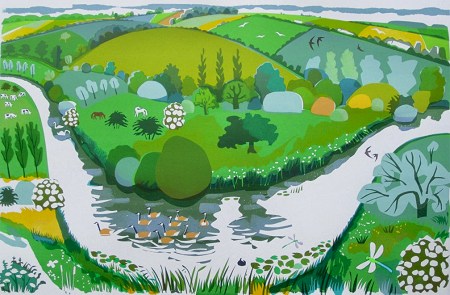
'River Landscape'. Screenprint by Carry Akroyd (from here)
The role of art and music in conservation need not be only celebratory – as shown by Carry Akroyd’s work, there is potential to communicate ideas of habitat destruction and species loss in creative ways. A challenge is to communicate these ideas of anger and loss whilst promoting the value of positive individual engagement with the natural world, and the diversity of ideas and emotions that stem from this.
In Scotland, there is a growing movement (with echoes of bioregionalism) to simultaneously restore nature and culture to degraded landscapes (see for example the Assynt crofting community). Traditional music, stories and poems concerning the environment are key to this process. Perhaps there is potential to apply these ideas to the songs, stories and poetry surrounding rivers and lakes to spark a similar resurgence of interest in freshwater ecosystems?
But can an engagement with the creative arts to translate into positive conservation action? It might be argued that creating environmental art or writing environmental poetry or songs is important, yet rarely inspires direct environmental action. Equally, are these ideas too niche in their appeal, resonance or geographic scope to have any real effect?
The point of this discussion is not that the introduction of creativity into conservation will suddenly solve all the pressing environmental problems. Instead, what is exciting is the potential to reimagine the relationship between landscape, culture and conservation through the creative arts to reinvigorate people who may have lost, or never acquired an engagement with the natural world.
This post has given a relatively shallow (sic) overview of some starting points for how the creative arts may complement freshwater ecosystem conservation. We’d welcome your thoughts, comments and suggestions as to how this idea might be extended. How could we think about using the creative arts to reconnect people with our rivers and lakes?
Cabinet of Freshwater Curiosities

Image: Robert Haas/National Geographic/Caters News Agency
This photo of Carribean flamingos flocking in the shape of a flamingo (!) in the Yucatan, Mexico in yesterday’s Guardian seems an apt way to introduce the relaunched BioFresh Cabinet of Freshwater Curiosities.
The Cabinet of Freshwater Curiosities is a modern adaptation of the Cabinet of Curiosities concept, intended to foster interest into the often neglected world of freshwater ecosystems. The Cabinet collects and collates a selection of the world’s most fascinating, bizarre and unique freshwater plants, animals and phenomena (much like the flamingos above!). It provides an interactive platform for users to engage with some little-known oddities and become further immersed in the curious world of freshwater ecosystems.
The site is highly interactive and linked to various social media platforms to encourage users to submit ratings, comments and suggestions for future “curiosities”.
Feel free to explore the Cabinet here, and let us know your thoughts.
Citizen science and new technology

Project Noah
Increasingly affordable digital camera and smart phone technology is being used to attempt to engage the public with the natural world and biodiversity conservation. Citizen science – where the public are involved as active researchers or collectors of biodiversity data – is being increasingly fostered by initiatives such as Project Noah. Project Noah allows the public to use a smart phone app to document (through photographs, measurements and map readings) the plants and animals they encounter. These “spottings” are mapped along with other user data to give a field guide to the wildlife found in a particular area, and can be ratified by independent experts. Project Noah also sets the user “missions” to spot a particular organism, and the data collected can be used to track processes such as the spread of migrating or invasive species.
This initiative is part of a larger movement to use new technologies to engage the public with the natural world. iSpot provides an online community for users to help identify photographed organisms; and projects like the OPAL Biodiversity Survey, the RSPB Big Garden Bird Watch or the Christmas Bird Count in the USA are increasingly using the internet to allow the public to submit their observations and sightings.
This reflects a shift to the increasing democratisation and openness of scientific knowledge. Historically, scientists and the public have largely existed as separate poles, with the communication of science aiming to fill a perceived “deficit” in public understanding. This “deficit model” assumes that once scientific literacy is improved then the public will understand how and why scientific decisions are made, and so avoid any controversy or debate.
However, this model is being viewed as increasingly flawed. Citizen science projects such as Project Noah fall under an alternative “public engagement” model that aims to empower the public in environmental decision-making by connecting environmental problems to their daily lives, values and beliefs. The science-public relationship becomes a dialogue, fostered through citizen science projects, community forums and novel means of science communication (see for example the BioFresh Cabinet of Freshwater Curiosities) to understand and influence how science is translated into environmental decision-making.
There are concerns that the data collected by citizen science projects is unreliable and inaccurate. Certainly, a browse through the Project Noah site reveals a number of “spottings” of pets, garden plants and fishermen’s trophy catches. However, you could argue that the quality of data is necessarily the key point to citizen science; it is instead the fact that it encourages people who may not otherwise to step outside and take notice of the natural world around them – even in a highly urban area.
As such – and seemingly paradoxically – I wonder if there is the potential for new digital technology to make it easier for the public to reconnect with the natural world? How would such a connection work? Do new technologies necessarily keep us at arms length from the world around us, or do they give new ways to reinvigorate our engagement and enjoyment of it?
As ever, let us know your thoughts, comments and suggestions.










 The Freshwater Blog