What is the ‘ecosystem services’ concept?
Within the past three decades, ecosystem services have risen to prominence within policy and academic circles. In this guest post, James Thomas Erbaugh from the University of Oxford talks about what ecosystem services are and introduces some of the tensions between an ecosystem services framework and biodiversity conservation.

The progression of ecosystem services within policy and academic writing has resulted in many redefinitions of what ecosystem services are. However, the current understanding of the ecosystem services concept is based on some common themes. As the UK Department of Environment, Food, and Rural Affairs (DEFRA) guide to ecosystem services notes:
“There is no single way of [sic] categorising ecosystem services, but they can be described in simple terms as providing:
- Natural resources for basic survival, such as clean air and water
- A contribution to good physical and mental health, for example, through access to green spaces, both urban and rural, and genetic resources for medicines
- Natural processes, such as climate regulation and crop pollination
- Support for a strong and healthy economy, through raw materials for industry and agriculture or through tourism and recreation
- Social, cultural and educational benefits, and welling and inspiration from interaction with nature”
Thus, ecosystem services provide anthropogenic value, for example: pollination, fiber production, and water filtration. The Millennium Ecosystem Assessment (MEA), one of the most important projects to the proliferation of the ecosystem services concept, uses four categories when defining specific ecosystem services:

MEA categories of ecosystem services
Provisioning, regulating, cultural, and supporting services help categorise what various ecosystem functions or components do that is of value to people. The conceptual definition and the categorisation of ecosystem services illustrate the primary function of the entire ecosystem services concept: translating ecosystem functions and components into commodities using economic or market-based logics. It is this translation that both confounds and permits the connection between ecosystem services and biodiversity conservation.
Biodiversity is considered necessary for providing ecosystem services while biodiversity is also an ecosystem service itself. Maintaining a level of biodiversity is required for a functioning ecosystem to provide economically valuable services (provisional service). This was the original reason for advancing the ecosystem service concept; ecosystem services were introduced as an educational tool to raise awareness for biodiversity conservation. In this portrayal, biodiversity is a component of ecosystems that must be considered and protected if we wish to benefit from all other ecosystem services. The role of biodiversity is still important in the framework, but ecosystem services are seen as more than just an educational tool to promote biodiversity conservation.
 Currently, those who use the ecosystem services framework seek to highlight how ecosystems contribute to commodities, markets, and how land should be valued. Ecological economist Robert Constanza and others, by demonstrating the economic value of ecosystem services, have been influential in promoting the concept. See here and here for key papers that introduce economic value to nature. These papers, and those related, sought to promote ecosystem services or payment for ecosystem services as a tool for economic valuation, policy-making, and conservation. Thus, in terms of biodiversity conservation the species diversity and richness of a particular area, or the existence of a charismatic species in a particular area, becomes a service that ecosystems provide, and can be valued within the market. Biodiversity is no longer a foundational cause for the ecosystem services concept, but one of the many anthropogenic benefits ecosystems provide. The problem is, if biodiversity is a functional component of all ecosystems, and if biodiversity is not conserved, then those ecosystems which provide a multitude of services could cease to function.
The difficulty of classifying biodiversity conservation within the ecosystem services agenda establishes the basic tension between these two concepts. This tension is philosophical: should biodiversity conservation be for its own sake, or is the utilitarian valuation of payment for ecosystem services the only important consideration? It is practical: how does biodiversity fit in the policy arena if ecosystem services is the dominant language? And it is personal: how should scientists, policy-makers, economists, or citizens best account for biodiversity conservation? And, for those of us compelled to promote biodiversity conservation throughout freshwater landscapes, determining how to navigate within the ecosystem services agenda is, above all, essential.
Works Cited:
Cardindale et al. 2012: Biodiversity loss and its impact on humanity. Nature 486: 59-67.
Costanza, R., and Daly, H., 1992: Natural Capital and Sustainable Development. Conservation Biology, 6, 1, 37-46.
Costanza, R. et al., 1997: The value of the world’s ecosystem services and natural capital. Nature, 387, 253-60.
DEFRA, 2007: An Introductory Guide to Valuing Ecosystem Services. London, Crown Copyright. Found at: https://www.gov.uk/government/uploads/system/uploads/attachment_data/file/181882/pb12852-eco-valuing.pdf. [Accessed on: 29 April 2013]
Gomez-Baggethun, E., de Groot, R., Lomas, P., and Montes, C., 2010: The history of ecosystem services in economic theory and practice: From early notions to markets and payment schemes. Ecological Economics, 69, 1209-18.
Millennium Ecosystem Assessment. 2005. Found at: http://www.millenniumassessment.org [Accessed on 29 April 2013]
Petchey, O. L. and K. J. Gaston (2006): Functional diversity: back to basics and looking forward. Ecology Letters, 9(6): 741-758.
Tilman et al. 1997: The influence of functional diversity and composition on ecosystem processes. Science, 277:1300-1302.
Read other articles in our Special Feature on Freshwater Biodiversity and Ecosystem Services
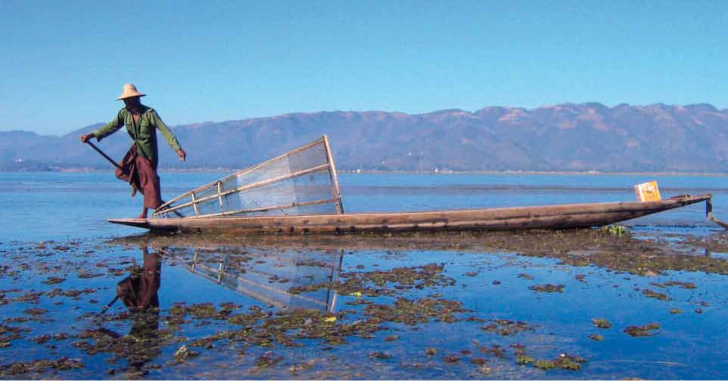
Fisherman on Inle Lake, Myanmar (Burma). The harvesting and consumption of freshwater species is just one of the many services that freshwater ecosystems provide. Photo: Shannon Holman
Over the last decade the notion of ecosystem services has transformed from metaphor into a mainstream policy framework. The concept of nature as a stock of capital that sustains flows of ecosystem services, which underpin and support economies and human well-being, nowadays has considerable currency. It was a central pillar of the Millennium Ecosystem Assessment and was reinforced in policy circles with the influential TEEB reports (The Economics of Ecosystems and Biodiversity). The ecosystem services concept is actively being embraced by European Commission directorates responsible for regulatory frameworks and policy in the areas biodiversity, ecosystem restoration, sustainable land and water use, climate change mitigation, and the design of green infrastructure.
For biodiversity scientists the ecosystem services policy frame poses a straight forward but challenging question, namely “what is the relationship between biodiversity and ecosystem processes, functions and services?” In these worrying economic and human-centric times this question can easily be re-framed as simply “how much biodiversity do we need? When faced with such questions, it is easy for people working on freshwater biodiversity to feel out of their depth (excuse the pun).
We can’t hope to answer questions of this magnitude in a blog special feature. However, the summer is a time to kick-back a little and to contemplate on the bigger questions. Whatever your view on the ecosystem services concept it is here to stay, for the time being at least, and it will change biodiversity science and policy. We all need to engage with it at some level so as to assure that freshwater biodiversity is not over-looked. This special feature aims to support such engagement though a series of posts that we hope will provide an accessible and interesting briefing on the underlying concepts, the state of the science-policy interface and some of the interesting issues and trade-offs that the ecosystem services concept generates. The articles included feature guest authors from inside and outside the BioFresh project, interviews with key actors, as well as pieces from the BioFresh blog editorial team.
Below is the list of posts we currently have in mind. If you think there is something missing and/or would like to contribute a post please get in touch. More importantly please extend and critique these posts by adding your comments. This is a complex and dynamic topic and the more voices the better!
Paul Jepson & Will Bibby
Feature articles:
What is the ‘ecosystem services’ concept? by James Erbaugh
The LIVING RIVERS Foundation: protecting and promoting the ecosystem services of rivers
Perspective: Martin Sharman on ethics and the ecosystem services paradigm
A tour of EU-commissioned research on ecosystem services by Dr Paula Harrison
What rivers do for us by Dr Christian Feld
Professor Victoria Strang: Thinking with water
Does ecosystem services need a radical critique? In conversation with Professor Victoria Strang
Perspective: Should the wildlife media pay for ecosystem services?
Water Funds an ideal ‘PES’ project – or better?
Highlighting an ecosystem services project in action: The DURESS Project
An update on the work that BioFresh is doing on ecosystem services
Biodiversity, ecosystem services and EU policy
Photo essay of the freshwater biodiversity present in a Thai food market
Bringing biodiversity in to the ‘food, energy and water security nexus’
Crayfish harvesting in the Thames – tackling a problem with a solution
This week the remarkable story of a one of the rarest frog in the world got even more incredible. Thought to be extinct, but rediscovered two years ago, the hula painted frog has now been declared a ‘living fossil’.
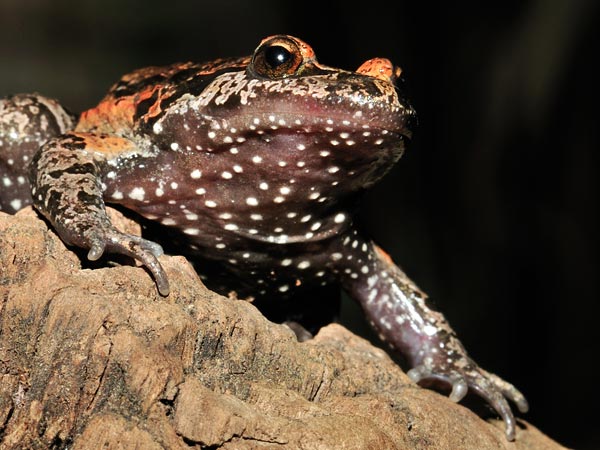
The elusive hula painted frog now turns out be a ‘living fossil’. Photo: Frank Glaw.
Last year, as part of our amphibian special feature the BioFresh blog reported on a campaign called the ‘Search for the Lost Frogs‘, which aims to find 100 species of frogs and other amphibian species that have been deemed ‘lost’. The hula painted frog was among them, and when it was rediscovered in 2011 it was one of the most highly prized finds of the whole campaign.
The frog, which has a distinctive dark belly with white spots, had only been seen 3 times and the last time had been nearly 60 years ago in 1955. Scientists had feared the worst for the species when it’s only known habitat, the Lake Hula marshes in Israel, was drained in the 1950’s. But, during a routine patrol in 2011, the frog hopped back into existence into the path of a stunned park ranger. There have since been another 10 sightings.
Now, scientists have added another layer to the story of this elusive amphibian: it is a ‘living fossil’. A living fossil is a term given to a species that has largely stayed the same over millions of years and that has few or no living relatives. This frog hasn’t just survived, hidden for 60 years in a swampy marsh in Israel. It has survived 15,000 years longer than its closest relative! The hula painted frog was originally thought to be a member of the genus Discoglossus. Scientists have now realised that the Hula painted frog is actually a member of the genus Latonia, previously only known through the fossil record and once widespread throughout Europe.
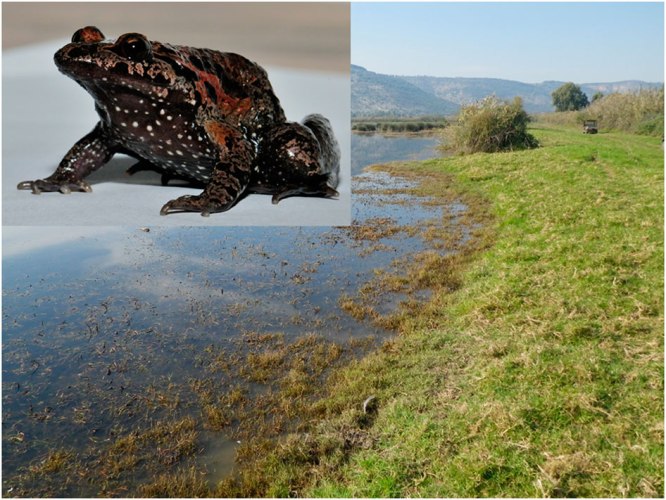
Female Hula painted frog (top left) and the typical habitat in the Hula reserve. Photo: Biten et al.
The revelation was made after scientists at Israel’s Ruppin Academic Centre performed DNA tests on tissue samples of the frog and the findings were published in the journal Nature Communications. “Nobody ever had a chance to see a Latonia because it went extinct in Europe. The only way anyone could see it was through looking at fossils,” said Professor Sarig Gafny, co-author of the study. “But then with every characteristic that you look at in the current Hula painted frogs, it matches that of the fossils of Latonia and not that of the Discoglossus… So this is a living fossil.”
Other amazing amphibians that have been rediscovered are the Rio Pescado stubfoot toad, the Chalazodes bubble-nest frog, last seen in 1874 and the Silent Valley tropical frog, which was incredibly found sitting in the bottom of a rubbish bin!
While this is a huge win for conservation, there are still over 200 species of amphibians that remain ‘lost’, perhaps forever. Amphibians the world over are facing an extinction crisis with the main threats coming from habitat loss, climate change and a deadly fungal disease. The rediscovery of the hula painted frog is a reminder not only of the resilience of nature, but also of what we stand to lose. It is at once a sign of hope, and a call to further action.
Freshwater biodiversity ranges from the giant Mekong catfish to the myriad microscopic aquatic lifeforms. But these tiny examples of freshwater life seldom receive attention. In this guest post, Katja Lehmann, a microbial ecologist with the Centre for Ecology and Hydrology, joins BioFresh to discuss a new campaign called River Sampling Day to help us learn more about these important microbial freshwater organisms.  River microbes are at the heart of many essential ecosystem services, playing important roles in the cycling of nutrients and carbon, maintaining water quality and the clean-up of pollution in our waterways. Despite the importance of microbial diversity in rivers, these microscopic bacterial communities are greatly under-researched. The lack of comprehensive data prevents us from fully understanding even basic processes.

Katja Lehmann in the lab.
What, for example, are the main actors influencing microbial communities in rivers? Do river microbial communities differ from river to river or are there clear patterns? Can we determine the nature of the river by looking at its biofilm? How do pollutants in run-off and sewage effluent change river bacterial communities? And, does pollution damage riverine communities – and ourselves – by breeding riverine ‘superbacteria’?
To help address this gap in knowledge and pose answers to some of these question, we are launching River Sampling Day (RSD), a simultaneous sampling campaign of the world’s rivers. River Sampling Day will be held on the solstices with the first ever pilot event to be held on June 21, 2013. River Sampling Day is a sister initiative to Ocean Sampling Day, the global marine sampling campaign which is part of the EU-funded Micro B3.
The River Sampling Day event aims to build a network of collaborators which we hope will form the core of an international freshwater Genomic Observatories Network. We aim to use the data generated to develop an index of ‘indigenous’ to ‘transient’ bacteria to serve as a potential predictor of river health, as well as to develop an Ecological Niche Modelling approach in collaboration with BioVEL, a virtual e-laboratory that supports biodiversity research.

A sampling site in Oxford.
For the June solstice water and sediment samples will be collected from various locations to analyse for microbial diversity and function. We currently have a list of 45 locations from Oxfordshire to Australia – and counting – and we would like to invite external researchers to join the River Sampling Day.
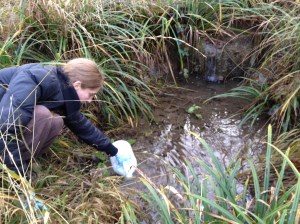
River sampling in action.
Ideally, all the samples should be taken between 10.00 and 14.00 GMT on the solstices. If this is not possible, researchers should contact us for alternative arrangements. The sampling itself should take approximately 20 minutes per sampling location. We supply the sampling protocol and also have a limited number of sampling kits available for sites that do not have any microbial sampling expertise.
If you are associated with a river research site or other regular river research activity and would like to participate in the River Sampling Day pilot study please register by clicking here.
For any questions please email riversamplingday@gmail.com.
Will Darwall, Head of IUCN’s Freshwater Biodiversity Unit, has used the International Day for Biodiversity to call for the formation of a single group of freshwater scientists and conservationists to give voice to the myriad of life under and on the surfaces of our lakes, rivers and wetlands.
Speaking with Paul Jepson from the University of Oxford, Will highlighted the need to work together and form a single advocacy group, pointing out that the community of freshwater scientists is quite small and fragmented worldwide relative to other groups working on more charismatic species. Can we bring together all these disparate groups working on freshwater biodiversity and ecosystems and form a much stronger, single ‘expert network’?
With World Biodiversity Day just one sleep away, Will Darwall, Head of the IUCN Freshwater Biodiversity Unit, sat down with Paul Jepson from the University of Oxford to discuss some of the big challenges facing freshwater biodiversity.
The theme of the International Day of Biodiversity 2013 is ‘Water & Biodiversity’, highlighting the crucial importance of both. However, freshwater biodiversity is currently facing some big challenges. 50% of the world’s wetlands have been lost last century, freshwater species most at risk from extinction, and habitat destruction is making the problem worse, yet the problem often literally remains out of sight and out of mind.
Listen to Will Darwall explore some of the key issues and explain why it is important to be concerned about freshwater biodiversity.
Tune in tomorrow for part 2 of the interview, where Will Darwall discusses a potential solution to address freshwater biodiversity’s lack of visibility.
Meet the BioFresh team: Will Darwall
We continue our ‘meet the team’ series, a behind the scenes look into the work of BioFresh, with an interview with Will Darwall, Head of the IUCN Freshwater Biodiversity Unit.
Will has over 20 years experience working on and leading collaborative research projects on the ecology and conservation of aquatic ecosystems in developing countries. We will also be posting a video discussion with Will this week, who outlines some of the key challenges for freshwater biodiversity, to promote the International Day of Biodiversity’s theme ‘Water and Biodiversity’.
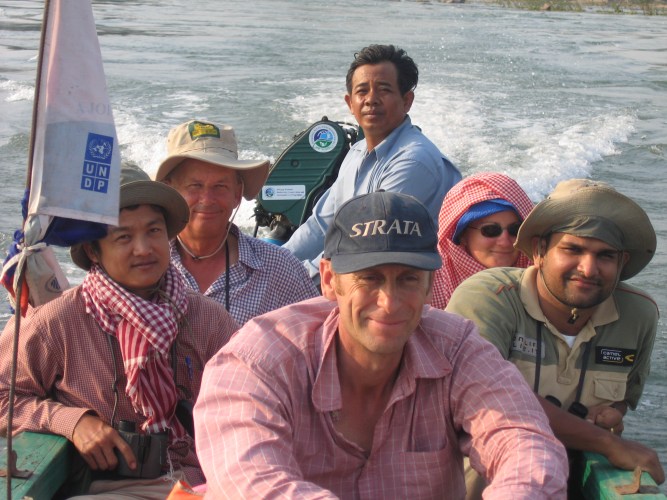
Will Darwall (front) on a biodiversity survey on the Mekong – a river where the fish are only really seen by fishermen as the waters are so turbid.
1 What is the focus of your work for BioFresh, and why?
The world’s inland waters are probably the most threatened of our ecosystems, with the best current estimates suggesting around 50% have already been lost over the last 100 years. Loss of habitat clearly also leads to a loss of species and indications from the IUCN Red List put freshwater species as some of the most threatened of all. Given this situation our focus in BioFresh is to improve and make freely available the information needed to guide policy decisions and on-the-ground conservation action to help halt the loss of freshwater biodiversity through effective conservation and development planning. One of the most powerful tools we are developing through the project is the identification and mapping of a network of Key Biodiversity Areas for freshwater species. Key Biodiversity Areas basically represent those areas we need to protect if we are to prevent the loss of species.
2 How is your work relevant to policy makers, conservationists and/or the general public?
A number of important Conventions, such as the Convention on Biological Diversity (under Target 11), and policies on environmental safeguards, such as Performance Standard 6 of the International Finance Corporation (guidance to the World Bank Group), specifically state the need to identify and protect important sites of biodiversity. Our work to map these important sites through BioFresh will directly provide the information needed for countries and developers to identify these sites. We are also able to determine how well the current protected area networks, such as Natura2000, incorporate freshwater species and we can identify areas where the coverage is poor and recommend additional or modified protected areas to better represent freshwater species.
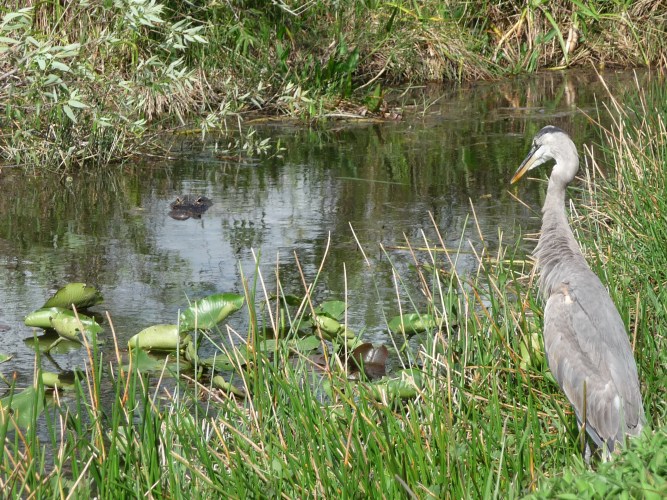
Heron eying an alligator in the Forida Everglades
3 Why is the BioFresh project important?
BioFresh is unique in its ability to bring together the widely dispersed information needed to inform policy for the conservation of freshwater biodiversity. The BioFresh portal will allow rapid access to much of the latest information on the status of freshwater biodiversity, the threats to that biodiversity, and predictions for the impacts of those threats on species, especially in relation to movements of species to new areas.
4 Tell us about a memorable experience in your career.
One of my more memorable moments was my first dive in Lake Tanganyika as part of a project where we were to train local scientists in underwater survey methodologies. Diving in the lake was like diving on an inland coral reef with a tremendous diversity of fish species, freshwater jellyfishes, crabs, shells and even the endemic water cobra.

Ophthalmotilapia ventralis, a type of freshwater fish only found in Lake Tanganyika, Tanzania, and member of the cichlid family.
5 What inspired you to become a scientist?
I was probably influenced quite heavily by my uncle who is an entomologist and excellent naturalist. He used to take me out “bug hunting” all the time and I became quite an expert on many species at an early age (since forgotten now I fear!). As part of this experience when looking after some of his “pets” I remember watching Atlas moths emerging in my bedroom and hanging from the curtain, and huge stick insects shooting their eggs off the walls! Later on my interest in freshwaters was possibly initiated when my sister won a goldfish at the fair and we set up our first fish tank.
6 What are your plans and ambitions for your future scientific work?
To inspire more people to be interested in the wonders of freshwater biodiversity – I see communication of the value of freshwater biodiversity as a major challenge. Most people will never see the amazing species we know are living in our lakes and rivers as they remain hidden in often murky waters and their loss often goes unnoticed.
Water and biodiversity is the theme for the International Day for Biological Diversity and provides an opportunity to raise awareness about the crucial role that water plays in sustaining life on Earth, as well the highlighting the abundance of life found within freshwaters.

It’s a big year for water! The theme of this year’s international day of biodiversity (or world biodiversity day) is ‘water and biodiversity’, which has been chosen to coincide with the designation of 2013 as the International Year of Water Co-operation. The date of the international day of biodiversity (22 May) marks the adoption of the Convention on Biological Diversity. 2005-2015 is also the UN decade of ‘Water for Life’. See here for some key messages.
World biodiversity day provides a key opportunity for the freshwater biodiversity community to raise the profile of freshwater biodiversity and highlight both the importance of it and the threats it faces. Please get involved and help us raise awareness of the vital role that freshwater biodiversity plays in our lives and the world around us.
We encourage you to take to twitter and other social media to create some buzz around the issue. You can follow us on twitter: @biofreshproject. Below are some example tweets that you can tweet yourself or use for inspiration. We would also like to encourage the freshwater scientists among us to tweet key findings from any relevant papers you’ve written. And don’t forget to hashtag your tweets (e.g. #water #biodiversity #BiodiversityDay)
Example tweets:
Did you know: #freshwater covers just 1% of Earth’s surface, but harbours 10% of all animals! #water #biodiversity #BiodiversityDay
#Water is not only a vital resource, but a medium for life – 35% of all invertebrates found in #freshwater! #biodiversity #BiodiversityDay
Should awe and wonder be taken seriously as an #ecosystem service? #water #biodiversity #BiodiversityDay
Millions of people around the world depend on freshwater ecosystems & the #biodiversity in them for their livelihood #water #BiodiversityDay
A shared knowledge base on #biodiversity needed for effective policy & conservation of freshwater ecosystems #water #BiodiversityDay
#Water is life: it underpins human well-being, as well ecosystem health & #biodiversity #BiodiversityDay
Freshwater #ecosystems & #biodiversity play crucial role for #water #security by regulating availability & quality of water #BiodiversityDay
Freshwater #ecosystems are natural #water infrastructure that can serve same purpose as dams or treatment plants #BiodiversityDay
Without #ecosystems, the #water cycle, & dependent carbon & nutrient cycles, would be significantly altered #biodiversity #BiodiversityDay
Conserving #wetlands can help regulate #water but can also support significant fisheries #biodiversity #BiodiversityDay
… or why not tweet one of John Barlow’s beautiful Haiku’s from our art-science animation Water Lives
waterush
the slow song
of a dipper
#Haiku by John Barlow ‘ Water Lives” http://vimeo.com/36863720 International #Water #BiodiversityDay
one cell
anchored in time
winter stillness
#Haiku by John Barlow ‘ Water Lives” http://vimeo.com/36863720 International #Water #BiodiversityDay
ripple light
catkins colour
the leafless alders
#Haiku by John Barlow ‘ Water Lives” http://vimeo.com/36863720 International #Water #BiodiversityDay
hazy day moon
all of the star shapes
awakened in the lake
#Haiku by John Barlow ‘ Water Lives” http://vimeo.com/36863720 International #Water #BiodiversityDay
between glides
the water striders
pockmarking sky
#Haiku by John Barlow ‘ Water Lives” http://vimeo.com/36863720 International #Water #BiodiversityDay
past a ghost of a water flea the fisherman’s cast
#Haiku by John Barlow ‘ Water Lives” http://vimeo.com/36863720 International #Water #BiodiversityDay
aswirl
in the water column
rafts of diatoms
#Haiku by John Barlow ‘ Water Lives” http://vimeo.com/36863720 International #Water #BiodiversityDay
back and forth a dragonfly hawks the fading light
#Haiku by John Barlow ‘ Water Lives” http://vimeo.com/36863720 International #Water #BiodiversityDay
leaf-drift
the snail’s tentacles
at full stretch
#Haiku by John Barlow ‘ Water Lives” http://vimeo.com/36863720 International #Water #BiodiversityDay
late autumn
from every brown stem
the stalks of diatoms
#Haiku by John Barlow ‘ Water Lives” http://vimeo.com/36863720 International #Water #BiodiversityDay
early dusk
one fish in a shoal of fish
ripples the surface
#Haiku by John Barlow ‘ Water Lives” http://vimeo.com/36863720 International #Water #BiodiversityDay
into the stillness
of the winter depths
all the spent lives
#Haiku by John Barlow ‘ Water Lives” http://vimeo.com/36863720 International #Water #BiodiversityDay
adding their stories
to centuries of stories
the silicate tests
#Haiku by John Barlow ‘ Water Lives” http://vimeo.com/36863720 International #Water #BiodiversityDay
Meet the team: Nicolas Bailly
We continue our ‘meet the team’ series this week with an interview with Nicolas Bailly from BioFresh partner organisation, WorldFish Center. Nicolas is an ichthyologist (that’s someone who studies fish for those of you not versed in the world of fish). He is the project manager of FishBase and scientific advisor to SeaLifeBase.

1 What is the focus of your work for BioFresh, and why?
My work in BioFresh is to help to bring more data on freshwater biodiversity available for free on the web. It is at the same time:
– a scientific work to think about data, information and knowledge representations in computers based on the most recent advances on the subject;
– a technical work of data processing;
– and also a networking effort to convince colleagues and institutions outside BioFresh to publish their data in the BioFresh Portal.
2 How is your work relevant to policy makers, conservationists and/or the general public?
Political decision should be based on sound facts and data. The role of the scientist is to present alternatives based on these data to decisionmakers and the rest of the society. In a way, with respect to policy making, scientists are scenarists: they propose various scenarios deduced from various hypotheses on environmental conditions and human society behaviour. It remains the responsibility of the society through its decision- and policy-makers to choose one of these scenarios. I work at the very beginning of this chain, providing sound data for other colleagues to build the scenarios.
3 Why is the BioFresh project important?

Arapaima sp. from Guyana. Image: D.J. Stewart.
Other domains have organized themselves, like within marine environment research community, to advocate for the sustainability of the related biodiversity. There is no such recognition that freshwaters host an important part of the overall biodiversity. It may not be as colourful as coral reefs, not as iconic as pandas or whales, but it is as much as fascinating. And we have our are iconic species too: sturgeons, arapaima, beaver, otter, freshwater dolphins, crocodiles; and they can be colourful! Killifish, cichlids, discus… BioFresh must make aquarium lovers realize that freshwater biodiversity goes beyond a glass tank. Just like zoos have shifted their main concerns from demonstration to conservation.

Killifish. Photo: Hristo Hristov.
4 Tell us about a memorable experience in your career.
During a field trip along the Bia river, which from spring to mouth flows from Ghana downwards to Ivory Coast, we had a collecting station along a river in a village in Ghana and were about to set up traps and nets to catch fishes. But we were stopped by local officers because it was a taboo period for the Goddess of the river. We met with the village chief the day after to request him to waive the taboo period for one day and to give us permission to go fishing there. It is customary for two chiefs to speak indirectly through their assistants/interpreters before an agreement is finally sealed by a glass of strong alcohol. Our expedition chief was head of the Ghanaian Hydrological Institute and had conducted field research in that village some years ago. He found the taboo explanation odd and suspected that it was more about the village being worried that we were illegal gold miners (which is often the case in that area).
Surprisingly, the chief of the village said to our expedition chief, through their interpreters: “I remember you. You came here three years ago. You took fishes, crabs, snakes. You plunged strange machines in the river. You had strange nets for collecting jelly stuff. But you never came back to show us and explain what you found. Why should we allow you to do it again?”. The story ended well and we got the permission; and left without being too drunk! And the moral of this story is that scientists must make efforts to report their findings in an understandable way to the whole society.
5 What inspired you to become a scientist?
Since I was 10 years old I wanted to know more about and study fishes. This was thanks to my father and my grandfathers who brought me fishing with them since I was 5 years old, waking up at 5 o’clock in the morning in the dark and cold sometimes. Hours spent along river banks waiting for a catch leaves you with a lot of time to think and wonder how many species there are, why they are there, what they are doing, what do they feed on, etc., the later point being related to “Why do they not take my bait?” Knowing and discovering all about species leads you to science because it is the only activity that does it in a structured way, which corresponded to what I wanted to have: a structured archive of knowledge.
I discovered later that science is much more than that. I cannot remember when I first encountered the words taxonomy or systematics, but I do know where I read for the first time the barbaric word ichthyologist: in a book entitled “Journey of the Oceanauts” by Louis Wolfe (1970), of which I read an abridged version translated in French (in the collection for teenagers, “La Bibotheque verte”, Hachette publ.). It is the story of three scientists crossing the Atlantic Ocean by foot with the help of a breathing/feeding apparatus implemented near the throat. One of them is an ichthyologist, knowing everything about every fish they encountered: it is what I wanted to do! And every beginning of the school year I had to explain what ichthyology meant to my teachers who would always ask ‘what do you want to do when you grow up?’
6 What are your plans and ambitions for your future scientific work?
I have developed the concept of ISBearG framework, where scientific data and information databases are progressively translated into information and knowledge websites that can be understood by the public at large and have impact on awareness about biodiversity vulnerability. ISBearG stands for Information Systems in Biodiversity: encodinG, analyzinG, reportinG. The iceberg image refers to the fact that only a very tiny portion of data, information and knowledge is usable by the whole society. But in order to make it visible and useful it must be sustained by all the invisible, tedious and scientific ant-work underwater. I want to see that iceberg implemented globally for all biodiversity, from viruses to whales. The BioFresh portal is an illustration, even if incomplete, of this concept.
From a more personal point of view, I dream to make the great unification between cladistics and phenetics in taxonomy, but this is another story far from BioFresh concerns so I will not explain here!
At the close of the annual BioFresh meeting a little over a week ago, Paul Jepson from the University of Oxford sat down with Klement Tockner, leader of the BioFresh porject and director of the Leibniz-Institute of Freshwater Ecology and Inland Fisheries (IGB) to discuss the BioFresh’s past achievements and the future of project.










 The Freshwater Blog