Interview with Anne Teller, chair of the EC Working Group on Mapping and Assessment of Ecosystems and their Services (MAES)
In March 2010, EU Heads of States and Governments adopted the EU Biodiversity Strategy to 2020 with the overarching target: “Halting the loss of biodiversity and the degradation of ecosystem services in the EU by 2020, and restoring them in so far as feasible, while stepping up the EU contribution to averting global biodiversity loss”
Action 5 of the EU Biodiversity Strategy to 2020 calls on Member States to map and assess the state of ecosystems and their services in their national territory by 2014. To assist in this task the European Commission set up a Working Group on Mapping and Assessment on Ecosystems and their Services (MAES).
 The BioFreshblog asked Anne Teller, the EC policy officer chairing MAES, about the role and activities of MAES and her thoughts on the efficacy of ecosystem services as a policy frame:
BioFreshBlog: How is MAES constituted and what does it aim to do?
Anne Teller: In 2011 The European Council [the institution that together with the European Parliament defines the general political direction and priorities of the EU] reiterated the importance of mapping and assessment of the state of ecosystems and their services. Subsequently, the European Parliament in its resolution on the EU 2020 Biodiversity Strategy, recognised that biodiversity and ecosystem services provide significant non-monetized benefits to industries and other economic actors and specifically stressed the need for setting a baseline against which restoration progress can be measured. The work is carried out by the Member States with the assistance of the European Commission. To operationalize this action, the Common Implementation Framework (CIF) – which governs delivery of the Biodiversity Strategy to 2020 – includes a working group that coordinates the work and agrees methods and scope. This is MAES.
The EU Co-ordination Group for Biodiversity and Nature (CGBN) made up of representatives from Member states, stakeholders and technical staff from the Biodiversity and Nature Units within DG Environment is overseeing the delivery from the working group and provide the supporting material for meetings of the Nature Directors from the Members States. They then agree the technical orientations of MAES, consider its recommendations, and if these are outside their policy’s competencies forward them to the relevant committees or working parties (e.g. of the European Council).
BFB: Developing a common conceptual framework and a toolkit for mapping and assessing ecosystem service across Europe and across scale sounds like quite an under-taking. What are the main conceptual challenges you are facing in this endeavour? More specifically do freshwater systems pose particular challenges?
AT: One of the main challenges of the common conceptual framework MAES is to ensure an optimum level of consistency of methods and typologies across scales while being realistic about the degree of convergence that is achievable in the 28 Member States. Also the relation between biodiversity, ecosystem condition, function, and ecosystem services is incompletely understood and requires multidisciplinary research. A particular challenge for freshwater is that it is a dynamic system providing ecosystem services that vary in space and time and the analytical framework is therefore difficult to apply.
BFB: The EC is noted for the openness of its policy making process and the involvement of interest groups in policy committees and working groups. How do you assure that the composition of MAES combines technical expertise and rigorous policy analysis?
AT: The membership of this hands-on working group is limited in number (i.e. 1 expert per Member State, a couple of scientific experts, and half a dozen of key stakeholders who are actively working on these issues and can contribute to the work of the group, and representatives from EU institutions – the European Environment Agency and its Topic Centres, the Commission Services and in particular the Joint Research Centre. The nature of the discussions is predominantly technical.
Members have been appointed by the official representatives of the Co-ordination Group for Biodiversity and Nature (CGBN) which is the overseeing forum in which wider policy issues are discussed. More information on this can be found on the Commission’s web-site. In addition, thematic workshops (e.g. marine) are organized to allow for more in-depth discussion with key sectors, experts and stakeholders.
 BFB: Your excellent discussion paper published in April 2013 noted the need to engage scientists. How do you think the freshwater biodiversity science community could best contribute to the ecosystem mapping and assessment of ecosystem services across the EU?
AT: The involvement of scientists is promoted through different channels. DG Research & Innovation is actively participating in the MAES Working Group and is organizing science policy dialogues between policy makers and coordinators of relevant EU-funded research projects. There are dedicated MAES Pilot groups, including on Freshwater, in which involvement is on voluntary basis and includes scientists. Freshwater biodiversity science could best contribute to MAES by delivering expertise, data and models that could substantially improve the common framework.
BFB: We are all aware that The Economics of Ecosystems and Biodiversity (TEEB) project and reports have been influential in raising the policy profile and influence of the concept of ecosystem services. However, what is less clear is how this translation or adoption process happened. Please could you provide an insider perspective.
AT: TEEB is not about research but is already a synthesis of knowledge and experience on the economics of ecosystems and biodiversity, based on the Millennium Ecosystem Assessment. It includes specific reports for policy-makers, local policy planners and business that already translate concepts into concrete mechanisms to take ecosystem services values into account in decision-making and in turning biodiversity risk into business opportunity. The success of the TEEB approach is that it is placing ecosystem services into a policy context, which is key if we want policy to change.
BFB: Recent posts and comments on this blog reflect concerns that rather than adding value to established conservation approaches, the concept of ecosystem services is over-riding and marginalizing older rationales and approaches. Do you think such worries are valid?
AT: Yes and no. The concept of ecosystem services is useful and complementary to other approaches such as biodiversity and nature conservation. It is by no means a surrogate. It can be a bridge-building concept that should be used opportunistically. We must not forget that “for every complex problem, there is an answer that is clear, simple, and wrong.” (H.L. Mencken).
Move over, pandas: ugly species find fans on the web
They’re weird, wild, and they’re popping up all over the web. From softshell turtles and the proboscis monkey to blobfish, biodiversity flaunts its ugly side.

Not your average cuddly mascot – a Florida softshell turtle (Apalone ferox) at Lake Woodruff. © Andrea Westmoreland. Source: Wikimedia Commons
It’s no secret that a photogenic face is a valuable commodity in the conservation world. The classic example is the panda, conservation’s poster child; taxonomic bias in favor of such “charismatic” species bedevils media coverage, research, and funding. But a new chorus of voices champions the ugly, the unloved, and the outright bizarre in the realm of biodiversity, and freshwater species are among the favorites.
Take the Ugly Animal Preservation Society, whose recent YouTube campaign for a mascot has crowned the blobfish as the world’s unofficial ugliest animal. Biologist and TV presenter Simon Watt, the project’s founder, says that the idea for the society was born when he was asked about his favorite species. “I would end up lecturing about how myopic we are, that we only like the cute and cuddly,” says Watt. When friends suggested he start a society, he decided to set it up as a comedy night: “It’s more fun and less paperwork.”
Since then, the Ugly Animal Preservation Society has toured the UK; at each performance, six scientist-comedians present their contender for the regional mascot and the audience votes. From there, it was a natural next step to take the vote worldwide via YouTube. Teaming up with the National Science and Engineering Competition, the society created a series of campaign videos on YouTube, which have snagged over 100,000 views.
Although freshwater scientists find beauty in diatoms, caddisflies and myriad lifeforms beneath the water’s surface, many freshwater species hardly class as lookers.
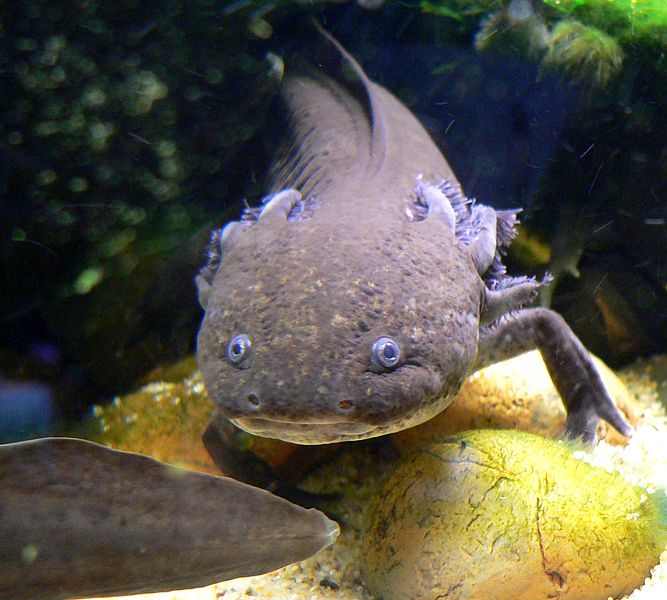
The axolotl (Ambystoma mexicanum), one of the top five contenders for world’s ugliest animal. Author: Stan Shebs. Source: Wikimedia Commons
Two of UAPS’ top five, the axolotl and scrotum frog, are freshwater animals, and a tour of our own cabinet of curiosities reveals such aesthetically challenged species as the hairy frog, the sea lamprey, and the Goliath tiger fish.
But YouTube and blogs aren’t the only places where the not-so-charismatic are finding their way into the spotlight. Mara Grunbaum, author of the Tumblr WTF, Evolution? also focuses on nature’s more curious creations. Featuring snappy commentary and hilarious, sometimes gruesome imagery, Grunbaum’s posts poke fun at the bizarre twists some species have taken on their adaptive journeys, with freshwater examples like softshell turtles (“Look, evolution, everyone has trouble staying motivated sometimes”) and the necrophilic frog Rhinella proboscidea. While her Tumblr mainly aims to entertain, links to further information allow the curious to dig deeper. The project has gone viral on the internet, with plans for a book underway. Grunbaum, who started the Tumblr to amuse fellow science journalists, says, “It just took off, a lot more than I expected or planned for.”
Why are these strange species so fascinating? Grunbaum says part of the lure is in discovering the unexpected, knowing something “completely crazy” exists out there. For Watt, drawing attention to lesser-known species is both an urgent need and an opportunity to engage a new audience. With more species going extinct all the time, he says, conservation needs to broaden its outlook. “The kind of person who’s going to be interested in the panda is already interested in the panda. We’ve been drilling the same vein for a hundred years now.”
From YouTube videos and blogs to Twitter and the image-focused Tumblr, the Internet’s media arsenal allows these quirky biological treasures to rise to fame, fast. But the big question is whether interest translates into action. Watt says that he’s already seeing impacts from the UAPS campaigns – he’s heard from US schoolchildren writing rap songs about ugly animals as well as newly inspired PhD students.
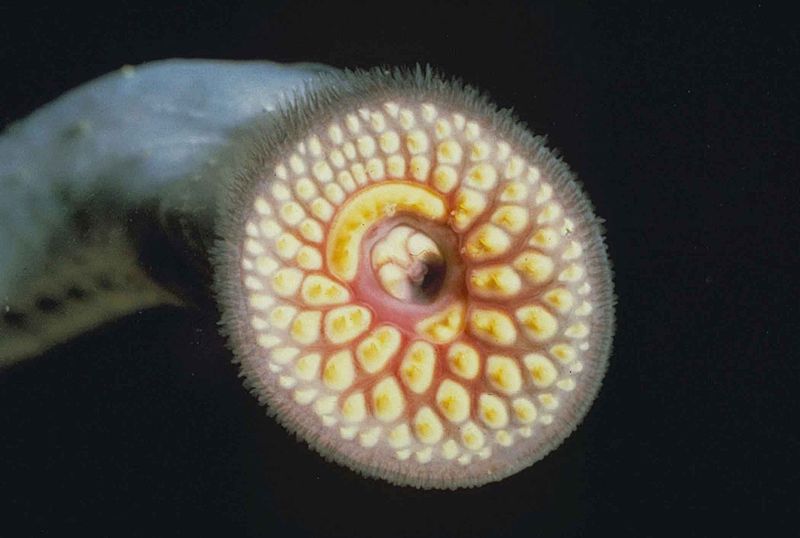
More yuck factor than cute factor? A sea lamprey (Petromyzon marinus) up close. © US Fish and Wildlife Service. Source: Wikimedia Commons
Perhaps, though, the greatest appeal of the blobfish is that it gives us reason to laugh. “If you are interested in conservation, you are basically condemning yourself to be depressed,” says Watt. Will celebrating the humor in these species help energize conservation? According to Grunbaum, part of the appeal is in being able to relate, knowing that not every animal out there is a graceful, perfect product of adaptation. She says, “We’ve all had awkward, awkward times in our lives.”
If that’s the case, perhaps promoting the weird side of biodiversity can work especially well for freshwater conservation. It’s rare to see freshwater species winning points for beauty, but we can showcase the wealth of freshwater species that are bizarre enough to pique the public’s interest. What do you think? Post a comment and propose your candidates for the ugliest freshwater species!
Structuring the biodiversity informatics community: the recent Horizons 2013 conference
In beautiful September weather, the European biodiversity informatics community, met in Rome for a three day conference to assess the state of the art and develop a strategy to engage constructively with Horizon 2020. The BIH 2013 was a significant step towards realising the Commission’s wish that consortia formation becomes more collaborative and less competitive.
BioFresh contributed to discussions in a number of ways: Aaike De Wever chaired a session titled “the who and the where”, each break Astrid Schmidt-Kloiber demonstrated our new information platform and Paul Jepson talked on BioFresh experiences with data mobilisation and presented a schematic to aid thinking on informatics futures.

Dr Schmidt-Kloiber demonstrating the BioFresh Platform at BIH2013
The conference concluded by stating the goal of biodiversity informatics as “delivering predictive modelling for biodiversity”. It was agreed that the community must move beyond digitizing things and start asking specific and applied questions. In the shorter term, the conference agreed the need to improve clarity of vision with greater focus on end-goals, to develop good, simple tools with syntactic operability, to build the identify of the biodiversity informatics community and to strengthen links. Summarised with the words: integration, co-operation, promotion.
The need to strengthen links referred to links with people, other disciplines and sectors as well as machines. Drawing on BioFresh experiences, we argued that data mobilisation must not be seen solely as a technological and resourcing challenge but also as a process with complex science sociology and cultural dimensions. We suggested a more personalised approach to building relations with data holders drawing on insights from fund-raising and lobbying colleagues. Paul Jepson also flagged how speakers were referring to policy in very general terms and commented that links in this area would be enhanced by engaging academics with disciplinary expertise in environmental governance, policy and politics. He also argued for a more expansive notion of informatics and one that more explicitly engaged with developments in automated sensing and mobile (citizen science) technologies. Click here to view our powerpoint presentation.

(c) P. Jepson Extended Vision of Biodiversity Informatics. Sept 2013
The conference organisers, Dave Roberts and Alex Hardisty have set up a mail list for the their white paper on biodiversity informatics published earlier this year which interested parties can ask to join. In addition that individuals can register their research group on the H2020 webpage if they are interested in becoming involved in consortia responding to future EU research and networking calls. A fuller summary of the conference will be published on this site in due course.
Here are some key papers and reports
Hardisty, A., Roberts, D. & The Biodiversity Informatics Community. (2013). A decadal view of biodiversity informatics: challenges and priorities. BMC Ecology 13, 16
Hobern, D., Apostolico, A., Arnaud, E., Bello, J. C., Canhos, D., Dubois, G., Field, D., García, E. A., Hardisty, A., et al. (2013). Global Biodiversity Informatics Outlook: Delivering Biodiversity Knowledge in the Information Age. GBIF Secretariat.
European Commission. (2013). Towards a Roadmap for Biodiversity and Ecosystem research in Europe. Workshop, Brussels.
Hardisty, A. (2012). Comparison of Technical Basis of Biodiversity e-Infrastructures. , Coordination of Research e-Infrastructures Activities Toward an International Virtual Environment for Biodiversity. Cardiff University.
Purves, D., Scharlemann, J. P. W., Harfoot, M., Newbold, T., Tittensor, D. P., Hutton, J. & Emmott, S. (2013). Ecosystems: Time to model all life on Earth. Nature 493, 295–297. doi:10.1038/493295a
Water funds: an “ideal” PES project – or better?
As payments for ecosystem services (PES) gain momentum, rules of “best practice” are also emerging. But how do these “ideals” for PES projects work on the ground, and what happens if you don’t follow them exactly? Rebecca Goldman-Benner and her colleagues at The Nature Conservancy ask precisely such questions in their 2012 Oryx paper,”Water funds and payments for ecosystem services: practice learns from theory and theory can learn from practice.” The group looks at South American water funds as examples to measure a theoretical PES project against the reality, and find that a little flexibility may not be a bad thing.

García Moreno street in the historic centre of Quito, Ecuador. The Andean city initiated South America’s first major water fund in 2000. Its Fondo para la Protección del Agua (FONAG) has become a model for the entire region. Source: Wikimedia Commons, Author: Cayambe.
The Latin American Water Funds Partnership, set up by The Nature Conservancy in partnership with FEMSA Foundation, the Inter-American Development Bank (IDB) and the Global Environment Facility (GEF), is launching 45 funds in various stages of development across the Caribbean and Latin America. The oldest, Quito’s Fondo para la Protección del Agua (FONAG), dates back to 2000. Although the structure has started to vary as the programs expand, the original projects in Ecuador and Colombia typically rely on an independently-governed trust fund. Downstream water users such as cities, utilities, and industries pay into the fund, which then pays upstream landowners to use their land in a more eco-friendly way. Investments focus on maintaining a clean, reliable supply of water throughout the year, as well as protecting ecosystems around the watershed and securing alternative livelihoods for upstream residents. A trust fund structure has been suggested for other kinds of PES projects too – for example, as a model for the wildlife media (for more information, see the previous BioFresh post discussing the current Oryx forum on PES and the wildlife media).
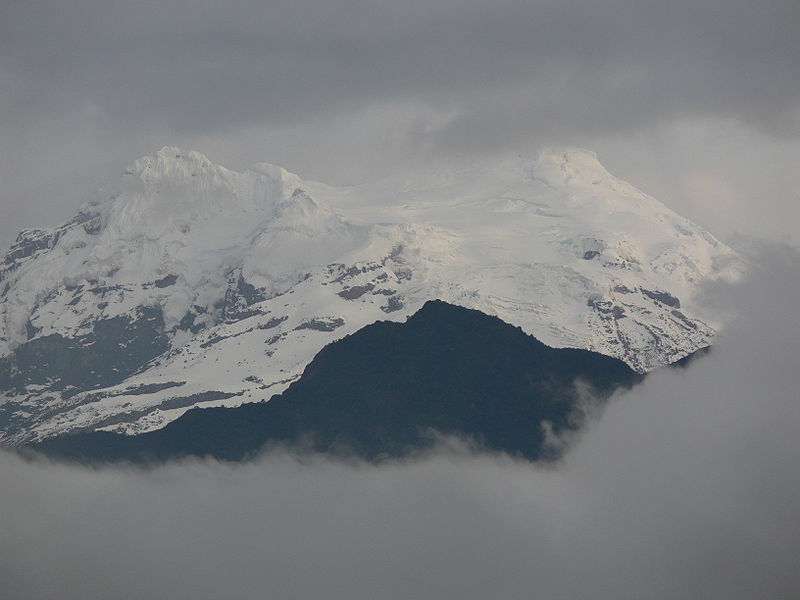
The Artisana reserve is part of the watershed for Quito. Source: Wikimedia Commons, Author: Author: Stefan Weigel.
Broadly speaking, this falls under the spirit of payments for ecosystem services. PES are supposed to convince landowners to manage their land in a way that promotes conservation and benefits others – for example, reducing fertilizer use in a sensitive watershed protects an ecosystem service (clean water supply) for everyone who uses that water. But this relies on two rules. First, the payments have to make the difference – they have to convince land managers to act in way that they wouldn’t otherwise. This is known as additionality. Secondly, the payments can only continue if the landowners in question provide the ecosystem service and then continue to protect it. This is called conditionality; in effect, making sure service “buyers” aren’t paying something for nothing.

Aerial view of the River Pirai in Bolivia, with Santa Cruz in the background. The Fundación Natura Bolivia has collaborated with departmental and municipal government to establish the water fund FONACRUZ. Source: Wikimedia Commons, Author: Sam Beebe.
In practice, water funds deviate somewhat from both of those rules. Additionality is very difficult to measure exactly, since it involves both putting a fixed price on a piece of land’s watershed value and figuring out what would have happened in a pretend future where the landowners weren’t paid to conserve. Also, a trust fund model means payments are usually made from the accumulated interest – this violates the conditionality rule, since you can’t just withdraw your money from the fund if you think the payments aren’t getting upstream landowners to conserve the watershed.
But Goldman-Benner and her colleagues claim that these departures from the strict PES definition may allow water funds to work better in the long term. Violating conditionality by using the interest from a trust fund rather than direct contributions keeps a sustainable source of financing for the project and protects the fund from political instability. It also gives the service users a reason to stay involved long-term. And targeting people who are more likely to conserve their land anyway (against the idea of additionality) may take advantage of “social diffusion” – the idea that if a small set of a population (sometimes as little as 15%) take up an initiative, then it may act to influence everyone else to do the same.
As more and more institutions move forward with payments for ecosystem services, from the World Bank to the UK government to NGOs like WWF, the tendency may be for an ever-more-standardized definition of PES. Goldman-Benner and her colleagues say that staying flexible about what constitutes a PES project allows for creative approaches that fit local realities, not just international ideals. However, Goldman-Benner argues that it is also critical to measure true return on investment from the water funds. “We need to not just show we are paying for keeping cows out of waterways, but that by doing so we are providing water with less sediment at a scale that matters,” she says.
Read other articles in our Special Feature on Freshwater Biodiversity and Ecosystem Services
Goldman-Benner, R.L. et al., 2012. Water funds and payments for ecosystem services: practice learns from theory and theory can learn from practice. Oryx, 46(01), pp.55–63. Available at: http://www.journals.cambridge.org/abstract_S0030605311001050.
Cabinet of Curiosities: the walking catfish (Clarias batrachus)
Our new entry to the BioFresh Cabinet of Freshwater Curiosities is the remarkably destructive walking catfish.

Source: eol.org. © CAFS
It breathes air, eats practically anything, and “walks” using its pectoral fins, wriggling along as it searches for water. It’s the walking catfish, and its bizarre lifestyle makes it both fascinating and disastrous for freshwater ecosystems.
A native to southeastern Asia, the catfish has been introduced around the globe, including the UK and the US, where in Florida it has been recorded coming up from sewers in schools of 30 fish and going for a waddle down the street. According to George Monbiot, who’s included the fish in his book Feral: Searching for Enchantment on the Edges of Rewilding, it eats “anything that moves,” and it’s especially dangerous because it can walk to isolated pools that other invaders can’t reach. It poses a particular threat to fish farms, eating its way through millions in valuable stock. The catfish spread rapidly through Florida in the 1960s and 70s, due in part to releases and escapes from aquariums, and it is now banned by several countries, although it can sometimes still be found in pet stores. Potential owners are warned to keep the walking catfish in a secure aquarium, so that it doesn’t just squirm away. Check it out among the other amazing creatures in Biofresh’s Cabinet of Freshwater Curiosities!
Perspective: Should the wildlife media pay for ecosystem services?
![By Kloer Phil, U.S. Fish and Wildlife Service [Public domain], via Wikimedia Commons](https://freshwaterblog.net/wp-content/uploads/2013/09/film_tv_crew_in_wildlife_show.jpg?w=728)
By Kloer Phil, U.S. Fish and Wildlife Service [Public domain], via Wikimedia Commons
The logic of Payments for Ecosystem Services (PES) proposes that companies that utilize ecosystem services in the production of their goods (termed service buyers) should pay a fee to those who manage or maintain the relevant aspects of the ecosystem (services providers). The Catskills Watershed is a famous example of PES in action.
In December 2012 some colleagues and I published a thought-piece in Science asking whether the logic of PES could be extended to media corporations who produce natural history content and are therefore users of ecosystem services. Our aim was to prompt discussion on the boundaries of PES approaches: in what cases are they appropriate/inappropriate?
To this end we outlined a possible PES scheme for media corporations that blends certification and a trust fund model. In brief, the idea is that a consortium (maybe of NGOs) would established a certification scheme for natural history content whereby certified broadcasters would pay a royalty into a trust fund (similar to that used in water funds, see Goldman-Benner et al 2012) and include an interactive facility whereby viewers could find out about, and donate to, relevant conservation projects. The trust fund would be independently administered and finance conservation initiatives based on transparent priorities.
Today Oryx has published a forum which takes up this discussion. Sven Wunder (who produced the most widely accepted definition of PES – see Wunder 2007) and Doug Sheil argue against the notion. In a nutshell they argue a) that this level of innovation with the PES concept would undermine its utility and b) that the wildlife media contributes to conservation in many and varied ways and increasing the production fees of natural history films would be counter-productive.
 For me debating the question of whether the wildlife media should embrace PES also helps interrogate and unpack the concept of ‘cultural’ ecosystem services and in particular whether they can be valued in economic or market terms, Our discussion on the wildlife media raises the interesting point that cultural ecosystem services are in fact co-produced by companies, publics and nature. As a result the distinction between service buyer and service provider is blurred and transaction value likely impossible to ascertain
In her video post Professor Strang commented that ‘the concept of cultural ecosystem services misses the point of culture’ and I tend to agree.
Paul Jepson
Forum Articles
To facilitate this discussion the journal Oryx and Cambridge University Press have kindly made the forum articles open access for 3 weeks. Our Science forum article can be accessed via my university web-page
Jepson, P., Jennings, S., Jones, K.E., & T. Hodgetts (2012) Entertainment Value: should the media pay for conservation? Science, 334(6061): 1351-135
Wunder, S. & D. Sheil (2013) On taxing wildlife films and exposure to nature
Jepson, P & S. Jennings (2013) Should the wildlife media pay for conservation? A Response to Wunder & Sheil
Wunder, S. & D. Sheil (2013) Wildlife film fees: a reply to Jepson & Jennings
Other papers
Goldman-Benner et al 2012 Water Funds and Payments for Ecosystem services: practice learns from theory and theory learns from practice Oryx 46:55.
Wunder, S (2007) The efficiency of payments for ecosystem servcies in tropical conservation. Conservation Biology 21, 48-58
Read other articles in our Special Feature on Freshwater Biodiversity and Ecosystem Services
 This quest post by Kevin Smith of the IUCN Global Species Programme responds to Susanne Schmitt’s request for information to strengthen the freshwater arguments of WWF’s Campaign to keep oil exploration out of the Virunga World Heritage Site.
Dr. Susanne Schmitt recently wrote for this blog, describing how WWF are campaigning for SOCO International, who own oil exploration licence for ‘Block V’ which covers a large part of the Virunga National Park and Lake Edward, to stay outside the park boundaries. WWF have highlighted the high biodiversity value of the lake, and others in the region, but it is often hard to find a central data resource with information on the biodiversity present (other than birds and mammals) – as would be needed in support of any Environmental Impact Assessment conducted.
IUCN, through its work on freshwater biodiversity assessments in Africa (including all species of fishes, molluscs, dragonflies, and crabs), has however, made large amounts of data freely available to help inform decision making processes such as these. Our data can be accessed in a number of ways, from the online ESRI powered ‘Freshwater Biodiversity Browser’ (Figure 1) which lets the user query any sub-catchment in Africa to identify which species of fish, mollusc, dragonfly, crab or aquatic plant is found within it, or with a smart phone using the ESRI Arc GIS app* (Figure 2). The app is the same as the desktop version but allows field workers to use their location (through gps on the smart phone) to query what freshwater biodiversity may be in the sub-catchment they are standing in. The species data all links back to the IUCN Red List, where you can find out more information on the conservation status of the species, and download the species distribution data.

Figure 1. IUCN Freshwater Biodiversity Browser (African freshwater species so far), allows the user to identify what species (with information on Red List status, utilisation, threats etc) are in every sub-catchment across Africa.
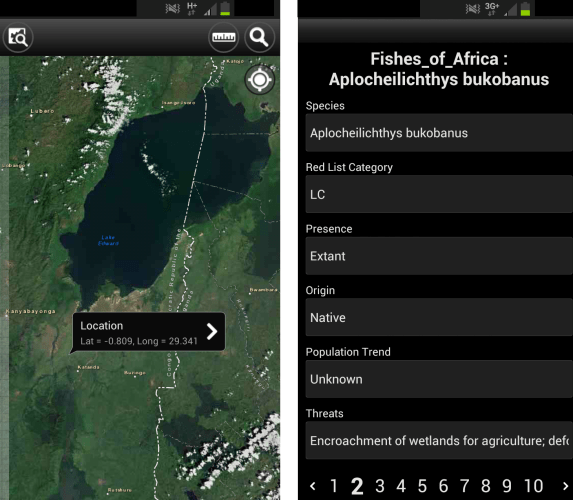
Figure 2. Freshwater Biodiversity Browser, allows the user to identify what species are in the sub-catchment they are located in the field.
Of the approximately 80 fish taxa in Lake Edward and the closely connected Lake George, the majority are from the family Cichlidae (including haplochromines) most of which are found nowhere else in the world (Snoeks 2000) and so are effectively “irreplaceable”. Using data from the IUCN Red List assessments along with their range information the distribution of threatened species within the immediate Lake Edward and George basin can be shown (Figure 3). Currently there are no globally threatened fish species within Lake Edward, or within the Block V oil concession area, (at least at the time of the assessments in 2006!). The threatened species of the basin are found in the Ruwenzori river systems or within Lake George and the Kazinga Channel. These species are primarily threatened by pollution from mining activities. However, the high levels of endemicity within Lake Edward cannot be ignored (Figure 2). The species flock of Lake Edward may not yet be threatened, but any impacts in the future to Lake Edward, or its upstream catchment (covering almost the entire ‘Block V’ area) would more than likely impact those endemic (irreplaceable) species possibly causing them to classified as threatened or even extinct.

Figure 3. The number of threatened freshwater fish species in the immediate Lakes Edward and George basin

Figure 4. The number of freshwater fish species endemic to the immediate Lakes Edward and George basin
The impacts to freshwater biodiversity itself, although very important, is not the only aspect that need to be considered when assessing the likely impacts of development upon freshwater systems. The links between biodiversity and ecosystem services need to be identified and considered, even if this is only possible for the most the obvious services (provisioning e.g. food). There are many other fish species within Lake Edward and its basin that are not endemic but play a crucial role in human livelihoods and food security. A recent IUCN study on the values of freshwater fish of Africa’s Albertine Rift (which uses the Red List assessments), found that 60% of fish species within the wider Albertine Rift lakes are important for human use primarily as either food, or for the aquarium trade (Carr et al. 2013). The report also noted that fishing not only provides the cheapest source of animal protein, it is a major source of income for those living near water bodies in Uganda and the DRC (Lakes Albert and Edward), and particularly for the most destitute of people (ADF 2003). However there are indications that fish populations are declining, for example, people living around Lake Edward [in the DRC] have begun cultivating crops to lessen the impact of declining fish stocks (Alinovi et al. 2007).
We therefore need to make informed decisions regarding the future of any development within the Lake Edward basin (not just the Virunga National Park), and this needs to adequately incorporate any potential impacts to biodiversity and human society, it cannot just be based on the profits and dollar ‘benefits’ from the development. The age old excuse of “but there is no information to do this…” is no longer valid for Africa. However, there are many similar developments planned throughout the world and it is all the more important that such data are made available for the globe’s freshwater ecosystems. Unfortunately, it is currently unavailable for more than 50% of the world’s wetlands and a lack of funding is hindering efforts to fill this information gap. We can’t expect to have sustainable development if there is no baseline information set on freshwater biodiversity. We can broker deals, improve governance structures etc. but all needs to be underpinned by sound information on the biodiversity that enables these ecosystems to function sustainably.
All of IUCN’s freshwater biodiversity data (see the Biomatrix), including datasets produced as part of our participation in the Biofresh Project such as global freshwater shrimp assessments, New Zealand freshwater biodiversity assessment, and global freshwater turtle distributions will be included in the Biofresh Freshwater Biodiversity Atlas along with other non-biodiversity freshwater related data.
For more information on IUCNs work on freshwater biodiversity contact – Kevin Smith (Kevin.Smith@iucn.org) or William Darwall (William.Darwall@iucn.org)
*note: search for ‘Freshwater Biodiversity Browser’ within the ESRI App
References
ADF (2003) Multinational. Democratic Republic of Congo and Uganda. Lakes Edward and Albert Fisheries (LEAF) Pilot Project. Nile Equatorial Lake Subsidiary Action Program (NELSAP). Nile Basin Initiative. Agriculture and Rural Development Department.
Alinovi, L., Hemrich, G. and Russo, L. (2007) Addressing Food Insecurity in Fragile States: Case Studies from the Democratic Republic of the Congo, Somalia and Sudan.
Carr, J.A., Outhwaite, W.E., Goodman, G.L., Oldfield, T.E.E. and Foden, W.B. 2013. Vital but vulnerable: Climate change vulnerability and human use of wildlife in Africa’s Albertine Rift. Occasional Paper of the IUCN Species Survival Commission No. 48. IUCN, Gland, Switzerland and Cambridge, UK. xii + 224pp.
Snoeks, J. (2000) How well known is the ichthyodiversity of the large East African Lakes? Advances in Ecological Research 31: 553–565.
On the clock: new technique improves precision of extinction predictions by giving a timeframe
 The Salt Creek pupfish, found in Death Valley National Park in California. A new BioFresh study predicts the Death Valley river basin may lose one or more of its few fish species to climate change within the century. Source: Encyclopedia of Life. Author: Jason Minshull
Predicting which species will be the casualties of climate change is a challenging task – but forecasting extinctions within a policy-relevant interval is even more difficult. Studies often use habitat loss to predict how many species will go extinct, but not how long that process will take. An important new BioFresh study lead by Pablo Tedesco and colleagues and reported in the Journal of Applied Ecology tackles this problem head-on. By building a modelling technique that predicts riverine fish extinctions by 2090, the study develops a meaningful timeframe for policy. A key finding is that climate change may have little effect in most rivers in the next 80 years, especially when compared to other anthropogenic impacts.
To develop effective actions and targets, policymakers need information about extinction threats within a relevant time-scale: the time between prediction and extinction represents a “window of opportunity” where species may still be saved. The EU’s Biodiversity Strategy to 2020 specifically aims to reverse biodiversity loss, as does Aichi Target 12 under the Convention on Biological Diversity, which calls for preventing the extinction of known threatened species. Good planning also means figuring out which threats are the most urgent.
To determine how climate change drives extinctions, researchers have relied on the so-called “species-area relationship” – the greater the area, the more species will be found there. By estimating how much of a particular habitat area will become unsuitable due to climate change, scientists can predict how many species will also eventually disappear. But the time lag can range from decades to millennia, which limits its usefulness for policy. BioFresh partners Pablo Tedesco and his colleagues, however, build on previous work that calculates the relationship between area and true extinction rates. They use that relationship to estimate how habitat loss from climate change will change extinction rates in over 90,000 river drainage basins worldwide, and then predict how many species will be threatened with extinction in a smaller set of the rivers by the year 2090.
The good news for fish is that overall, these new models predict that even under a “pessimistic” climate change model, less than one-quarter of the drainage basins should lose habitat. On average, those basins that do are predicted to have around a 24% higher extinction rate. The effects should concentrate in arid, semi-arid, and Mediterranean climates, especially in the southwest USA, Mexico, southern America, northeast Brazil, northern and southern Africa, southern Europe, western and middle Asia, and Australia. Using actual species numbers, the study found that only 20 out of 1,010 basins would lose species by the year 2090, with the number of species lost ranging from 1 to 5.
 Extinction rates in Western Australia’s Robe river basin are predicted to accelerate by over 340%, translating to about two species in the next 80 years, as the river loses water to climate change. Source: Wikimedia Commons. Author: SyntaxTerror
These findings give climate change a much smaller role in driving extinctions than in other studies – particularly when compared to other anthropogenic pressures. In Central and North America, human impacts have driven 47 species extinct over the last century in 20 river basins, a rate 130 times greater than that predicted for climate change.
Although Tedesco and his colleagues point out that other effects of climate change could also drive extinctions, such as rising water temperatures or changing seasonal variability and extreme events, they stress that ongoing factors such as habitat degradation, overexploitation, eutrophication and invasive species are more pressing. Such immediate issues feature prominently in existing international and national policy; for example, a dedicated legislative instrument on invasive alien species is due to be adopted this year under the EU Biodiversity Strategy. “There still is a chance to counteract current and future fish species loss [by] focusing conservation actions on the other important anthropogenic threats generating ongoing extinctions in rivers,” comments Tedesco.
*Tedesco PA, Oberdorff T, Cornu JF, Beauchard O, Brosse S, Dürr HH, Grenouillet G, Leprieur F, Tisseuil C, Zaiss R & Hugueny B (2013). A scenario for impacts of water availability loss due to climate change on riverine fish extinction rates. Journal of Applied Ecology (online).
Does ecosystem services need a radical critique? In conversation with Prof Veronica Strang
After Veronica Strang presented her insights on bioethics developed through ‘thinking with water’ (see last post), I discussed with her the relevance of her thinking to policy and on-going discussions on the ecosystem services framework.
Several of Veronica’s points have stuck with me. One was her comment that we see ourselves as rational beings, yet in Ecosystem Services we are adopting a policy frame that places humans outside systems and this seems irrational! A second was her reflection that ‘if you reframe cultural meaning as an ecosystem service it is sort of missing the point of culture!”
I am sure you will find this video conversation with Veronica thought provoking and challenging. It reinforces my view that the ecosystem services policy frame would benefit from a radical and multi-disciplinary academic critique. Please share you thoughts and reflections on the issues raised with other readers of this blog via the comments box.
Read other articles in our Special Feature on Freshwater Biodiversity and Ecosystem Services
Professor Veronica Strang: Thinking with Water
The EC funds BioFresh to strengthen the scientific basis of policies intended to conserve biodiversity. Increasingly our science – the questions, analysis and communication of our findings – need to be aligned with the Ecosystem Services Framework. Demonstrating links between freshwater biodiversity and ecosystem services requires sophisticated and multi-scalar understandings of freshwater ecosystem processes and function, something that may be beyond current scientific capacity. Reflecting this situation, I have heard several BioFresh colleagues express concern that the ESF marginalises the ethical basis of policies linked to freshwater biodiversity.
It was for this reason that I asked Martin Sharman to contribute his perspective on the Ethics and Ecosystem Services. His post is already No4 in the BioFresh rankings of most viewed posts: it promoted a rich discussion on the LinkedIn Biodiversity Professionals group. There is clearly a desire to discuss ethics!
A little while ago, while herding my children out to school, I caught on the radio the phrase “water is good to think through a new bioethics”. The lady talking was Professor Veronica Strang, Director of the Institute of Advanced Study at the University of Durham. Veronica kindly agree to share her thinking with us in this video presentation. Her fascinating and deep insight adds a cultural anthropology perspective to the discussion initiated by Martin and bears direct relevance to the issue of oil exploration in Lake Edward/Virunga National Park introduced by Susanne Schmitt.
Please post your reactions to Veronica’s video presentation in the comments box and discuss with others.
Read other articles in our Special Feature on Freshwater Biodiversity and Ecosystem Services