Top posts of 2024

In these early days of 2025 we continue our annual tradition of looking back at our top posts from the previous year.
Freshwater issues were at the heart of many of the big environmental issues of 2024. In Europe, the need for ambitious ecological restoration was enshrined in policy through the adoption of the EU Nature Restoration Law. Across the continent, the effects of extreme floods and droughts were increasingly felt, signalling the urgent need for environmental restoration to help support the lives of both people and nature.
2024 also saw the ongoing rise of nature-based solutions to help tackle such major issues. Nature-based solutions – which harness the potential of natural processes in environmental management – are increasingly being used across river, stream, lake and peatland restoration, both in Europe and globally.
The EU MERLIN project was a hive of activity, as its learning Academy and Marketplace were launched, alongside a raft of policy briefings and reports. Our MERLIN podcast featured a range of ‘behind the scenes’ glimpses into this work to help bring Europe’s freshwaters back to life, including stream restoration in Portugal and the restoration of the Danube River in Austria.
And now looking forward to 2025, we want to say a big thank you to you, our readers and listeners, for your eyes and ears. We appreciate your support, and are always happy to hear your thoughts and ideas, whether by email or on our social media platforms.
///
Can European agriculture be economically viable and environmentally friendly? (February)

The relationship between agriculture and the environment is a hot topic in Europe right now. In recent months farmers across the continent have been protesting to highlight a system they see as increasingly unprofitable and burdened by EU rules aimed at making the bloc climate-neutral by 2050. Farmers have organised motorway and city blockades in tractors across Greece, Germany, Portugal, Poland and France, and last week pelted the European Parliament in Brussels with eggs.
A new study explores how the impacts of different agricultural approaches across Europe affect the ecological health of rivers and streams across the continent. A research team led by Dr. Christian Schürings from UDE in Germany analysed data on agricultural land use across 27 European countries. Writing in Water Research, the researchers then linked this analysis to data on the ecological status of flowing waters across the continent, from small streams to huge rivers like the Ruhr and Rhine. (read more)
///
Can the EU Nature Restoration Law help make Europe’s rivers flow more freely? (March)
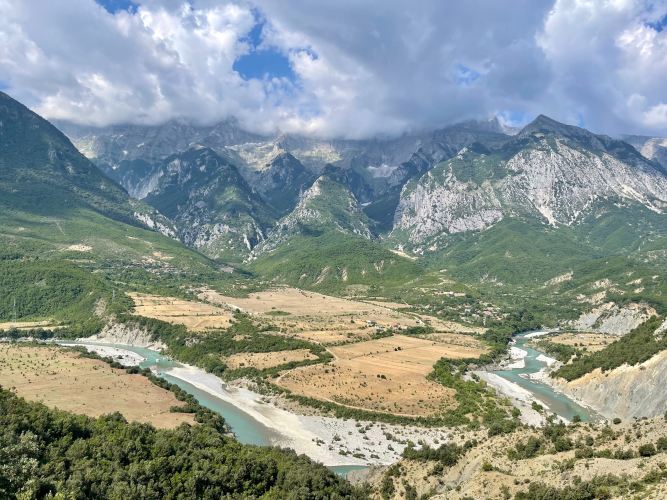
After months of debate and revisions the EU Nature Restoration Law was approved by the European Parliament in late February. The law represents an ambitious step towards restoring Europe’s depleted ecosystems, requiring EU countries to restore at least 20% of their land and sea by 2030, and all ecosystems in need of restoration by 2050.
The EU Nature Restoration Law is a significant response to the fact that over 80% of European habitats are in poor condition and in need of restoration. Moreover, it foregrounds the vital roles that nature plays in supporting our lives, whether through food security, flood protection or water supplies. On a continent increasingly stressed by the effects of the climate emergency and economic crisis, it offers a hopeful vision of fostering more sustainable and resilient societies and economies in the future. (read more)
///
Ringing the doorbell to help fish migration in the Netherlands (April)

It’s well known that barriers to fish migration are a major issue in rivers across Europe. An innovative scheme in the Netherlands has harnessed the power of online citizen scientists to alert ecologists in Utrecht when fish are congregating behind a boat lock between the rivers Kromme Rhine and Vecht.
Visitors to the ‘fish doorbell’ website can then press a button to tell the lock keeper to open the gate to allow the fish through. This scheme – which allows fish such as carp, bream and eels to move upstream and avoid predators such as grebes and cormorants – has been extremely popular, with over a million visitors this year alone. (read more)
///
Global migratory fish populations have declined by 81% since 1970: but river restoration projects offer hope (May)

Global migratory fish populations have declined by 81% since 1970, according to a major new report released last week. This startling decline has been documented in freshwaters across the world, with particular severity in Europe, Latin America and the Caribbean.
The new Living Planet Index for Migratory Freshwater Fishes states that the downward trend in migratory fish populations represents an annual decline of 3.3%, and is largely the result of habitat degradation and loss coupled with human over-exploitation. The report cites that a key driver of migratory fish declines is the fragmentation of rivers and the blockage of migration routes due to dams, weirs and other barriers. (read more)
///
The MERLIN Academy: a new open-access learning and resources hub for freshwater restoration (July)

The EU MERLIN project has launched its new online Academy, a hub for cutting-edge learning, resources, webinars and podcasts around freshwater restoration. The open-access Academy is designed to help support practitioners, students and policy makers in mainstreaming freshwater restoration, both in Europe and globally.
Visitors to the MERLIN Academy can sign up to a series of Learning Modules for free. The first public Module covers the economics and financing of freshwater restoration in a series of videos featuring experts on the topic, along with a series of worksheets and quizzes. (read more)
///
Making the Seine swimmable for the Paris Olympics (August)

This summer’s Olympic Games in Paris saw swimmers compete in the River Seine, a waterway that had been closed to public bathers for more than a century due to high levels of water pollution.
The Seine, which flows 481 miles from Burgundy to the sea in Normandy, has long defined the architecture and culture of Paris. However, before this summer, centuries of domestic and industrial wastewater coupled with Paris’s complex and antiquated sewage system had made the river highly polluted and unsafe to swim in. (read more)
///
Restoring Europe’s landscapes to tackle the effects of the climate emergency (September)

Devastating flooding has killed at least 24 people as more than five times the average monthly rainfall for September has fallen across Austria, the Czech Republic, Hungary, Poland, Romania and Slovakia in the past week. At the same time, the Portuguese government has declared a ‘state of calamity’ as wildfires have torn through forests across the north of the country.
Through these floods and wildfires, we are witnessing the effects of the climate emergency in action. “Make no mistake. This tragedy is not an anomaly. This is fast becoming the norm for our shared future,” the EU’s crisis management commissioner Janez Lenarčič told MEPs last week. “Europe is the fastest warming continent globally and is particularly vulnerable to extreme weather events.” (read more)
///
MERLIN Podcast EP.9 – Why community matters to freshwater restoration (October)

It’s increasingly recognised that restoring damaged ecosystems is not only about improving habitats for wildlife, it is also vital to consider the needs of the people who live and work in a restoration landscape.
In the new episode of the MERLIN podcast we hear stories about how community has been placed at the heart of freshwater restoration projects. We hear from Tal Marciano Ratner about how the restoration of the Tzipori watershed in Israel offers a meeting place for people from different religions and ethnicities to come together in a time of great unrest and conflict.
Ruben Rocha from Dam Removal Europe talks about the challenges of communicating the benefits of dam removal to local communities, and describes how he is beginning to see the demand for removal projects coming from communities themselves. Roland Bischof and Julia von Gönner from iDiv in Germany tell us about the innovative citizen science work in the FLOW project, where the public can help scientists generate valuable data about the health of their streams.
Robert Arlinghaus from IGB and Humboldt University in Germany describes his long-standing work with angling communities, outlining how a productive form of aquatic stewardship can emerge from their interactions with nature. Finally, María Sánchez from ECOLISE outlines how community-led initiatives across Europe are helping give people a stronger voice in shaping environmental restoration.
///
Notes from the water’s edge: how MERLIN is helping bring Europe’s freshwaters back to life (November)

Plans for environmental restoration are gathering pace across Europe as we move closer to the adoption of the EU Nature Restoration Law. This planning is supported by four major European projects which aim to develop new approaches to help restore the continent’s freshwaters, forests, wetlands and coastlines.
These four projects – MERLIN, SUPERB, WaterLANDS and REST-COAST – were funded by the EU’s big environmental policy, the Green Deal. As they all have around a year left to run, the four projects are rapidly producing guidance, tools and support to help environmental managers bring Europe’s environments back to life. (read more)
///
Signalling the path towards healthy freshwaters in Europe (December)

Europe’s freshwaters are under increasing pressure from human activities. For centuries, rivers, lakes, streams and wetlands across the continent have been altered, abstracted and polluted. And as floods and droughts across Europe intensify, we are seeing the real-time effects of climate change directly impacting both our freshwaters and our everyday lives.
In recent years there has been a groundswell of activity promoting freshwater conservation and restoration across the continent. Large EU projects like MERLIN and WaterLANDS are rigorously testing the potential of so-called ‘nature-based solutions’ to help restore rivers, streams and wetlands.
These topics are at the heart of a new report by the European Environment Agency (EEA). In Signals 2024, the EEA state that despite ongoing attempts to safeguard European freshwaters, urgent action is needed to safeguard water security and build resilience to every-growing pressures. (read more)
///
You can read all our 2024 articles here – happy 2025!
This article is supported by the MERLIN project.








 The Freshwater Blog
Comments are closed.