A reality of 21st century science is that publications and citations are key metrics used to evaluate the performance and impact of scientists. Until recently, there has been no incentive for work -pressured scientists (other than good will) to invest time in preparing their data sets so they can be shared and used by others. With the launch of journals specializing in the publication of data papers this looks set to change. Data papers, can perhaps be compared to those reporting a new taxon: they will have a standard format and users of the data set will cite the data paper in a similar manner to how scientists cite the authority (descriptor paper) when using a scientific name. In this way, scientists contributing data to the common scientific endeavor will gain a publication credit and the number of citations will provide a measure of the scientific value of the data.
 Lyubomir Penev of Pensoft Publishers has launched several innovative journals in biodiversity science, including an established infrastructure for publishing and dissemination of biodiversity data, and he kindly provided the following perspectives on the value and importance of data journals.
Biofresh Blog: What motivated you to launch a family of innovative journals for the publication and dissemination of biodiversity information?
Lyubomir Penev: The main motivation is perhaps that, as a biodiversity scientist, I have often been disappointed with the speed and manner with which conventional journals handle manuscripts and data. I was even more disappointed with the dissemination of published results, which are often hidden behind a pay-wall barrier with restrictions for copyright and use. Our journals build on three important pillars, namely open access, high-tech XML-based editorial workflow, and active dissemination of the results we publish for our authors.
BB: Why do you think scientists should make the effort to submit data papers: what’s in it for them?
LP: There are many benefits here and they are certainly not restricted to the authors of data papers alone. First, data collectors, managers and authors will be properly credited through a permanent scientific record, priority registration and citation of the data paper. Second, the extended metadata associated with a data set will be properly described and published in order to make data easy to share, use and re-use for others scientists. Sharing data will open new perspectives for collaboration with other scientific groups and institution. Last but not least, re-use of original and collated data sets will tremendously increase the efficiency of public funds investments in gathering all these data!
BB: To what extent do you think data journals will change the way we do Science?
LP: The change will be dramatic and extremely useful in my opinion. The appearance of new data visualization and analysing tools will lead to an ever increasing interest in inter-operability and collation of data with compatible data gathered by other groups. This should provide exciting new views and produce better proven scientific results.
The titles of journals in the Pensoft family include ZooKeys (systematic zoology, phylogeny and biogeography), PhytoKeys (systematic botany), NeoBiota (alien species), and Nature Conservation. A similar initiative is Dataset Papers in Ecology.
Saving Biodiversity Data
With the strap-line ‘Biodiversity Needs Data’, reBIND is a fantastic new initiative of the Botanic Gardens and Museum in Berlin funded by the German Research Foundation (DFG) that responds to the reality that many scientists collate valuable biodiversity datasets which are then stored on their personal hard-drives or archived on media which become out of date (remember Zip drives!). As a result, important ‘legacy’ data sets are being lost, or at risk of being lost, as scientists retire, change office or clear out their lofts.
The aim of reBIND is simple: to provide the tools to integrate isolated databases into an institutional data curation strategy. To this end, the reBIND team is developing workflows that combine software tools for transforming data stored in outdated database systems into well-documented, standardized, and commonly understood XML-formats with a system for storing, documenting, and publishing the information as a web service.
It’s a neat idea and wonderfully explained in this innovative and engaging video.
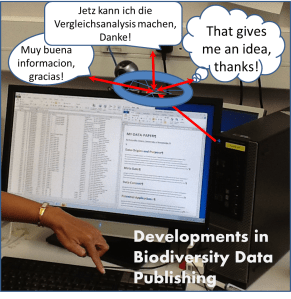 Knowledge on the status and distribution of biodiversity is fundamental both to the delivery of key conservation conventions and the development of effective policy planning and management. Unfortunately the temporal and spatial resolution of available biodiversity data currently falls well short of what is needed. This data shortfall is constraining the ability of conservation science and management to effectively embrace important concepts of adaptive management, subsidiarity, participation as well as big new policy frames such as the ecosystem approach.
BioFresh is part of a wider scientific endeavor working to improve geographic databases on the distribution of biodiversity on Earth. This involves creating a new digital architecture of data platforms and portals to pull together and make accessible biodiversity data-sets languishing on servers in research institutes and on the hard-drives of people’s personal computers. Needless to say achieving this vision is not exactly a walk in the park! In an earlier Special Feature on Assembling the Freshwater Database, BioFresh scientist, Aaike De Wever introduced the challenges involved in setting up a system of interoperable databases and explained some key terminology: metadata, inter-calibration and so forth. In this special feature we continue this theme by presenting an overview of some important, and we think exciting, advances in data publication.
Over the next 3 weeks we will run the following series of posts reporting on important new developments, new projects, and explaining terms. If you think there are other important aspects of data publishing that we should cover please let us know. We also invite you to add your comments to amplify and extend each post so as to make this special feature as useful as possible.
We hope that you will find this special feature interesting and would be grateful if you could let your colleagues and students know if its existence.
Paul Jepson & Aaike De Wever
Posts:
Saving Biodiversity Data, an introduction to the ReBIND project.
The Arrival of Data Journals including and interview with Lyubomir Penev of Pensoft Publishers.
Freshwater Journals Unite to Boost Primary Biodiversity Data Publication reports an important new agreement on data publishing.
What does a Data paper look like? outlines the structure and content of a typical data paper
Science made easier : Darwin Core explained introduces this important standard which is helping overcome key barriers to data publishing.
What is a digital object identifier? explores how this can be applied to data sets.
The effect of dams on fish biodiversity: A global view.
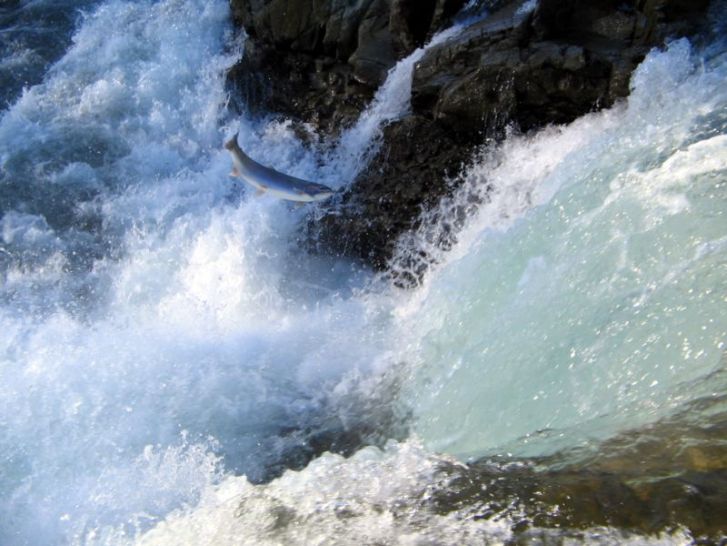
A salmon jumping up a waterfall in Canada. Diadramous fish species often face mortality or reproductive failure when their migratory route is obstructed by dams. Image: Jerome Charaoui.
The world is currently facing a freshwater biodiversity crisis and the key to preventing further extinction lies in understanding all the threats facing aquatic habitats. Global freshwater habitats are losing biodiversity faster than terrestrial or marine areas, but so far they are the least well understood. Amongst the threats to freshwater species, including climate change and pollution, the most difficult to quantify are man-made obstructions to water flow. Dams can be found in every major biosphere, but very little is known about the effect of river obstruction on freshwater biodiversity, especially on a global scale.
Damming a river has a variety of effects on the freshwater ecosystem, more than just altering the flow from A to B. Dams create calm bodies of water, changing overall temperature regimes and sediment transport, leading to conditions which tend to favour generalist species. Loss of specialist species, particularly endemics, changes the community structure and leads to biotic homogenization. A dam will withhold sediment in the reservoir, not just decreasing the amount of substrate available to local freshwater species, but even impacting diadromous, estuarine and marine species much further downstream. The competition between resident species for food and breeding sites will increase as damming isolates populations, and perhaps more importantly, damming completely restricts migratory fish species. Isolation may lead to decreases in genetic diversity and therefore puts species at greater risk from disease. All of these effects may be exacerbated by changes in the surrounding land use. Overall, damming river flow will lead to both a loss of native species, but also an increase in exotic species which are more likely to become established in degraded habitats. For this reason, dams are one of the greatest global threats to freshwater biodiversity.
A lack of data on global freshwater fish distributions has restricted a thorough investigation of the dam-related threats to fish species. However, a recent publication by Liermann et al maps global dam obstruction, identifying areas and taxa at risk of species loss. This is the first paper to quantify this in a manner which could be useful for future planning and management. Liermann et al quantify and map dam obstruction in all of the world’s main freshwater ecoregions (397). These are areas that contain geographically distinct groups of freshwater communities. This data was integrated with fish distribution data, particularly focussing on the numbers of obligate diadromous species (species demonstrating migratory behaviour between freshwater and marine habitats, such as the Salmonids) and ecoregional endemics. These species were used as a measure of potential species loss in relation to dam obstruction. The model also included an assessment of the difference between dam impact in an undisturbed landscape and the compounded effect of dams and land-use change. The distribution of areas predicted to be most affected by climate change were also compared with the distribution of the most heavily obstructed ecoregions.
Liermann et al produce the first comprehensive set of maps for highlighting habitat fragmentation by dam obstruction and the corresponding taxa and ecoregions most at risk of species loss. This information is vital for providing information needed to identify the freshwater systems most in need of protection. 18 ecoregions were identified for which less than 50% of the freshwater systems were free flowing. These areas include central and southern Iberia, the Mississippi, the Indus Basin, and the Murray Darling. Some of these areas also face high levels of landscape alteration. Liermann et al identify 8 ecoregions which may be facing the highest level of threats to species loss, but would therefore benefit the most from conservation and restoration projects. These ecoregions also have a high number of endemic and diadromous species, the loss of which would have effects on even global biodiversity! The study provides a gradient score for each ecoregion, from freshwater habitat restoration to conservation (at the least affected end). This will allow the global community to prioritize both management and research efforts for more efficient prevention of the current freshwater biodiversity loss.
This afternoon WWF, Greenpeace and key Brazilian organizations will be mounting a Twitter campaign to urge Brazil’s President Dilma Rousseff to veto the Forest Code Approved by Congress in April. The bill has been condemned by WWF on three key grounds: a) millions of acres forest illegally cleared prior to 2008 will be legalized through amnesty, b) landowners could be allowed to reduce the obligatory required forest cover from 80% to 50%, and c) large areas of floodplains and other sensitive areas will be opened to cattle ranching and farming. Writing in the Guardian, John Vidal reports that critics of the bill say it could lead to the loss of 220,000 square kilometres of Amazonian rainforest, an area close to the combined size of the UK and France.
As our small contribution to the debate, today we added the fantastic Arapaimas to the BioFresh Cabinet of Freshwater Curiosities. Guest curator, Daniel Gurdak, profiles these ancient, armored freshwater giants that ply the rivers and floodplains of the Amazon. The Arapaima’s, riverine habitats are susceptible to forest clearance and this group of river giants remind us that future generations may judge today’s decision makers harshly if incredible life forms like this are lost from the Earth.
 Arapaima sp. from Guyana. Image: D.J. Stewart[/caption]
More than 1.5 million people have already petitioned President Dilma and the number is expect to rise with this afternoon’s twitter campaign (#vetatudodilma #SOSBrazil) which is encouraging others to sign-up to the Avaaz petition

An adult male Ecnomiohyla rabborum, a species ravaged by chytridiomycosis in its native habitat. Image: Brian Gratwicke
A series of recent papers in Nature frame the key threats to amphibian species on the global scale. IUCN classifies 30% of all amphibian species as threatened and establishing the cause of this trend is pressing priority for conservation science.
Widespread declines in amphibian populations were first noticed in the 1980s. Habitat degradation through pollution, human land-use and climate change were initially identified as causal factors, but recent papers give more attention to the fungal disease chytridiomycosis. This is caused by Batrachochytrium dendrobatidis and occurs mainly in cooler regions, with varying virulence in different species. The disease was first discovered in amphibians in 1998 and is widespread: it is known to have caused local extinction in some frog species. A current chytridiomycosis global pandemic is underway and may be responsible for many species becoming critically endangered. However, little is known about the overall effects of these major threats (chytridiomycosis, climate change and habitat degradation) and how they could interact to further endanger the global amphibian population.
Hof et al publish a letter in Nature addressing the issue of understanding how the fungal disease pandemic, climate change and land-use change are affecting amphibians worldwide. In a model which takes into account the spatial distribution of these three threats, the interactions between them and the global distribution of all amphibian species, they predict that species in different regions will face varying levels of each threat, often not simultaneously. All three orders of amphibian were included in this model, frogs, salamanders and caecilians, and the outlook for all is fairly poor.
Hof et al predict that by 2080 over half of the species in tropical regions (with the greatest amphibian diversity) will be facing drastic declines due to both climate change and habitat degradation. The occurrence of chytridiomycosis will become more concentrated in temperate and mountainous areas. What is most worrying is that the spatial distribution of these declines is very widespread and not particularly overlapping. For example, amphibians in tropical areas such as Africa and South America will be most negatively impacted by climate change, but not so threatened by the disease pandemic. Overall, more than half of the total geographic distribution for frogs, salamanders and caecilians will be highly affected by the three main threats.
Our beleaguered amphibian species are facing accelerating rates of decline over the next few years, Hof et al predicting that the interaction of climate change, disease and habitat degradation is far more damaging than each threat alone. Amphibians can be found in almost every terrestrial habitat (apart from Polar Regions) and in some ecosystems are important apex predators. They also play an important role in linking terrestrial and freshwater habitats in both tropical and temperate zones. It is important that future conservation takes into account all threats to amphibian species before making decisions on how best to ameliorate population decline.

At this week’s 2012 Whitley Awards Ceremony two freshwater conservationists were among the eight winners. The Whitley Fund for Nature locates and recognizes the world’s most dynamic conservation leaders and support projects founded on good science, community involvement and pragmatism.
 Ir Bundioni was honored for his efforts to conserve Indonesia’s last population of freshwater Irrawaddy dolphins in the Mahakam River system. In 2000 Budi, founded the NGO Yayasan Konservasi RASI (YK-RASI) to protect endangered aquatic species and their habitats in Indonesia. They are working to established community-supported protected areas for the dolphins and their prey and deploying the dolphin as a flagship species to promote the adoption of less harmful fishing practices and the development of ecotourism and other alternative livelihoods.
 Carlos Vasquez Almazan, Curator of Herpetology at Guatamla’s National Museum of Natural History and Coordinator of the Amphibian Conservation Programme of Foundation for Eco-development and Conservation (FUNDAECO), was honored efforts to rally support for protection of the Sierra Caral cloud forest on the border of Guatemala and Honduras. Carlos has led amphibian surveys across Guatemala discovering new species and re-discovering others thought to be extinct. In so doing he has raised interest in the country’s diverse amphibian fauna. As a result, Guatemala’s first reserve for amphibian conservation, encompassing 2,300 hectares, and protecting five critically endangered species was declared in 2011.
The BioFresh Blog salutes the great work of Budi and Carlos and we wish them and their teams every success in the future.
A key output of BioFresh will be Climate Vulnerability Index (or CVI) for freshwater biodiversity. Jon David and Paul Jepson, at the University of Oxford, are leading on the design of this index. This will be the first index to explicitly consider the vulnerability of riverine biodiversity to climate change at a global scale. As such, the design process has involved returning to first principles and specifically settling on a definition of ‘vulnerability’ that is both quantifiable and ecologically meaningful at the global scale.
So what is vulnerability? There are many existing vulnerability indices that consider the potential impact of future climate change, but the vast majority of these focus on human livelihoods and infrastructure. In spite of this, the term ‘vulnerability’ is used to mean different things within these papers and often consists of different components. The International Panel on Climate Change (IPCC) currently defines ‘vulnerability’ as a function of ‘exposure’, ‘sensitivity’ and ‘adaptive capacity’. However, after much deliberation and consultation we have decided to externalise exposure from vulnerability for the reasons outlined below.
Our definition of ‘intrinsic vulnerability’ assesses the degree to which the persistence of a population is dependent upon the prevailing climate (sensitivity) and the capacity of a population to cope with future climate change (adaptive capacity) (see Figure 1). A great advantage of conceptualising vulnerability in this way is that it removes the need to use climate and hydrological models to forecast future changes (exposure), and shifts the analysis towards a trait-based approach. This is particularly desirable due to the lack of accurate and reliable future data at a sufficiently fine-scale resolution globally.
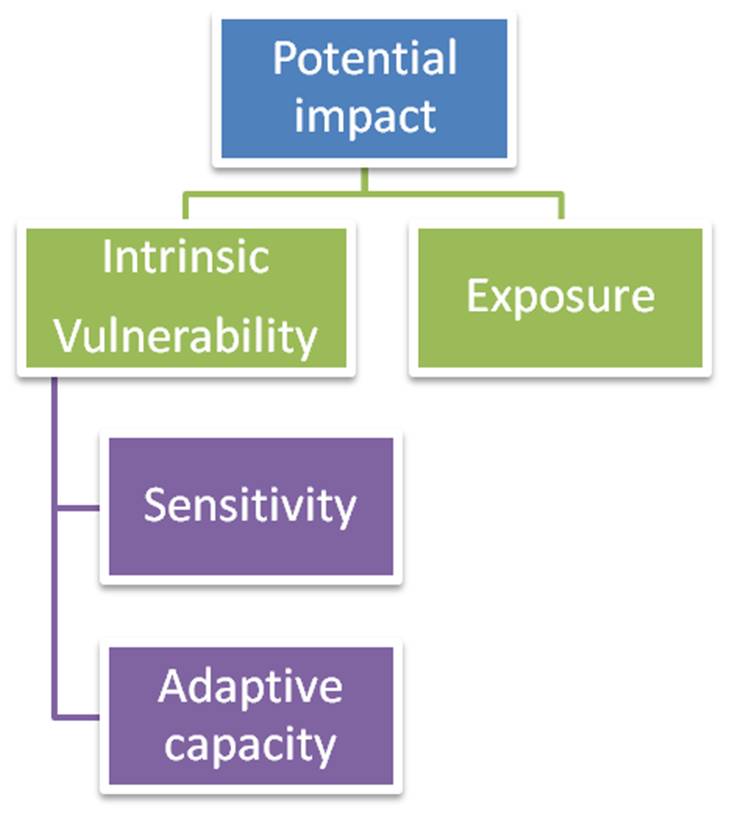
The significance between the IPCC definition of ‘vulnerability’ and our definition of ‘intrinsic vulnerability’ can be summed up clearly in the following analogy. An individual may be immunologically pre-disposed to contracting a specific disease (sensitivity) but live in a region where vaccinations against the disease are not available (adaptive capacity). However, the disease does not occur in the region that they live (exposure). Thus, if exposure is included as component of ‘vulnerability’ the individual would have a low vulnerability index score because they are not exposed to the disease. However, if exposure is externalised from vulnerability, the individual would score as highly vulnerable due to both their high sensitivity and low adaptive capacity. Furthermore, in a scenario where the individual were to come into contact with the disease (future exposure), this could be combined with their high intrinsic vulnerability to identify them as high risk to potential impact from the disease. In our view this latter approach of externalising exposure provides a more logical and robust vulnerability index that can be combined with various exposure scenarios generate spatial maps of potential threat impacts. This approach supports the idea that such indices should be designed as ‘plug-ins’, or informatics components, that can be utilised in a wide range of future applications.
The CVI also covers exciting new ground by including an ‘Institutional Adaptive Capacity’ component. This is an essential addition that is frequently left out of other global indices and brings a multi-disciplinary approach to this global index. Put simply, it recognises that freshwater life residing in ‘High Conservation Capacity’ regions (such as Western Europe, North America etc.) will be less vulnerable than that residing elsewhere because institutions and publics have more capacity to mobilise and form polices and management schemes that will aid climate adaptation.
It is our target to release a version 1.0 of the CVI in September 2012. The CVI makes use of the best global datasets available within the financial and time constraints of the project. As such, it is our vision that the CVI will be augmented and bettered as newer data becomes available. Next week’s blog post will consider how the CVI makes use of these global datasets and what scope there is for future development of the index.
From 27-30 March 35 Biofresh project members met at Merton College four days of discussions, presentations on on-going research and forward planning. Here Biofresh project leader, Prof Klement Tockner, provides his reflections on key outcomes of the meeting.
Meet the BioFresh team: Klement Tockner
We continue our series of articles giving a ‘behind the scenes’ look at the work carried out by BioFresh scientists this week with an interview with BioFresh project leader Klement Tockner who is the Director of the Leibniz-Institute of Freshwater Ecology & Inland Fisheries (IGB). The IGB is an independent and interdisciplinary research centre dedicated to the creation, dissemination, and application of knowledge about freshwater ecosystems. The Institutes three cross-cutting research domains focus on freshwater biodiversity, freshwater boundaries and linkages, and on human-ecosystem interactions.

1 What is the focus of your work for BioFresh, and why?
My key duty as coordinator of BioFresh is to lead, support, and integrate the various activities of the entire project. I would consider it as great success if BioFresh increases the awareness of the critical state of freshwater biodiversity, stimulates novel, innovative research directions, and supports the development of a new culture of data sharing.
Personally, I am working on floodplain systems, the most diverse, dynamic, and complex ecosystems globally. With respect to biodiversity they are as diverse as rainforests and coral reefs. A main focus of my research is to disentangle the complex linkages and feedbacks between hydrogeomorphic processes and biodiversity, and the consequences of biodiversity on ecosystem processes.
A side project that is very relevant for BioFresh is to build up a global data base on Biological Field Stations. At present, we include about 1500 stations in the data base; these stations form a global infrastructure and information network that is pivotal for long-term biodiversity research, education, and regional outreach activities.
I consider my work as a fundamental basis to develop strategies for managing river corridors as coupled socio-ecological landscapes, by integrating multiple natural ecological services with constructed services for increasing the total wealth provided by these ecosystems.
Today, most ecosystems have been comprehensively “domesticated”. They have been optimized for few ecosystem services that provide major economic benefit to humans, yet concurrently causing unforeseen changes in other ecosystem attributes. Thus, it is a key challenge in science and management to determine the extent to which the negative trade-offs of domestication can be avoided by changing the way ecosystems are managed. To have accurate data, as they will be provided through BioFresh, is the fundamental basis for the sustainable conservation of biodiversity.
3 Why is the BioFresh project important?
Most people are not aware about the disproportionately high biodiversity of freshwaters, the multiple ecosystem services that they provide, and that rivers, lakes, wetlands and ground waters are amongst the most threatened ecosystems globally.
BioFresh will provide an open data platform for scientists, policy makers and the public. We collect widely dispersed information and make it publically available. This information is expected to help setting priorities for biodiversity conservation and ecosystem management.
Unfortunately, the present discussion on the nexus between water, energy and food ignores freshwaters as ecosystems and the role of water as a medium for life. However, we urgently need to establish synergies among the different users of water, including the ecosystem. If there is competition amongst different users, it is always the ecosystem that loses.
4 Tell us about a memorable experience in your career
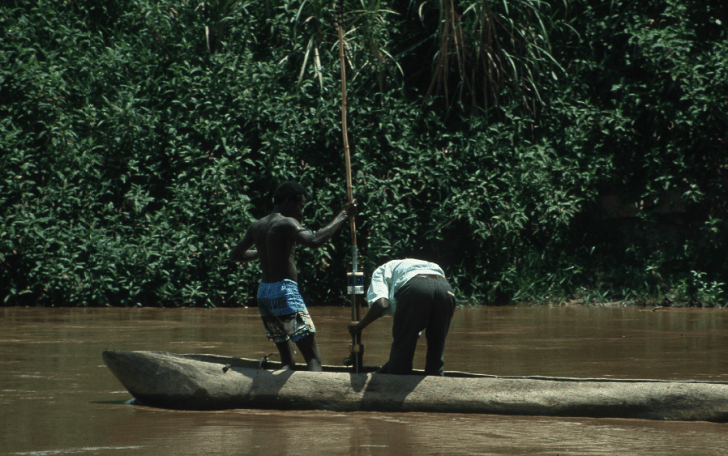
I have worked across 4 continents, gaining and understanding different perspectives and valuations of freshwaters. For example, I worked for 8 months in Central Africa in Rwanda where I experienced completely different ecosystem types as well as a very challenging way of how to do research. We sampled on boats made of a tree trunk, and we worked in areas where no one did river research so far. Due to the high erosion rates of fertile land the transparency of the rivers was often less than 2 cm. In Rwanda, the future of this country lies virtually in its rivers. Fertile land is constantly washed downstream because of a high demographic pressure and the overexploitation of the limited land resources.
Overall, it is the critical role of freshwaters for both humans and nature which stimulated me doing research and in trying to support the development of sustainable solutions.
5 What inspired you to become a scientist?
It was a child dream to become an explorer, i.e. to explore the unknown spots of the world. Fortunately, I met fascinating, interesting people at school and at university who inspired me and who supported me in following unconventional ideas rather than searching for a safe path.
6 What are your plans and ambitions for your future scientific work?
I am still dreaming to make an expedition to the very last wild spots on earth – to go to the Congo Basin or to Sothern Sudan – or to establish a biological field station on the banks of the Rufiji River, Tanzania.
A fascinating domain for future research, in particular for BioFresh, would be to get citizens stimulated enough to provide data for the portal and information that would then be available to the wider community. It would not only provide more data, but would involve the public in the generation of information and in the support of science.










 The Freshwater Blog