Meet the BioFresh team: Szabolcs Lengyel
After our annual meeting last week, we return to our series of ‘behind the scenes’ looks into the work of BioFresh scientists this week with an interview with Dr. Szabolcs Lengyel, co-leader of the Conservation Ecology Research Group at the Department of Ecology at University of Debrecen in Hungary.

Szabolcs Lengyel. Photo: Gábor Ruff (http://www.gaborruff.com)
1 What is the focus of your work for BioFresh, and why?
I focus on benthic invertebrates, mainly mayflies such as the spectacular Long-tailed Mayfly (Palingenia longicauda), and on water-birds and true bugs of sodic alkali lakes, a habitat typically found on sea coasts but which also occurs in a unique biogeographic setting in the landlocked country of Hungary. We apply approaches and methods in systematic conservation planning to assist in the identification of hotspots and optimal conservation networks for freshwater biodiversity. We use sophisticated spatial analyses to quantify patterns in and prioritize areas for the conservation of freshwater biodiversity and ecosystem services in Europe. We also carry out smaller studies on rivers and alkali lakes to understand patterns in freshwater biodiversity at smaller scales that can be used to validate the larger-scale approach.
2 How is your work relevant to policy makers, conservationists and/or the general public?
Several recent studies pointed out that freshwater biodiversity is declining faster than either terrestrial or marine diversity. Knowledge of key areas for freshwater biodiversity allows us to improve conservation efforts such as designating protected areas and habitat management or restoration to areas that are critical for the maintenance of this quickly declining component of global biodiversity. Such information is crucial for policy makers and the general public to come up with ideas and solutions to allocate conservation efforts where they are needed the most or to identify areas where development and conservation may present conflicting interests.

Mayflies swarming
3 Why is the BioFresh project important?
The databases and joint knowledge integrated in the BioFresh project on freshwater biodiversity and ecosystem services offer a unique opportunity to ask questions that could not be addressed previously. For me, one of the most important of such questions is what would be an optimal designation of protected area networks based solely on freshwater biodiversity (considering as many species groups as possible: fishes, mollusks, odonates, aquatic plants, amphibians etc.). Such an optimal network could then be compared against currently existing protected areas that were predominantly selected to conserve terrestrial biodiversity. A knowledge of gaps and overlaps based on this comparison could then provide essential information for policy makers and the general public on where further conservation action is necessary.
4 Tell us about a memorable experience in your career.
I have been lucky to have several of such experiences. A recent one is from a comparison of genetic diversity of a large and a small existing and an extinct population of Long-tailed Mayfly. The results showed that the small Rába river population in western Hungary is the last remnant of the once widespread but now extinct northwestern European populations and that the large population of the Tisza river in eastern Hungary still harbours unexpectedly high genetic diversity, which may be explained by the existence of refugial areas for this species here during the ice ages.

Long-tailed mayflies
5 What inspired you to become a scientist?
When I was 11 years old, my uncle Csaba Aradi, a renowned ornithologist in Hungary, showed me White-tailed Eagles (Haliaetus albicilla) performing their spectacular pre-mating display flight above the endless plains of Hortobágy National Park in eastern Hungary. Ever since I have wanted to become a biologist doing research to save these and other mighty species from extinction.
6 What are your plans and ambitions for your future scientific work?
We have recently carried out the currently largest active restoration of grasslands on former crop-lands in Europe and our team continues to monitor the changes in plant and animal communities after the various restoration and management actions. I would like to extend this and other previous knowledge to larger spatial scales and to freshwater biodiversity to optimally allocate and improve conservation strategies and actions to meet the objectives of policy instruments adopted by the international community and eventually to do some good for declining biodiversity.

An alkali lake in Hungary
Bridge over troubled waters: cooperation crucial to bridge the gap between freshwater science and policy
Cooperation and collaboration between biodiversity science and policy were the themes of day 4 of the BioFresh meeting.
The 4th day of the annual BioFresh meeting was dedicated to a training workshop for BioFresh scientists in the concepts and best practice of Science-Policy interfaces (SPIs). In the afternoon, we mobilised insights to plan out a freshwater biodiversity SPI symposium in early 2014.

Hard at work at the BioFresh annual meeting
Science-policy interfaces
There is a growing recognition by both scientists and policy makers of the importance of an improved dialogue across the two cultures and the need to better integrate important scientific findings into the relevant policy areas. Identifying and participating in SPIs, spaces where scientists and policy-makers are brought together either in person or in virtual spaces, will be essential in achieving these aims.
But there is also a growing acceptance that policy does not always occur in a linear fashion with science feeding straight into policy. Instead policy creation increasingly happens with and through a various array of networks. Dr. Paul Jepson, leader of the Conservation Governance Lab at the University of Oxford who leads on BioFresh dissemination comments ‘we can’t treat science as separate from the policy context in which it operates’. A much wider range of actors from NGOs, industry groups, journalists, academics and wider publics are involved which produces a messy policy process, but one that can be open for various forms of engagement .

Science-policy interface workshop presentation
Connecting with EU water and biodiversity projects
The day also saw several contributions by colleagues from sister EU FP7 projects join the BioFresh meeting and give talks. Dr. Carston Nesshoever from SPIRAL (Interfacing Biodiversity and Policy), an EU project working on biodiversity SPIs, described how they have mapped SPIs to help scientists navigate the complex policy landscape within which freshwater biodiversity science must interact. ‘Compiling and mapping the policy contacts of project consortium members is key to effective science-policy interfaces’, said Nesshoever.
Following this, Ulf Stein from WaterDiss argued for the need of a greater recognition of the importance and opportunities to link biodiversity science-policy communication with those of wider water science community. BioFresh will be at the WaterDiss stand at the Wasser International in Berlin next week.
Several BioFresh members are also involved in complementary projects. Dr. Eleftheria Kampa from BioFresh partner the Ecologic Institute in Berlin, for example, is also a member of REFORM, an EU river restoration project. Because REFORM looks at the pressures that exist for river ecosystems and BioFresh investigates how those pressures affect the life living in them, there is a lot of scope for cooperation between BioFresh and REFORM, Dr. Kampa argued.
The final guest speaker was Pavel Stoev from Pensoft Publishing and ViBrant, a project consortium supporting biodiversity research communities. Stoev reminded participants about the growing importance of data publishing for both science and policy, an issue directly relevant to the work of BioFresh (see our special feature). Stoev’s presentation prompted the idea of a freshwater biodiversity special edition of where we would publish data papers arising from BioFresh and the data compilation project funded from the BioFresh contingency fund.

Schloss Machern, location of the 4th annual BioFresh meeting
Freshwater ‘science meets policy’ symposium
A theme that emerge from the day’s discussions was that coordination and partnership between European biodiversity and water projects is vital for effective policy impact. Horizontal networking between projects, coordinating and sharing resources when interfacing with policy, and passing scientific and policy products and assets on to future projects are areas where improvements can be made in this regard. This may require the development of new tools to map the landscape and identify networks of influence.
BioFresh is working to make these links. Another project with complementary aims as BioFresh is REFRESH, a project developing adaptive strategies to mitigate the impacts of climate change on freshwater ecosystems. An in principle agreement was made to team up with REFRESH to design and host a joint water and biodiversity symposium to bring not only scientists and policy-makers together, but also NGOs, industry representatives and politicians.
Dr. Martin Kernan from UCL, coordinator of REFRESH and a project member of BioFresh, says “the symposium is an exciting opportunity for REFRESH and BioFresh to work together to utilise combined networks and maximise resources to ensure the uptake of research, in line with the recommendations of the recently published Roadmap for Uptake of EU Water Research in Policy and Industry.”
The symposium is planned for late January 2014. Until then, the BioFresh blog will keep you updated and provide you with a more detailed plan in the coming months.
Building the Global Freshwater Biodiversity Atlas
Day two of the annual BioFresh meeting again saw BioFresh’s information infrastructure at the forefront of discussions. This time, it was the BioFresh Global Freshwater Biodiversity Atlas that was the focus.
The Atlas allows stakeholders, policy-makers, scientists and the wider public to explore a wide range of maps about life in freshwater across the globe. It uses all available freshwater-related information and will be closely integrated to existing BioFresh information infrastructure such as the BioFresh data portal.
The Atlas is not only a collection of maps, but also a tool to increase the accessibility of scientific research into freshwater life. The Atlas is different from other online mapping tools because it allows you to navigate through it like you would a book. Users can leaf through the Atlas and explore what interests them and perhaps discover something unexpected. It is organised into different ‘chapters’, which cover past, present and future status of freshwater biodiversity, information about different ecosystems and where species live, current and future threats to freshwater biodiversity such as climate change, pollution or dams, and finally a chapter on what we can do about it.
The Atlas is currently in its final stages of development. Work is being done to create more features on the Atlas and make it an easy to use and interactive product. Such features will include pop-ups that will have information on map features, the ability to combine different aspects of maps together (e.g. climate change threats and key biodiversity areas), and interactive graphs and tables.
Another important development in the Atlas project has been the formation of an editorial board headed by two editors, Dr. Astrid Schmidt-Kloiber and Joerg Freyhof, who gave an interview about the Atlas recently. The editorial board of the BioFresh Atlas is actively searching for contributions of maps, articles and any other information relating to freshwater biodiversity. Dr. Schmidt-Kloiber says ‘it is a great way for scientists who contribute to increase the visibility and impact of their science and we invite scientists to publish their research on the Atlas.”
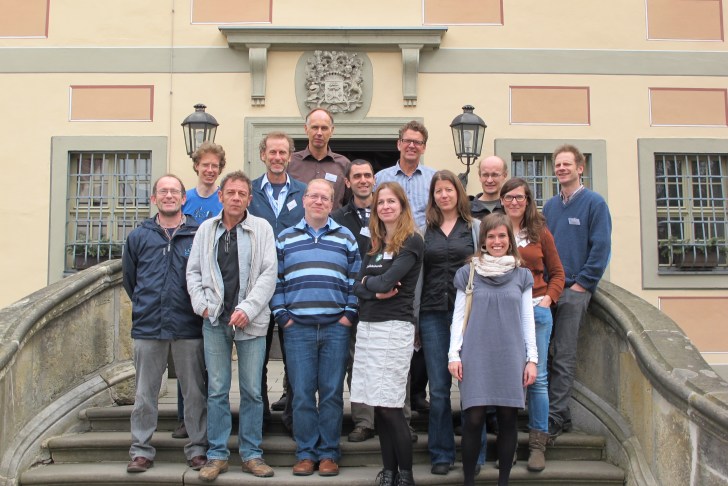
The editorial board of the Global Freshwater Biodiversity Atlas
So who should use the Global Freshwater Biodiversity Atlas? It is really a resource for everyone, but three main types of users might find it useful. Firstly, the Atlas will be a huge resource for scientists. We are constantly flooded with information and scientists know this better than anyone. The Atlas helps because it provides an overview and visualisation of the freshwater-related science that has already been done. This enables the Atlas to be used as a platform for scientists to situate their own research, but also for providing inspiration for new ideas for future research projects.
Secondly, one of the most important uses of the Atlas will be for planners and policy-makers. It can be used by NGOs to identify key areas of freshwater biodiversity, policy-makers and governments to create Protected Area networks and meet conservation targets such as the Aichi Biodiversity Targets, as well as minimising harm caused by large-scale land use projects such as dams, and by corporations in their environmental impact assessments or land-use considerations.
Last, but by no means least, the Atlas will be great for anyone with an interest in freshwater, conservation, science or just good old-fashioned map enthusiasts. It opens up the world by getting science out of journals and presenting it in an easy to understand and open way. Making science accessible is a goal of the BioFresh project, and the Atlas should contribute to this aim enormously.
Our goal is to launch the Atlas later in the year. We’ll keep you informed and up-to-date in the meantime.
The 4th annual meeting of the BioFresh project kicked off yesterday with biodiversity informatics and hot policy issues taking centre stage.
The first day of the annual meeting in the picturesque German village of Machern, just outside Leipzig marked the start of the final phase of the BioFresh project and provided a status update of all of the work from BioFresh team.
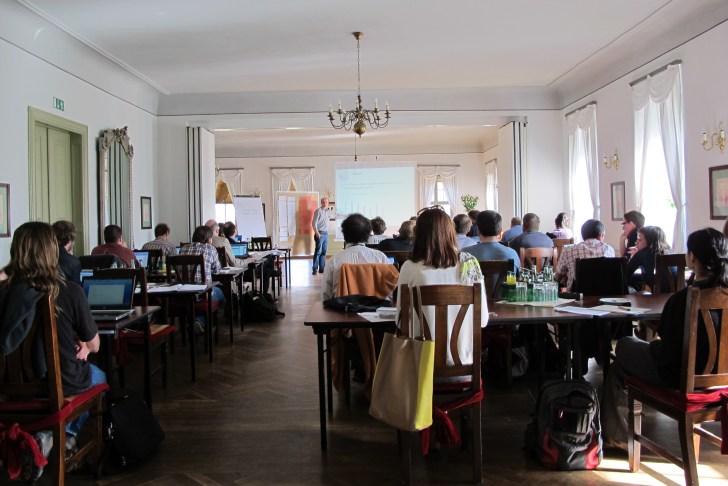
Opening session of the 4th Annual BioFresh Meeting
A central focus of the day was biodiversity informatics, an emerging area in which BioFresh is a strong contributor. The BioFresh project is not just concerned with the science of freshwater biodiversity. It’s also about creating a public information infrastructure on the abundance of life found in freshwaters that can be used by and added to by anyone to facilitate better science and inform policy.
The first of these information infrastructures is the BioFresh data portal. The aim of the data portal is to help scientists to advertise and publish their data and to create an open and freely accessible platform of freshwater biodiversity information. Aaike De Wever from Royal Belgian Institute of Natural Sciences gave an overview of the work to improve and update the portal and it now contains a range of extended functions and extra options, as well as a redesign of the mapping interface. For a short walk-through introduction of the data portal click here.
Second, is the related metadatabase, a database of freshwater biodiversity datasets. It contains 154 freshwater-related datasets and BioFresh is working to enlarge the content. BioFresh, under the leadership of Astrid Schmidt-Kloiber from the University of Natural Resources and Applied Life Sciences (BOKU), aims to get 300 datasets into the metadatabase by the end of the project. If you have any datasets you would like to share, please get in touch.
BioFresh Biodiversity Matrix (BioMatrix)The final piece of bioinformatics infrastructure that BioFresh is building is the , which is being developed in conjunction with BioFresh partner, the IUCN. The BioMatrix holds the distributions of freshwater species published on the IUCN Red List. It is a “living” repository for data that is actively updated and added to via current and future IUCN projects to ensure that knowledge on freshwater species available to the scientific community is ever-expanding. At the latest count, the BioMatrix contains over 11,000 species maps.
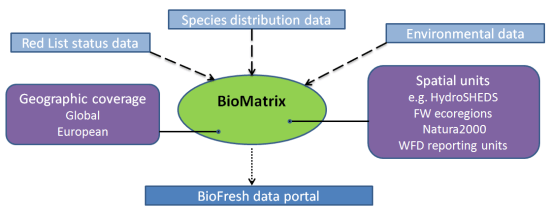
Conceptual overview of the BioMatrix database
The other key theme of the day was about important topics concerning freshwater biodiversity policy. The services that freshwater ecosystems provided by freshwaters such as rivers, floodplains and groundwaters has been identified as a key topic of focus. In fact, the BioFresh blog will be hosting a special feature on ecosystem services and EU policy in the coming weeks featuring a range of issues from a number of guest authors. The policy concept of Key Biodiversity Areas (KBA) was another topic that received attention during the 1st day of the BioFresh meeting. The KBA framework aims to identify areas of international importance in terms of biodiversity conservation and provides a powerful way forward for freshwater conservation. However, the potential of this approach is constrained by the lack of information about freshwater sites. Will Darwall from the IUCN stated that there is a strong need to identify key areas of freshwater biodiversity in order to inform policy for effective conservation planning, an area that BioFresh is working to improve. Another important policy issue is covered was Science-Policy Interfaces (SPI). Paul Jepson from the University of Oxford argues that the notion of SPI is gaining traction in part because of a failure of governments to meet key biodiversity targets set out under international conventions. It is vital that work continues to be done in this area in order to ensure that freshwater science can be mobilised for use in policy. On day 4 of the BioFresh meeting a full day SPI workshop will be held to discuss the potential of this approach further.
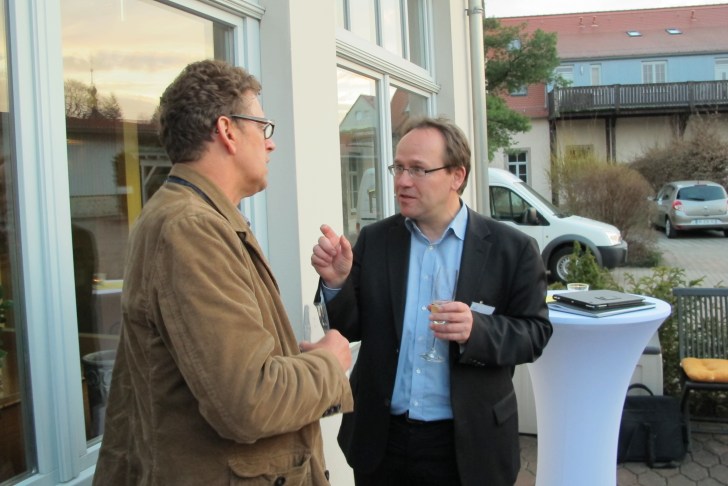
Paul Jepson (left) & Klement Tockner (right)
Stay tuned for more updates during the week. You can also follow our live updates on twitter: @biofreshproject
BioFresh goes political: an overview of the 4th annual meeting of the BioFresh project
The 4th annual BioFresh meeting is just around the corner! The focus of this year’s meeting will be on the interface between science and policy and making freshwater biodiversity science more politically influential.
The fourth annual meeting of the BioFresh project will be held next week from April 15-19 in the trendy Germany city of Leipzig. The slogan of this year’s meeting is “BioFresh goes political”, which captures the focus of linking BioFresh science with policy and conservation outcomes. The meeting is a chance for members from our 19 partner organisations of the BioFresh team to get together and assess the progress of the previous 3 years and discuss plans for the final phase of the BioFresh project.
If you’re not familiar with the BioFresh project, you can check out this wonderful animation below explaining what it’s all about:
Alongside the important status updates and preparation for the future, a key feature of the meeting will be a workshop on understanding the science-policy interface and the implications for freshwater biodiversity research and funding. A full day of the week-long meeting will be dedicated to discussing the issues around making freshwater biodiversity science into policy, an indication the high priority BioFresh gives to linking the science of freshwater biodiversity with policy and conservation. This workshop should result in two main outcomes: one aim is to create a space where science and policy can come together to discuss current ways and methods of science-policy communication and its best practices, its challenges, and futures needs when engaging with policy makers and stakeholders. For this, BioFresh will profit from the experiences and inputs of several guests involved in other FP7 EU projects (KNEU, OpenNESS, REFORM, SPIRAL, ViBRANT, WaterDISS) related to freshwater, e-infrastructures, data mobilisation and publishing. Finally, BioFresh hopes to join forces with these EU projects to design a Science-Policy Symposium on freshwater biodiversity, to be held in the Spring of 2014 in Brussels.
With BioFresh entering its final project phase, all of us are also looking forward to what will be beyond BioFresh. What happens to the biodiversity infrastructures built up such as the BioFresh portal, the Metadatabase and the Global Freshwater Biodiversity Atlas? Will there be new initiatives? And where is and where should Europe be going in biodiversity research?
BioFresh newsletter out now
BioFresh’s latest newsletter has been published ahead the annual BioFresh meeting in one week’s time. The newsletter features the latest scientific papers that the BioFresh team have published and the work BioFresh is doing to link science with policy.
As BioFresh enters its final project phase it is important to remember the major goals of the BioFresh project. BioFresh aims to improve the capacity to protect and manage freshwater biodiversity by building an information platform, do scientific analyses, increase the awareness for freshwater biodiversity and support the European Union and other bodies’ environmental policies with our knowledge and results. Since the beginning of the project, BioFresh have made important progress in building the platform and doing science.
As an example of this work, in the last few months BioFresh papers have appeared in leading journals including in the fields of biology and ecology. An overview of each of these are included in the newsletter, which are listed below: 
- BioFresh in Hydrobiologia
- BioFresh in Ecological Indicators
- BioFresh in PLoS One
- BioFresh in Global Change Biology
- BioFresh in Systematic Biology
- BioFresh in Science
In addition to the many BioFresh papers that have been published over the last few months, the newsletter also covers some of the BioFresh work on linking science with policy. For example, the BioFresh newsletter highlights work by members of the BioFresh team and partners on freshwater Key Biodiversity Areas (KBA) and the BioFresh Global Freshwater Biodiversity Atlas.
And last, but by no mean least, the newsletter discusses the annual BioFresh meeting, which will be held in Leipzig, Germany in one week’s time. The meeting will run from 15-19 of April and will. Make sure to stay tuned for a more detailed introduction to the meeting in the coming few days, as well as regular updates during the meeting itself.
New species of fish discovered in India
At team of Indian freshwater scientists have found a new species of freshwater fish in one of the most biodiverse regions of the world.

Newly discovered species of Stone Loach – Balitora jalpalli
The new species, which was found in the Kunthi river in South-West India, is a type of stone loach fish and has been called the ‘Balitora jalpalli’. It becomes the lucky 13th species of the Balitora genus, which live in the hill streams of South and South-East Asia, four of which can be found in India. The name ‘jalpalli’ is a combination of two Sanskrit words: ‘jal’ meaning water and ‘palli’ meaning ‘small lizard’ and it is named so because of its lizard-like appearance and its behaviour of clinging to rocks in fast-flowing waterways.
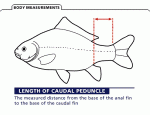
Caudal peduncle
The tiny fish is just over 6cm in length and has a yellow-brown appearance. The researchers say that the new species can be distinguished from its cousins by the size of its head (length and width), unique patterns and the number of bands on its back, and differences in the narrow part of the fish’s body that connects to the tail fin – or for the fish biologists among us the caudal peduncle, a sexy name for a body part if ever there was one!

Western Ghats. Photo: UNESCO
The Kunthi, where the Balitora jalpalli was found, is a tributary of Bharathapuzha River, India’s second-longest river. It runs through the Silent Valley National Park in southern Western Ghats, in the state of Kerala. The Western Ghats is a UNESCO World Heritage Site and in the top 10 ‘hottest biodiversity hotspots’ in the world. This latest find follows the discovery of another species of stone loach in the Western Ghats just last year and highlights the importance of the region as one of the world’s richest sources of biodiversity. The Western Ghats is home to over 5,000 species of flowering plants, over 500 bird species, 179 amphibian species, 139 species of mammals, over 100 freshwater fish species and now one more ! It is likely than many more species remain to found in this oasis of biodiversity.
The findings were published in the Journal of Threatened Taxa.
World Water Day 2013: Water as a medium for life
World Water Day is an opportunity to think about the importance of water and to reflect on what water really is. Water is not only an instrumental resource to meet the needs of humanity, but it is also a medium for life itself.
All life on Earth depends on water for its survival. Civilisations have risen and fallen around the question of water. Without water life as we know it would simply not exist. But water is not just an inert substance that sustains life. It is alive with an abundance of life itself.
Freshwater habitats cover just 1% of the Earth’s surface, but hold over 10% of all life on the planet and 35% of all vertebrates. Yet despite this, no component of global biodiversity is declining faster than freshwater ecosystems.
With 2013 marking the ‘International Year of Water Co-operation’, it is the perfect time to work together to meet the many pressing and interconnected issues relating to water. If the needs of people and freshwater ecosystems (and the services they bring) are to be met, freshwater ecologists, economists and policy-makers must all work together. The nexus between food security, water and biodiversity, is just one of many examples of the need for water co-operation.
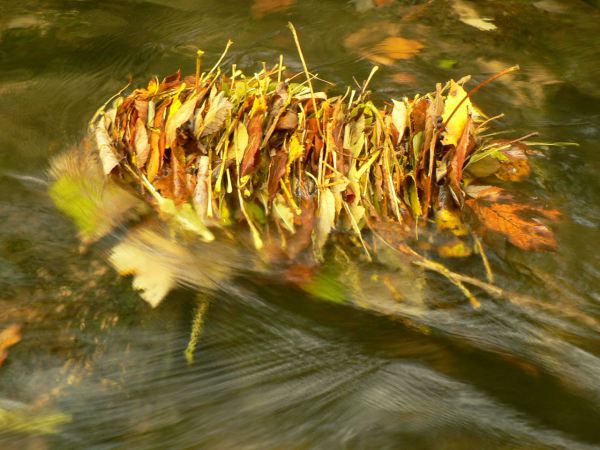
Leafpack in the Cuisance river, France. Photo: Nuria Bonada
Given the interrelated and multiple roles that water plays on Earth, BioFresh member Dr. Paul Jepson from the University of Oxford asks whether “water policy should, therefore, also consider the diversity of life that inhabits freshwater ecosystems before it is harnessed, filtered and transformed into the inert substance used by humanity. The crucial question is how do we understand the relationship between water as an instrumental resource and water as the basis of dynamic, diverse and living ecosystems?”

A myriad of microscopic diatoms.
Today provides an opportunity to step back and reflect on the nature of water. UN Secretary-General stated today that “water holds the key to sustainable development, we must work together to protect and carefully manage this fragile, finite resource.” No-one would argue with that. But water is much more the simply a natural resource.
Look beneath the surface of this vital resource and it is transformed into another world filled with strange and fascinating creatures. Our lakes and rivers support an amazing diversity of life, from tiny diatoms all the way to us humans. These beautiful, complex webs of freshwater life often go unseen, and their importance un-noticed. However, this remarkable diversity of freshwater life is vital in supporting our everyday lives. Are we capable of creating policies to manage water not only as a resource for humanity, but also as a medium for life?
For more see the article ‘Going with the flow‘ by Dr. Paul Jepson and Rob St John.
Freshwater species given protection at international summit
It’s good news for some of the world’s most endangered freshwater species. Nearly 50 freshwater species – from threatened freshwater turtles and tortoises to the rare freshwater sawfish – were given stronger protection at the recent CITES summit.

The critically endangered Roti Island snake-necked turtle is highly south after on the exotic pet market. Photo: ARKive.
Last week governments from across the world came together in the Thai capital, Bangkok, to discuss proposals to protect some of the most threatened species on the planet from harmful international trade. The Convention on International Trade in Endangered Species (CITES) puts in place rules agreed upon by the world’s governments for the conservation of some of the most threatened species by banning the trade of certain species or placing quotas, restrictions and rules concerning the trade of endangered species (these are known as Appendix I, II or III listings).
The biggest news from the summit was that countries agreed to protect 47 species of the world’s most endangered freshwater tortoises and turtles in Asia and the United States. The decision to strengthen the rules governing the trade of these species was agreed upon by consensus from the nearly 200 countries present and saw the United States and China vote together for the first time ever at the international wildlife summit. This saw 44 species of freshwater turtles and tortoises in Asia and three species of pond turtles in America receive increased protected to prevent these species from disappearing.
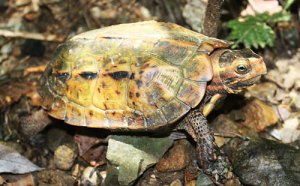
The Ryukyu black-breasted leaf turtle is a National Treasure of Japan.
Over half of the world’s freshwater tortoises and turtles face extinction and are in desperate need of conservation efforts, but many are still under threat from hunting for food, collectors of exotic animals, use in traditional medicine and for their shells, which are made into ornaments. And the trade is a lucrative one too. Some collectors are willing to pay anywhere between €2000-€10,000 per individual of some species, which will prove a big challenge in terms of cracking down on illegal trade.
Last week’s summit also saw another precedent: Japan, for the first time ever for any species at CITES, asked the help of the world’s governments to protect the rare Ryukyu Black-breasted Leaf Turtle, which is a ‘natural monument’ in the country.
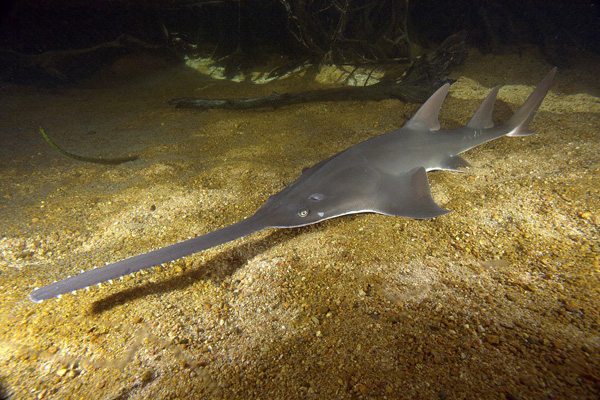
Prized for its fins and unique saw.
The freshwater sawfish (Pristis microdon) is another critically endangered species that was given the top protection under CITES. This elusive animal is a large, shark-like ray that used to found in the waters in and around the Indian sub-continent, South-East Asia and Australia, but is now virtually extinct in most of this region having not been seen in decades in Indonesia and Thailand and now only found in northern Australia. The freshwater sawfish can live in on the bottom of muddy or sandy rivers and estuaries or shallow coastal water and are high-order predators, eating a delicious diet of mainly fish and prawns. These unique sea creatures are sought after for their valuable fins and saws and the decision to protect the freshwater sawfish means that international trade in all species of sawfish has now been banned.
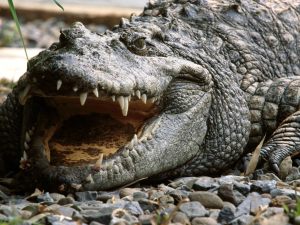
There was another win for freshwater biodiversity at the CITES summit. The critically endangered Siamese freshwater crocodile retained the highest level of protection under the convention, after a bid from Thailand to downgrade it failed. The Siamese crocodile is one of the most endangered crocodiles in the world. Once found widely throughout most of South-East Asia, it is now confined to just 1% of its original habitat. Although a few small wild populations remain, mostly in Cambodia with smaller populations in Indonesia, Laos, and Thailand, there is a significant captive population for commercial uses throughout the region. The importance of this decision is underscored by the extinction of the crocodile in Vietnam last year. The last Siamese crocodile in Vietnam was found strangled to death aged nearly 100 years old, possibly killed by hunters.
Though there is still work to be done in enforcing these new rules and cracking down on illegal poaching and trade, the outcomes of the CITES 2013 summit can definitely be seen as a big win for freshwater conservation and biodiversity and is welcome news.
For an overview of some of the other key decisions made during the CITES summit see here and here.
Progress towards a global freshwater biodiversity atlas
An online atlas providing open access to information on global freshwater biodiversity is an exciting and important future output of the BioFresh project. The atlas will map primary data available through the new BioFresh data portal as well as make available key map overlays such as the Freshwater Ecoregions. Maps will be accompanied by an up-to-date and authoritative survey of the underlying science and their policy relevance and organized into thematic chapters.
Atlas editor Dr. Jörg Freyhof of the Leibnitz Institute of Freshwater Ecology explains his vision for the BioFresh Biodiversity Atlas
The Atlas editorial team would welcome suggestions for additional content . If you have, or know of, maps and overlays relevant to freshwater biodiversity science and policy which you would like to see included in the Atlas please contact Jorg Freyhof email freyhof[a]igb-berlin.de or Vanessa Bremerich email bremerich[a]igb-berlin.de










 The Freshwater Blog