Interview: Freshwater conservation in pictures with Michel Roggo
We continue our three-part interview with respected freshwater photographer Michel Roggo. Roggo has taken thousands of amazing photographs over the years. We asked him what three images best summed up his vision for freshwaters. From swarms of salmon to eery flooded forests to a different side of the world’s biggest lake, these were the photos he chose.
|
Salmon swarms: the migration of the sockeye salmon in Canada’s Adams River 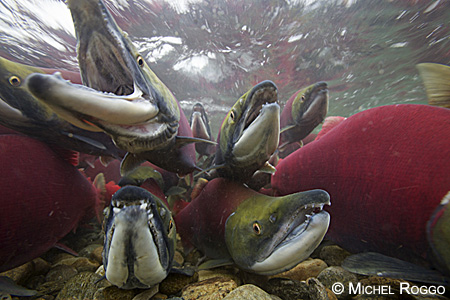 Sockeye salmon, Adams River, British Columbia, 2010 “Thirty years ago on an expedition to Alaska, I caught my first glimpse of these migrating Pacific salmon and resolved to return each year until I had captured good photographs of them underwater. After several failed attempts, I perfected my technique for shooting underwater without having to dive, instead using a small structure on the riverbed. The advantage of this is that fish are not really concerned about the structure, which allows me to capture their natural behaviour. At the beginning of my career, I worked a lot in Alaska and later in British Colombia, especially at the Adams River, pictured above, where every 4 years there is a major run of about four million Sockeye salmon. They enter the Adams river to spawn and to die. So this is really an abundance of life and for me perhaps the best example of how much of life a river can produce.” Many more incredible photos and millions more salmon can be viewed over at Michel Roggo’s website. Flooded forests: the annual flooding of the Amazonian rainforest 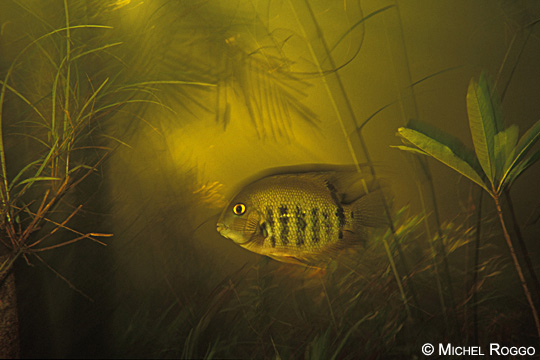 Flooded forest of the Rio Tabajos, Amazon, Brazil, 1992 “Every year the waters of the Amazon and its tributaries rise up to fifteen metres, entering the rainforest. Where there have been birds, there are now fish. They enter the rainforest to spawn, and to feed on fruits and seeds. By doing so they disperse the seeds of the trees, helping them to expand their territory. In turn, predators such as river dolphins and caimans follow the fish into the transformed forest in search of a meal. In the earlier stage of my career as photographer I worked a lot in the Amazon, travelling for months at a time on riverboats on Xingu, Trombetas, Tabajos, Rio Negro and such. I was not very experienced at that time and had a lot of problems in the humid environment with my high tech equipment. After a total of seven months of work I had less than ten good underwater images. But it was a great time!” You can see more of Roggo’s eery photos of flooded forests here and here. Beneath Baikal: the world’s biggest lake like you’ve never seen it before  Lake Baikal, Siberia, Russia, 2013 “Although I still mostly use remote controls to make underwater images, I started shooting pictures while snorkeling – the day after my 60th birthday – in the dangerous Verzasca river in the southern Swiss Alps. Last September, I finally started diving at age of 62 in Lake Baikal, the world’s most voluminous and the deepest freshwater lake in the world – it’s never too late for a new experience. But even here, I photograph without flashlight. Everyone has seen Lake Baikal from the surface, but I like to make underwater landscapes. I try to show the world down there through the eyes of a fish, without artificial light. In fact, I haven‘t used flashlight under water for perhaps ten years now.” A selection of Roggo’s underwater (and above water) landscapes can be seen here. We conclude our three part interview with Michel Roggo next week, when he will share some tips and tricks for budding freshwater photographers, so make sure you don’t miss it! Check out part one of the interview. |
Michel Roggo may be the quintessential modern-day explorer. Instead of taking back samples of his journeys, he captures them with his camera. This week we are featuring a three-part interview with Roggo, who talked to the BioFresh blog about his amazing freshwater photography, his latest work, The Freshwater Project, and some tips and tricks for budding freshwater photographers.
 Michel Roggo at Lake Baikal, Siberia BioFresh Blog: Michel, thanks for speaking with the BioFresh blog and welcome. Tell us about The Freshwater Project: what is it and what inspired you to do it?
BB: Why? MR: Well, we know what coral reefs look like, but what about the creeks, streams, lakes and ponds on our doorstep? I’m always looking for new and interesting scenes with the most dramatic light. A marsh pond, beneath the ice in a mountain stream, among algae – these habitats are hardly ever seen but they are incredibly beautiful. The goal of The Freshwater Project is to take pictures of around thirty special freshwater locations, places that are spectacular, mostly different from each other, and of an unbearable beauty and therefore very important. In short, our aim to produce a photographic record of important freshwater environments from across the globe, focusing on underwater images. To date, twenty four locations have been photographed (which you can see here).  Verzasca River, Swiss Alps. BB: What motivated you to team up with the IUCN freshwater programme?
 Michel Roggo diving into Lake Baikal Stay tuned for part 2 of the interview this week. If you want to see more of Michel extensive work, visit roggo.ch. |
 Michael Roggo: I started photography in the countless crystal clear rivers and lakes of the Swiss Alps. In 2010, with twenty five years experience photographing freshwater landscapes, animals and plants and about a hundred expeditions worldwide, I decided to work on a global effort: The Freshwater Project.
 MR: First of all, I am doing this project for myself, as a photographer. I just had to do it: searching for this magic moment under the surface, with the perfect light and composition. At the same time I know that many of these freshwater ecosystems are under threat. It breaks my heart to see how quickly things go bad. But I’m not Bruce Willis. I can’t save the world alone. So it makes sense to team up with an important and global conservation organization like the IUCN. I have already worked with NGO’s, on national and international level, for example in the Amazon with WWF. But when Will Darwall, Head of the IUCN Freshwater Biodiversity Unit asked me for a cooperation, I was very happy. Now I can jump into the water and do my job, and the IUCN can use the images to help to save the Blue Planet of Freshwater. They have to do Bruce Willis’ job.
Top ten moments for freshwater biodiversity in 2013
With the new year upon us, we take a look back at the year that’s been to discuss our top ten moments for freshwater biodiversity in 2013. What are yours?
10. World Water Day 2013
Held on March 22nd, World Water Day is an opportunity to focus attention on the importance of freshwater and advocate for the sustainable management of freshwater resources. Water is not only a vital resource for humans, however, but a medium for life itself. This year’s theme was ‘water co-operation‘, fitting with 2013 as the ‘International Year of Water Co-operation’.
9. Leading scientist calls for freshwater advocacy group
The Head of the IUCN Freshwater Biodiversity team, Will Darwall, spoke to BioFresh about the big challenges for freshwater biodiversity conservation and called for the formation of a freshwater advocacy group. In the interview, which you can watch here, Darwall urges closer cooperation between freshwater scientists and conservationists to provide a stronger voice for freshwater biodiversity.
8. New campaign to shed light into the hidden world of microbial life
Freshwater life comes both big and small. They also come in the microscopic size! River Sampling Day, a new campaign that kicked off in 2013, aims the highlight the amazing diversity of microbial life hidden in our rivers and lakes. Although these tiny specks of freshwater life are at the heart of many essential ecosystem services, they are greatly under-researched; a situation that River Sampling Day intends to improve.
7. World biodiversity day helps raise awareness about freshwater biodiversity
This year’s theme of the International Day for Biological Diversity was ‘water and biodiversity’. It provided the perfect opportunity to raise awareness about the crucial role that water plays in sustaining life on Earth, as well the highlighting the abundance of life found within freshwaters.
6. UN RIvers Convention close to reality
Efforts create an UN rivers convention have taken a leap forward this year. Originally drafted in 1997, thirty-two countries have now ratified the convention that aims to protect rivers shared by a number of countries, just three short of the number needed for it to take effect. More than 150 major rivers are shared by two or more countries, often leading to international tensions over their use. The international environment framework is officially known as the Convention on the Law of the Non-Navigational Uses of International Watercourses.
5. The IPBES, the new international authority on biodiversity, kicks off their agenda
Dubbed the IPCC of the biodiversity world, the Intergovernmental Platform on Biodiversity and Ecosystem Services or IPBES has had a big year. Founded last year, the new global nature authority held its first meetings this year, laying the foundations for its future work and setting its top priorities. The IPBES plans carry out two assessments focusing on pollination and food production, and the impact land degradation on biodiversity and human well-being.
4. WWF launches a global campaign to protect Congo’s Lake Edward from oil exploration
Not all of the items in this list are positive. The threat of oil exploration project in Africa’s oldest national park is one such example. London-based company Soco International plans to look for oil in the Virguna National Park, Africa’s most biologically diverse protected area and a World Heritage Area. Encompassing Lake Edward, a key freshwater biodiversity area upon which thousands of people also rely, Virguna is home to over 200 species found nowhere else on earth, including many freshwater fish. Read about WWF’s global campaign to protect the region from oil exploration.
3. The world-renowned Experimental Lakes Area is kept alive
Known as the super collider of ecology, the Experimental Lakes Areas (ELA) in Canada was facing a bleak future at the turn of last year. The Harper Government had announced that it would close the freshwater science research facility to save money. But after a strong campaign the provincial government of Ontario stepped in and saved the ELA, which will now be managed by the International Institute for Sustainable Development. The ELA is the only facility in the world that allows the study of whole lake ecosystem research and has produced almost 750 peer-reviewed papers including 19 in Science and Nature.
2. Hundreds of new freshwater species found
With the ‘discovery’ of hundreds of species of freshwater critters previously unknown to science, from fish to frogs to water beetles, 2013 proved that there is still so much to find out about the world. The new species were found in places ranging from the Amazon to Australia and include a giant air-breathing fish, an eyeless cave fish, a vegetarian piranha, and fish that has been named after Barack Obama.
1. New protected areas announced for vital freshwater ecosystems
A suite of new freshwater protected areas were created this year. Bolivia has continued its reputation as a conservation leader by creating the world’s biggest protected wetlands, covering a whopping 6.9 million ha of the Amazon and protecting nearly 2,500 species! Cambodia also stepped up to the plate this year by protecting over 50km of the Mekong, safeguarding local people’s livelihoods and iconic species such as the Irrawaddy river dolphin. This comes has Columbia and Peru celebrate 10 years of successful freshwater conservation in the Amazon.
BioFresh Christmas newsletter
BioFresh’s latest newsletter is out just in time for Christmas. You will find a range of topics and news covered in the newsletter from BioFresh’s new look to featured science .
It’s been a busy few months for the BioFresh team. As we head into our final stage of funding, we’ve had a makeover, held and participated in workshops on endangered species and key biodiversity areas; had our latest scientific research published in respected journals; and done work on freshwater biodiversity science-policy interfaces, including planning an exciting joint science policy symposium for freshwater life.
Although the BioFresh Project is coming to a close in 2014, much of BioFresh’s work will be carried forward. Klement Tocker, the head of BioFresh, explains that there are “strong commitments by several partners to continue the development of the project’s core elements such as the portal, the meta database, the atlas, and the blog.” “I am convinced that BioFresh will serve as a nucleus in forming a global freshwater biodiversity network,” he said.
In this issue of the newsletter, you will find the following topics:
- Introduction
- BioFresh’s new look
- European database of caddis-flies
- BioFresh at the IUCN Red List workshop
- BioFresh Key Biodiversity Areas workshop in Morocco
- BioFresh workshop on multiple stressors
- BioFresh in Freshwater Biology
- BioFresh in Molecular Ecology
- BioFresh in Applied Ecology
- BioFresh and Science-Policy Interfaces
- The BioFresh Blog
- BioFresh REFRESH Symposium
The ongoing work of freshwater scientists and projects such as BioFresh is vital at time where future challenges, such as the construction of large-scale dams and canals, draining of wetlands, and climate change, are enormous. As Tockner says, “water is more than just a precious resource for human consumption; it is one of the most diverse, complex and dynamic ecosystems globally.”
Most popular posts of 2013
Seasons greetings everyone! The year is coming to a close, so we thought we would bring you a list of our most popular posts of 2013. Here they are:
 Perspective: Martin Sharman on ethics and the ecosystem services paradigm
Martin Sharman caused quite a stir in this Perspective about the ethics of ecosystem services. In it, he argues that for those with a reverence of nature, the ecosystem services concept is fundamentally immoral and unethical. Take a look for yourself to see if you agree or not.
 New species of fish discovered in India
It’s 2013 and we’re still finding things out about the world all the time. Like the discovery of this new species of fish by Indian freshwater scientists.
 Waterfalls promote freshwater biodiversity in rivers
Here’s another reason why waterfalls are awesome. Not that they needed one. BioFresh scientists found that natural habitat fragmentation caused by waterfalls can lead to an increase in biodiversity in rivers. But we’re not talking about overnight. More like millions of years.
 Special feature: Freshwater Biodiversity and Ecosystem services
Our special feature on this hot (and wet) topic generated a lot of interest. In it, you will find a range of pieces from overviews and perspectives on ecosystem services to guest articles and interviews with leading policy figures
 Anti-anxiety drugs making fish angry
Apparently when fish take anti-anxiety medication they get moody. Seriously moody. Not that the critters have any say about it. This study published in Science adds to a growing list of common drugs that are affecting our waterways and the creatures that inhabit them.
New international authority on biodiversity sets top priorities
Pollination and land degradation are to be the top priorities for the Intergovernmental science-policy Platform on Biodiversity of Ecosystem Services (IPBES), known as the IPCC of the biodiversity world.

Delegates from over 100 governments reached agreement on the new international biodiversity body’s work agenda and budget for the next five years. The second meeting of the Platform (IPBES-2), which was held in Antalya, Turkey last week from December 9-14, was hailed a success by IPBES Chair, Professor Zakri, who described the “Antalya Consensus” as a “testimony of the power of collective ambition to face biodiversity challenges.”
The agenda includes a commitment to develop a set of assessments on pollination and food production, land degradation and invasive species aimed at providing policy-makers with the tools to tackle pressing environmental challenges. “There’s an old saying: We measure what we treasure,” said Dr. Zakri. “Though we profess to treasure biodiversity, most nations have yet to devote or acquire the resources needed to properly measure and assess it along with the value of ecosystem services. Correcting that is a priority assignment from the world community to IPBES.”

The new top nature platform plans to carry out two key assessments, similar to the IPCC’s climate change assessments. The first focus on pollination and food production. Three-quarters of the world’s crops depend on pollination by bees and other pollinators, but more information is needed to understand how pollination underpins food production, the IPBES said.
The second assessment will investigate the impact on land degradation and restoration on biodiversity, ecosystem services, and human well-being. With land degradation over the next 25 years threatening to reduce global food production by up to 12 percent, resulting in an increase of as much as 30 percent in global food prices, the assessment will provide a vital foundation for future policy solutions.
The Platform will also support work on the integration of indigenous and local knowledge in scientific processes, and on valuation and accounting of biodiversity and ecosystem services and has established task forces on capacity-building, biodiversity knowledge and data, and indigenous and local knowledge.

IPBES Chair Prof. Zakri closes the five-day meeting
The IPBES was established to assist governments and the public to better understand the trends and challenges facing the natural world and humanity in the 21st century, and thus promote human wellbeing and sustainable development through the sustainable use of biodiversity. It held its first plenary meeting earlier this year and plans to have its first assessment finished by as early as December 2015.
* Look back over the formation of the IPBES as the BioFresh blog tracked it progress in a series of posts which can be accessed here (June 2010), here (July 2011) here (Nov 2011), and here (Feb 2013).
Please complete our reader’s survey
The BioFresh blog will be transferring over to the new MARS project in 2014. We thought it high time that we asked you what you thought about the blog and how it can be improved.
Please complete this short survey. It will take less that 10 minutes (guaranteed!). Many thanks in advance!
Cabinet of Curiosities: Lake Titicaca water frog

Illustration by P. Roetter, Bulletin of the Museum of Comparative Zoology
One of the largest completely aquatic frogs in the world, the Lake Titicaca water frog grows to the size of a salad plate in its home over 3,800 metres above sea level and avoids the harshest elements of a high-altitude life by spending all its time under the water. Rejoicing in the Latin name of Telmatobius culeus – “aquatic scrotum,” the frog has a bizarre set of adaptations to deal with its lifestyle.
People have been fascinated with the frog since ancient times, when it was believed to have the power to call rain, with more recent admirers including the Victorian explorers who christened it and Jacques Cousteau. But the frog is now suffering from its popularity – it suffers from over-collection (though the reason might surprise you!) as well as pollution and loss of habitat, invasive predators, and fishing of its favorite prey, the ipsi, may also be playing a role, while the chytrid fungus remains a looming threat. The population has fallen by about 80% in fifteen years. Plans to save the critically endangered frog include captive breeding programs in Peru, Bolivia and abroad, and potentially large-scale frog farming.
To find out more about this amazing animal – recently ranked as one of the ugliest creatures on the planet – check out it and the other weird and wonderful species in the BioFresh Cabinet of Freshwater Curiosities!
Science-policy interface: the European policy context
Among the goals of the strategic dialogue workshop in which BioFresh participated last week, one of the most fundamental was to find out how EU-funded research could maximise its contribution to policy. Such contributions come within the structure of current European policies, with three initiatives being particularly relevant: the EU Biodiversity Strategy to 2020, the 7th Environment Action Programme, and Horizon 2020 (the funding arm of the Innovation Union). So how do these frameworks set up the European science-policy interface? A brief look at the context:
 The EU Biodiversity Strategy to 2020, called “Our Life Insurance, Our Natural Capital,” followed from a recognition that the EU had missed its target to halt biodiversity decline by 2010. The strategy is the EU’s framework to fulfill its commitments under the Convention on Biological Diversity (CBD), and the new policy includes a headline target to stop biodiversity loss by 2020, as well as stopping the degradation of ecosystems. A vision for 2050 says that by that date, biodiversity and ecosystem services will be protected, valued and appropriately restored. The strategy has six targets, indicating the main causes of biodiversity loss that relate to EU policy:
-Improving the status of species and habitats covered by EU nature legislation
-Enhancing ecosystems and their services through restoration and green infrastructure
-Practising biodiversity-conscious agriculture and forestry
-Managing fisheries sustainably
-Controlling invasive species
-Addressing the EU’s role in the global biodiversity crisis
To tackle these targets, the Biodiversity Strategy calls for the EU to coordinate its efforts with those of member states. It should propose new initiatives to fulfill gaps in policy, as well as mobilising funding and fostering research and private-sector collaboration.
 The 7th Environmental Action Programme (7EAP) is the latest step in 40 years of European environmental policy. Proposed by the European Commission in November 2012 and adopted by the European Parliament last month, it is titled “Living Well, within the Planet’s Limits.” Th e framework draws on recent policy developments such as the Biodiversity Strategy above, as well as making use of lessons learned under its predecessor, the 6th EAP. Like the Biodiversity Strategy, it takes the form of strategic goals for the short- to medium-term coupled with a long-term vision, and identifies a suite of objectives, with nine in this case. But while the Biodiversity Strategy sets out goals by environmental sectors such as fisheries management and invasive species, 7EAP is broader in defining its objectives:
– Protecting nature and environmental resilience
-Supporting sustainable, low-carbon development
-Tackling environmental health hazards
-Implementing EU environmental law more effectively
-Ensuring policy-making uses state-of-the-art science
-Obtaining the investment necessary to support policy on the environment and climate change
-Ensuring other EU policy takes environmental needs and issues into account
-Improving sustainability in European cities
-Improving the EU’s effectiveness in addressing regional and global challenges related to the environment and climate change
 Horizon 2020, on the other hand, is a funding instrument, developed to implement the EU’s Innovation Union, which seeks to keep the EU competitive by fostering research and innovation. Starting early next year, Horizon 2020 will run until 2020 and will combine all of the research and innovation funding currently under the Framework Programmes for Research and Technical Development, the Competitiveness and Innovation Framework Programme (CIP) and the European Institute of Innovation and Technology (EIT). It will provide a dedicated budget to address shared European concerns such as climate change, sustainability and renewable energy. Horizon 2020 will take a market-driven approach, partnering with the private sector as well as member states to provide resources, and it will make international cooperation a priority. It will also be complemented by the development of the European Research Area by 2014, which aims to create a “genuine single market for knowledge, research and innovation.”
In this context, last week’s strategic dialogue is a step towards coordinating between these different policy objectives, pointing research funded by the Seventh Framework Programme for Research (FP7) towards areas where where policymakers have identified needs. It also aims to provide guidance on better communication between existing projects and related policy – an explicit goal under 7EAP, for example – as well as promoting collaboration among projects, particularly those on biodiversity and ecosystem services.
Protecting peat: Lydia Cole discusses the role of tropical peat forests as freshwater carbon stocks
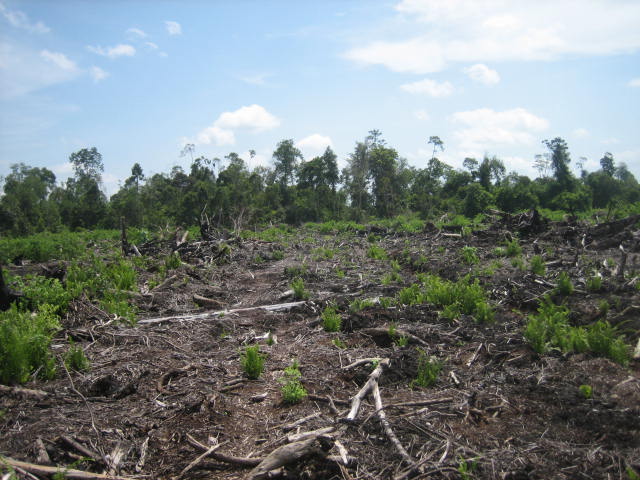
Degraded peat swamp forest behind an area cleared for an oil palm plantation. ©Lydia Cole
With the UNFCCC conference in its second week in Warsaw, carbon is in the limelight. While high-profile market-based initiatives such as REDD-plus focus on forest carbon, freshwater ecosystems with significant stocks – such as peatlands – are comparatively overlooked in carbon finance. But Lydia Cole argues these unique wetlands are a critical piece of the emissions puzzle. Cole’s work focuses on tropical peat swamp forests, which hold the most dense terrestrial carbon stocks on the planet – about 500 Gt in 4 million square kilometers, just 3% of the terrestrial surface. Cole, who recently completed her DPhil at Oxford’s Biodiversity Institute, is the first subject of BioFresh’s “Young Thinkers” series, showcasing the work that early-career researchers are doing at BioFresh-linked universities.
An ecologist by training, Cole became interested in tropical peat swamp forests during her master’s studies at Oxford, as she studied the issues surrounding palm oil production. Initially focusing on the role of Imperata grasses in taking over degraded areas, she transferred her energies to peat swamp forests after traveling to Sarawak for fieldwork and seeing the rapid rate at which extensive tracts are being drained for agriculture. Through counting fossil pollen preserved in peat cores dating back up to 5,000 years ago, she studied the role of fire and human land conversion and concluded that while fire had always been a part of peat swamp forest ecosystems, it had rapidly increased in the last two hundred years, coinciding with significant human land-use change and a likely loss of resilience in the ecosystem. Once peat swamp forests are drained for agriculture, the stored organic carbon, normally protected in the water-logged environment of an intact peatland, becomes exposed to the air and oxidizes and produces carbon dioxide. The areas also become much more susceptible to fires, which release even greater amounts of carbon dioxide – globally, equivalent to at least 6% of fossil fuel emissions every year. “It’s really a disaster that they’re being converted,” says Cole.
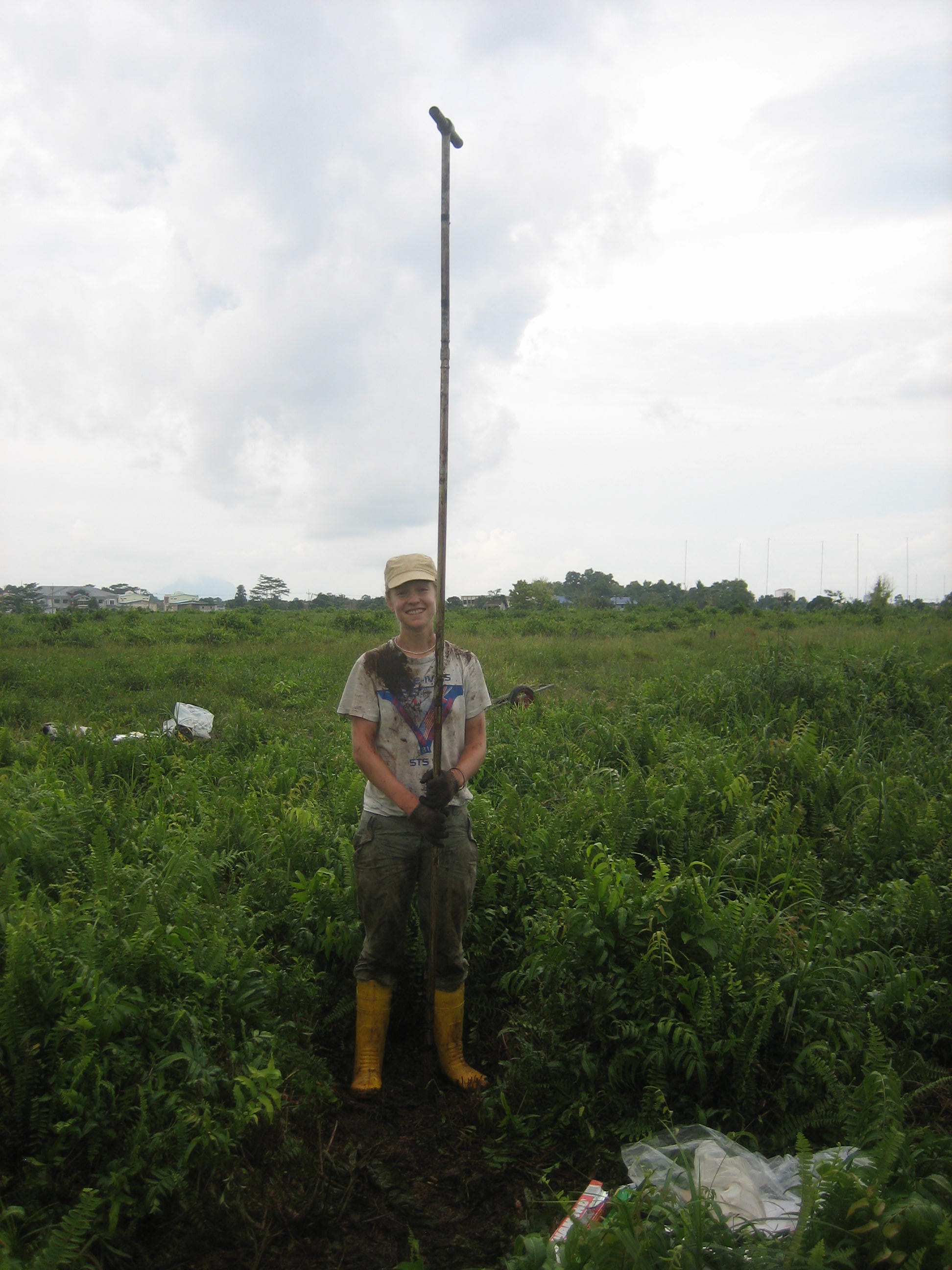
Lydia Cole has studied the resilience of peat swamp forests in Sarawak, Malaysia, using fossil pollen cores
After finishing her degree, Cole is spending several months testing the waters of the business world, working with Rezatec to develop a means to quantify carbon stocks held within peat. If this is successful, peatland conservation projects may be able to join in global carbon markets. “Not being able to quantify the carbon is slowing down the potential to conserve peat swamp forests,” says Cole. “Big businesses are becoming more comfortable with forest carbon, but very few people know about peat carbon.” Cole will be working with Rezatec for 8 months, trying to find a way to simplify the complex process of calculating how much carbon is stored in peat. “I’ve always wanted to be very applied, to feed research into very practical conservation issues,” Cole says. “The next 8 months I see as a way of assessing one aspect of potential [peatland] conservation.”
Although currently peatlands aren’t a popular carbon-trading option because of uncertainty in how to measure the carbon being stored, Cole says that there are several reasons why they match well with carbon markets. For one thing, in Sarawak she found that in general the peatlands have fewer land rights issues than other forested areas, because there are fewer people living or extracting resources from them. There are also co-benefits – for example, they supply water to several of the major cities, because in their intact state they remain wet all year round. In some areas there is also the potential for eco-tourism, as species such as orangutans may retreat into intact peat swamp forest refuges. But perhaps the best incentive is the urgency of the issue – peat swamp forests are some of the most vulnerable areas to conversion, particularly in nations such as Malaysia which are aggressively pursuing oil palm agriculture.
Why peatlands? Cole says that she often gets that question from friends and colleagues. “They just couldn’t understand why I was interested in this muddy, swampy, mosquito-ridden ecosystem, coming from the UK,” says Cole. But aside from being fascinated with the peat swamp forests themselves, the fact that not many people are interested – in Malaysia or elsewhere – means that there’s the potential to make a difference. Peat forests are a particularly important carbon sink, and a particularly vulnerable one, but for Cole they highlight the threats facing many ecosystems. “To be someone who does care, I feel it’s important that I keep caring, keep working towards a positive change,” she says.










 The Freshwater Blog