Global migratory fish populations have declined by 81% since 1970: but river restoration projects offer hope

Global migratory fish populations have declined by 81% since 1970, according to a major new report released last week. This startling decline has been documented in freshwaters across the world, with particular severity in Europe, Latin America and the Caribbean.
The new Living Planet Index for Migratory Freshwater Fishes states that the downward trend in migratory fish populations represents an annual decline of 3.3%, and is largely the result of habitat degradation and loss coupled with human over-exploitation. The report cites that a key driver of migratory fish declines is the fragmentation of rivers and the blockage of migration routes due to dams, weirs and other barriers.
The report – which monitored 1,864 populations of 284 migratory fish species across the world between 1970 and 2020 – states that habitat loss and degradation – which also includes the conversation of wetlands for agriculture – accounts for half of the threats to migratory species. Overfishing, increasing pollution and the growing impacts of the climate emergency all also contribute to the cocktail of pressures faced by migratory fish.
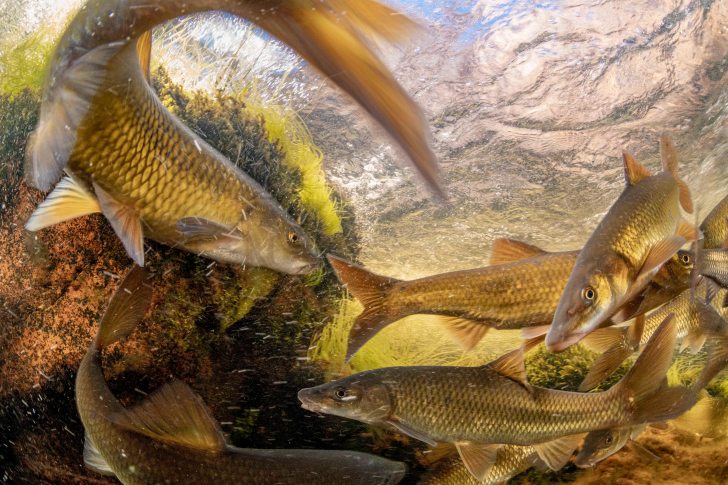
Populations of migratory salmon, trout, eel and sturgeon – alongside numerous other species – are not only vital to healthy freshwater ecosystems, but they also support the food security and livelihoods of millions of people who live around rivers, lakes and wetlands. This is particularly the case in areas of Africa, Asia and Latin America, where migratory fish support the livelihoods of tens of millions of people through fisheries, global trade and recreational angling.
“The catastrophic decline in migratory fish populations is a deafening wake-up call for the world. We must act now to save these keystone species and their rivers,” said Herman Wanningen, founder of the World Fish Migration Foundation. “Migratory fish are central to the cultures of many Indigenous Peoples, nourish millions of people across the globe, and sustain a vast web of species and ecosystems. We cannot continue to let them slip silently away.”
Despite its startling headline figure, the report contains glimmers of hope. Nearly one-third of the monitored migratory fish species populations have increased since 1970. The authors suggest that this means river restoration projects such as dam removals, habitat restoration and fisheries management can have positive effects on the health of migratory fish populations.

The report – supported by the World Fish Migration Foundation, ZSL, IUCN, The Nature Conservancy (TNC), Wetlands International and WWF – highlights that thousands of river barriers are being removed across Europe and USA. In 2023, 487 barriers were removed across Europe (an increase of 50% on the previous year), whilst in the USA, some of the largest dam removals in history are underway along the Klamath River in California and Oregon.
The challenge is to keep the momentum behind these initiatives growing, to help restore free-flowing rivers that not only benefit migratory fish, but also the wider ecosystem and human communities. The embattled EU Nature Restoration Law – if passed – contains an imperative for European countries to restore 25,000km of free-flowing rivers across Europe, whilst in the USA the the White House’s America the Beautiful Freshwater Challenge Partnership offers the largest freshwater restoration and protection initiative in history. Moreover, major freshwater projects such as MERLIN are providing valuable tools for environmental managers seeking to implement and upscale restoration activities across Europe.
“In the face of declining migratory freshwater fish populations, urgent collective action is imperative,” said Michele Thieme, Deputy Director, Freshwater at WWF-US. “Prioritising river protection, restoration, and connectivity is key to safeguarding these species, which provide food and livelihoods for millions of people around the world. Let’s unite in this crucial endeavour, guided by science and shared commitment, to ensure abundance for generations to come.”
Read the 2024 Living Planet Index for Migratory Freshwater Fishes
///










 The Freshwater Blog
Comments are closed.