Should wildlife films contribute to the conservation of the environments they film?
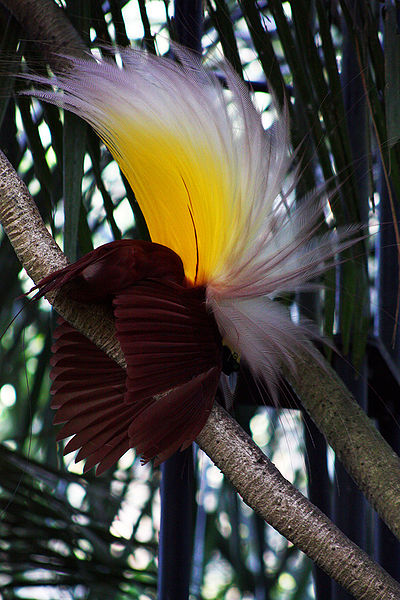
The Bird of Paradise: a favourite subject for wildlife filmmakers (Image: Wikipedia)
Ask many environmentalists to explain their early inspirations for becoming interested in the natural world and it’s likely that watching wildlife documentaries is likely to rank highly. However, beyond sparking a warm, fuzzy engagement with the representations of the natural world found in such films, can the wildlife filmmaking industry do more to contribute to the conservation of the environments it features?
A new paper in the journal Science by BioFresh partner Paul Jepson at Oxford University and colleagues Kate Jones at Zoological Society of London, Steve Jennings at Oxfam and Tim Hodgetts at Oxford University suggests that media corporations that make and broadcast wildlife programmes and films should pay towards the cost of nature conservation. It is suggested that this extra funding could come from innovatively extending the existing ‘Payments for Ecosystem Services’ funding mechanism.
The authors argue that the global conservation movement is critically underfunded, and there is a pressing need to find new and innovative funding for conservation initiatives. In the context of recent political focus on the value of the services that nature provides, it is suggested that global media companies that make money from wildlife films should pay for the environmental services they use in the same way other companies have begun to do. This would provide a guaranteed and sustainable source of funds for conservation, in comparison to the currently fragmented and ad hoc contributions made by media corporations.
Media corporations would make payments to a conservation trust fund, which would be used to finance on-the-ground conservation, says the paper. In return for this contribution, their wildlife films could carry a certification ‘kitemark’ similar to the Forest Stewardship Council or Marine Stewardship Council schemes. In this way consumers could be guaranteed that they are supporting corporations that actively contribute to conservation.
It could be suggested that wildlife films already contribute to the environmental movement by raising awareness and promoting public engagement with environmental issues (see for example the recent Frozen Planet series). However, the article argues that there is little empirical evidence to support this claim, instead suggesting that the proposed scheme gives a direct, clear link between a wildlife film and increased funding for the environment it features.
Dr Jepson concludes: ‘Our aim is to start a conversation. We all love wildlife films and want to secure the fabulous environments where they are filmed for generations to come. Rather than just leaving the audience with a warm, fuzzy feeling about the animals and places that have featured, we need to think about how we might harness the appeal of these programmes in an organised way that can benefit nature conservation. My hope is that filmmakers, broadcasters, academics and conservation professionals can come together to create innovative ways through which the wildlife media can pay for conservation.’
Dr Jepson continues: “From an academic perspective, our article has three aims. First, to explore the boundaries of the ecosystem services framework: what entities is it feasible to apply PES principles to? Second, to conceptualise new institutional arrangements for conservation governance and the potential to “blend” different approaches, namely certification and a capital asset trust. Third, to draw attention to the under-researched nature of the relationship between the wildlife media and contemporary environmentalism.”
Some useful links:
DNA barcoding: a new ‘master key’ for identifying species?

Crick's original DNA sketch (1953). Image: Science Photo Library
DNA barcoding – identifying the species of an animal through its DNA, much like a supermarket scanner reads a barcode – may sound like a concept from a dystopian futuristic film. However, recent work culminating in the Fourth International Barcode of Life conference last week suggests the technology holds rich possibilities for species identification, for scientists and consumers alike.
In essence, if a ‘master reference library’ of species DNA can be assembled and made available, then this can be used to identify an animal using a short snippet of its DNA. This data is currently being assembled – The Barcode of Life database currently holds reference DNA for over 167,000 species, and is growing rapidly.
The concept has been gaining traction since it was suggested in a 2003 article by Canadian scientist Paul Hebert and provides scientists with the ability to identify species in previously tricky situations, such as from predator’s dung, animals trapped in permafrost, or microbes in water (which in turn can indicate water quality).
There are also likely to be benefits for consumers looking to be sure of the food they eat and the medicines they take. For example, restaurants could use the technology to authenticate the provenance of the fish they buy. In October 2011, the US Food and Drug Administration approved the technology for just this purpose.
The public health and biodiversity conservation value of barcoding is stated in the press release issued by the conference: “In 2007, several people became seriously ill from eating illegally imported toxic pufferfish from China that had been mislabeled as monkfish to circumvent U.S. import restrictions. Endangered species are also sold as more common fish varieties”.
More information:
Two new BioFresh publications: homogenisation of fish populations and the effect of bridges on mayflies

Invasive Asian carp jump in the Illinois River, USA Credit: Nerissa Michaels / Illinois River Biological Station
Two fascinating journal articles have been recently published by BioFresh partners. The first, “Homogenization patterns of the world’s freshwater fish faunas” was co-authored by Thierry Oberdorff, a BioFresh scientist based at the Institut de Recherche pour le Développement (IRD) in France. You can download the article here.
Cultural homogenisation – a McDonald’s and Starbucks in every global city – is a widely discussed (and often derided) topic. However, similar processes of global hyperconnectivity in how people, food andother resources are shipped around the world are causing researchers to investigate the so-called biodiversity “Homogecene”. The “Homogecene” is a term coined to describe how the rapid invasion of non-native species into new habitats around the world (a process we’ve covered before) has caused the extinction of many unique and locally specific populations of species, causing a “levelling out” or homogenisation of the patterns in which species are distributed around the world. The article investigates the effect of the “Homogecene” on global freshwater fish populations, following previous work on freshwater invasions.
Positively, the authors suggest that this process of biodiversity homogenisation is not as pronounced for freshwater fish as for other taxa. This is due to the way that many freshwater basins – including lakes, rivers and wetlands – are highly isolated from others, making invasions less common than on land. To put it simply, it is more difficult (if not highly unlikely) for a fish to “invade” one river basin from another unassisted (although see this amazing entry into the Cabinet of Freshwater Curiosites), than it is for a species of bird to “invade” another terrestrial (land-based) habitat. However, the authors note that in a number of highly altered river basins in the Nearctic (Northern America) and Palearctic (Europe, northern Africa and Asia), biological homogenisation is proving more severe. As such, understanding freshwater ecosystem invasions and the resulting effects on the homogenisation of biodiversity is a key topic for future work.
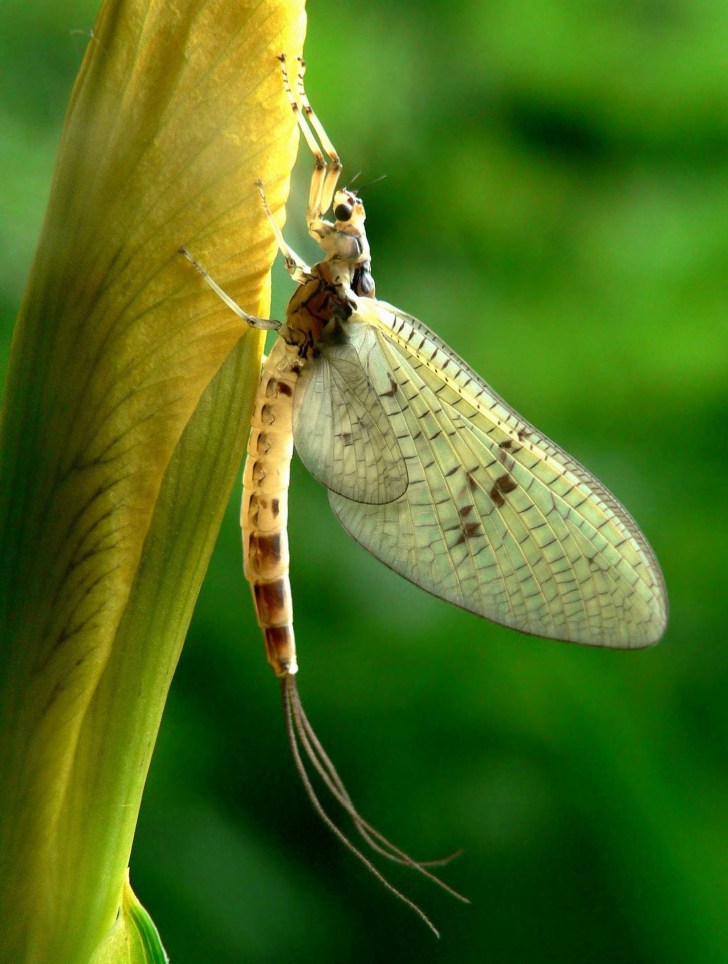
(c) Colin Ebdon Prize winner National Insect Week 2008. National Insect Week 2012 runs 25 June - 1 July http://www.nationalinsectweek.co.uk
A second paper by BioFresh scientist Szabolcs Lengyel at the University of Debrecen and colleagues called “Bridges as optical barriers and population disruptors for the mayfly Palingenia longicauda: An overlooked threat to freshwater biodiversity?” has already been covered on this blog (you can read a fascinating description of the paper by Szabi himself here). However, it has just received a full publication through the Journal of Insect Conservation. You can download the paper for free here. And if this piques your interest in mayflies, there’s a wealth of writing, audio, video and other resources on these amazing wee insects through the BioFresh “Mayfly Week” held in May 2011.

Rapids near the Inga Dam on the Congo River, Democratic Republic of Congo. Image courtesy of R. Schelly
A press release circulated today states that energy ministers in the Democratic Republic of Congo (DRC) and South Africa have signed a memorandum of understanding to start development of the first phase of the proposed 40,000-MW Grand Inga hydroelectric project on the DRC’s highly biodiverse Congo River. However, this is the latest development in a lengthy process of debate and negotiation over the environmental effects of such a large-scale project on the Inga Falls, and the energy and economic benefits such a dam may provide (for example this and this).
South Africa President Jacob Zuma states:
“The agreement aims at starting the development of large-scale power generation in sub-Saharan Africa, with particular focus on hydropower resources,” Zuma said. “If further seeks to realize the biggest hydropower project, which will not only benefit the people of Congo but will also benefit the entire African continent.
The Grand Inga complex, falling within the Bas-Congo Strategic Development Corridor that forms part of the SADC (Southern Africa Development Community) Regional Indicative Strategic Development Plan in the eastern part of the Democratic Republic of Congo, could potentially generate 40,000 MW,” Zuma said. “The plant would be able to supply electricity to 500 million people on the continent. This partnership is therefore an important milestone for the two countries.”
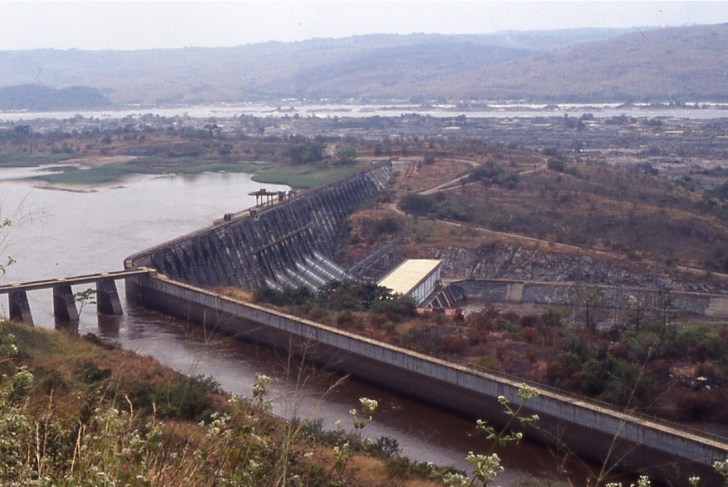
Current hydroelectric development on the Inga Falls. Image: Wikipedia
An ongoing debate
As Kate Showers, a researcher at the University of Sussex, explains in a 2009 paper on the subject, the idea of using the River Congo— the second largest river on earth – for electricity production has existed for nearly a century, originally in response to post-World War II industrial pressures on colonial powers. The energy production potential of the 96 metre high Inga Falls is now attracting attention as a means of generating low-carbon, renewable power as a catalyst for socioeconomic development. There are already two, small and relatively inefficient dams at the location, generating around 1,775 MW of electricity. However, Showers raises concerns over the potential environmental impacts of large-scale hydro-power development on the Inga Falls, stating (2009: 31): “Rivers across the continent (Africa – ed) have been dammed in the name of ‘development’, benefiting elites and international corporations with scant regard for environmental consequences.”
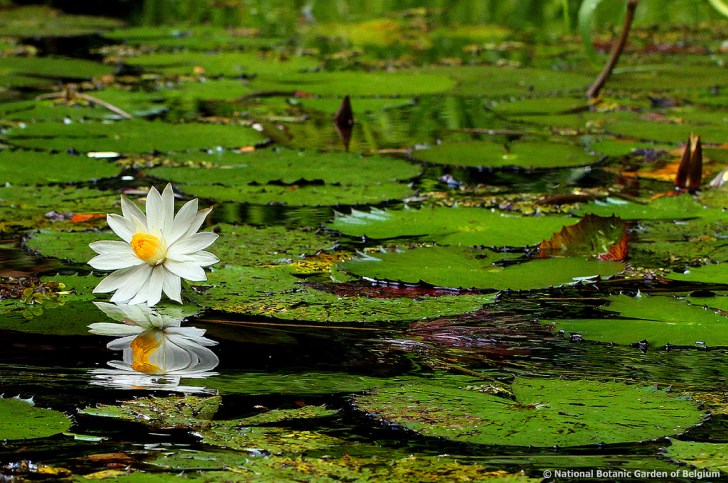
Nymphaea Lotus Lily on the Congo river, from Aaike De Wever's article. Image: Bart Wursten
Congo basin biodiversity
The Congo river is highly biodiverse, home to at least 686 fish species, including the incredible Goliath Tiger Fish, at least 80% of which are found nowhere else on Earth (a phenomenon known as endemism). A recent article by BioFresh partner Aaike De Wever described the amazing diversity of aquatic life found on a recent scientific expedition through the Congo Basin. However, as research such as this 2001 IUCN report suggests, large dams may negatively impact freshwater biodiversity by affecting river flows, sedimentation, flooding patterns and migration routes.
Showers also suggests that changes to the Congo’s river flow may also have global scale impacts on climate. The river’s influence does not stop where it meets the sea, as Showers states: “A vast submarine canyon extending 730 km from the coast and ending in a 300,000 km2 fan on the ocean floor serves as a major conduit of terrestrial minerals and carbon to the deep sea. On the surface, the river’s plume has been detected 800 km offshore. Accumulating marine evidence indicates the Congo’s significant influence on the equatorial Atlantic, which, in turn, is central to many climate change models.”.
Weighing up the debate: energy and environment
It is clear that there are many issues to weigh up in this debate. Where are the trade-offs between energy production, socio-economic development and environmental degradation? How can the multiple scales that these processes play out at be understood and managed?
What is your opinion? Add your voice to the debate in the comments below.
IPBES: a frog in a well?
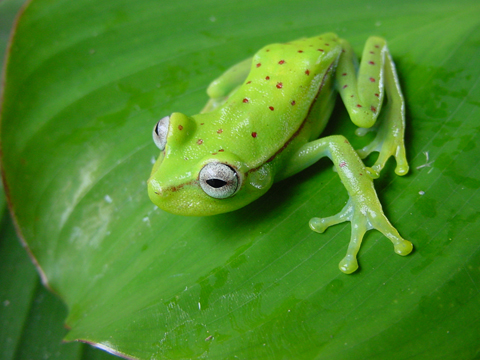
A yellow frog (Hyla punctata) native to the Colombian Amazon, one of the tropical areas where amphibians are at risk from climate change and deforestation: Image: http://rydberg.biology.colostate.edu
BioFresh partner Hendrik Segers follows his previous piece for the blog with an update on the progress of the formation of IPBES, a global, intergovernmental agreement designed to support biodiversity conservation.
From 3 to 7 October 2011 government representatives, scientists, policy makers and NGOs convened at the United Nations Environment Programme (UNEP) headquarters in Nairobi, Kenya, in a “first session of a plenary meeting to determine modalities and institutional arrangements for an Intergovernmental Science-Policy Platform on Biodiversity and Ecosystem Services (IPBES)”. This meeting is the most recent in an on-going process that should finally lead towards the establishment of an IPBES, which should become for the biodiversity debate what the Intergovernmental Panel on Climate Change (IPCC) signifies for the climate debate. In a nutshell, the IPBES process emanates from the Millennium Ecosystem Assessment (MA) that, from 2001 to 2005, successfully prepared an assessment of the consequences of ecosystem change for human well-being, involving the work of more than 1,360 experts worldwide.
The process was formally initiated at the “Biodiversity, Science and Governance” conference (Paris, January 2005), by the establishment of an International Mechanism of Scientific Expertise on Biodiversity (IMoSEB). The latter mechanism lead to three subsequent “ad-hoc Intergovernmental and Multi Stakeholder Meeting on an IPBES” (2008 – 2010), at the end of which governments finally adopted the Busan Outcome . This agreement included decisions that a scientifically independent IPBES should be established, in collaboration with existing initiatives on biodiversity and ecosystem services. It was then also agreed to invite the UN General Assembly (UNGA) to consider the conclusions of the meeting and take appropriate action for establishing an IPBES. The present meeting, convened by the United Nations Environmental Programme, is the most recent development in the process.
Integrating freshwater ecology and biodiversity conservation

- Image: http://deerlakewatershed.org
Freshwater ecosystems – our lakes and rivers – are so important to our wellbeing yet we are hampered by a lack of understanding of the ecological interactions and processes that shape and produce the services they provide. A new journal review in Ecological Indicators by Juergen Geist at the Technische Universität München in Germany proposes an “Integrative Freshwater Ecology and Biodiversity Conservation” (IFEBC) as an attempt to holistically understand and manage freshwater environments at all levels, from the ecosystem down to the cellular and molecular.
Freshwater ecosystems are incredibly diverse – thought to hold about 10% of all global animal species. However, they are amongst the most highly altered and threatened environments on earth, vulnerable to pollution, abstraction, species invasions and over-extraction. The IFEBC proposes how freshwater ecosystems (and their functions) might be modelled using a range of factors at all scales that control the spatial and temporal (i.e. over time) distribution of aquatic biodiversity and productivity as a means of managing freshwaters in response to these threats.
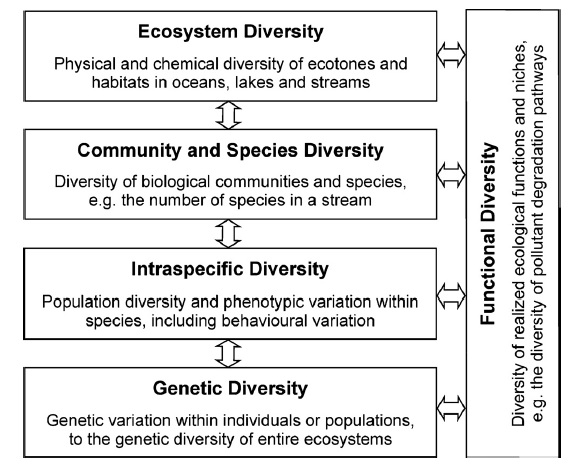
Biodiversity in aquatic ecosystems is in an interconnected hierarchy (Image: Geist 2011)
You can read the full paper here, and a useful illustration of the key arguments is given in the diagram above. It shows how biodiversity through a freshwater ecosystem is interconnected in a hierarchy, where different levels of diversity connect and interact. The ecosystem function (and the resulting services it can provide) is a result of these interrelated levels of diversity. However, Geist suggests that not only will understanding this multi-scale ecosystem diversity entail more analysis, modelling and interpretation of freshwater ecosystems, it will also require increased co-operation between different researchers from different disciplines, all working on different scales. However, despite these logistic challenges, the IFEBC proposes a clear and useful basis for how we might better understand and conserve our rivers and lakes.
Explosive dam removal promotes salmon migration
This incredible video shows timelapse footage of the demolition of the 40 metre high Conduit Dam on the White Salmon River in Washington State, USA. Ecologists hope that the dam removal will allow salmon to migrate upstream to spawn, previously impossible due to the impassable dam. The return of salmon to the river’s headwaters is hoped to improve the health of the wider ecosystem (more on this phenomenon here).
Read the full story on the National Geographic and the White Salmon Restored site.
Ghosts of Gone Birds

Meet the BioFresh team: Daniel Hering
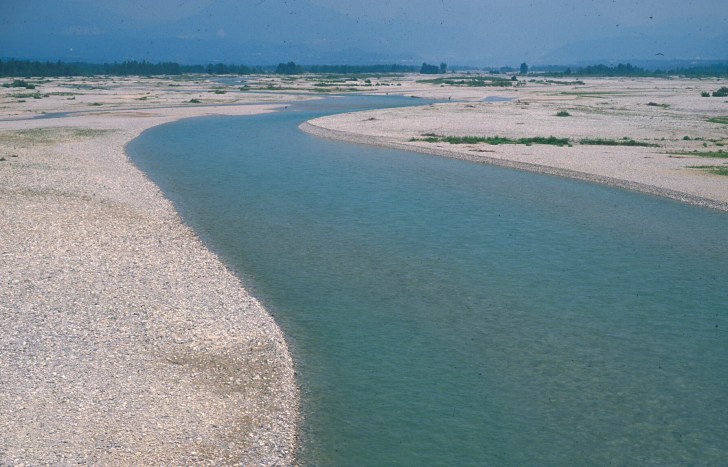
Tagliamento River in North-East Italy showing impressive riparian zones. Image: D Hering
We continue our series of interviews with BioFresh partners this week with Prof. Daniel Hering from the University of Duisburg-Essen in Germany. Prof. Hering is the coordinator of several national and international projects on Water Framework Directive implementation and river restoration. He leads BioFresh Work Package 6, which aims to understand how freshwater biodiversity will respond to stresses such as climate change.
 1 What is the focus of your work with BioFresh, and why?
My colleagues and I compare the responses of biota to stress between different freshwater ecosystem types. In the past we have analysed how fish, invertebrates, higher plants and algae respond to different types of stress in rivers. In BioFresh, we are adding a “third dimension” by comparing organism groups in lakes, rivers, ponds, riparian wetlands and potentially in groundwaters.
Our previous work was mainly dedicated to the implementation of a European policy, the Water Framework Directive, and thus of direct policy relevance. BioFresh, as a whole, is much broader, with components of basic science and a strong dissemination target. Our work in BioFresh has implications for restoring and protecting European freshwater ecosystems, as we compare how biota react to different types of stressors (nutrient enrichment, organic pollution, habitat degradation, acidification, temperature increase) and the drivers causing these stressors.
For rivers in large parts of Europe it is obvious that current agricultural practises are a main threat to aquatic ecosystems and their biota. Agriculture is increasingly competing with freshwater ecosystems for water, in intensively used areas corn if often planted close to the river shores, leading to inputs of fine sediments, pesticides and nutrients. Protection and restoration of freshwater biota (and also the targets of the Water Framework Directive) will not be achievable without some of agricultural practises at least in the riparian zones.
Still, many scientists (and also many conservationists) are reluctant to share their data. In certain cases, there might be good reasons for being reluctant: e.g. the fear of wrongly interpreted complex and sensitive data. However, as a whole, this attitude is an obstacle for the advancement of science. In the field of freshwater biodiversity a lot is invested in monitoring rivers and lakes; the data, however, are not centrally stored, often even not on a national level, and are thus not available for scientists and conservation groups. I think that BioFresh can contribute to changing this attitude – at least, BioFresh is collating a lot of data and making them publicly available. This is a showcase – and hopefully a starting point for a constantly growing portal. Read more…
New BioFresh newsletter published
The October 2011 issue of the BioFresh newsletter has been published! It features a range of information on research, news and plans for the BioFresh project.
You can read it through the interactive Issuu publication above.









 The Freshwater Blog