Does ecosystem services need a radical critique? In conversation with Prof Veronica Strang
After Veronica Strang presented her insights on bioethics developed through ‘thinking with water’ (see last post), I discussed with her the relevance of her thinking to policy and on-going discussions on the ecosystem services framework.
Several of Veronica’s points have stuck with me. One was her comment that we see ourselves as rational beings, yet in Ecosystem Services we are adopting a policy frame that places humans outside systems and this seems irrational! A second was her reflection that ‘if you reframe cultural meaning as an ecosystem service it is sort of missing the point of culture!”
I am sure you will find this video conversation with Veronica thought provoking and challenging. It reinforces my view that the ecosystem services policy frame would benefit from a radical and multi-disciplinary academic critique. Please share you thoughts and reflections on the issues raised with other readers of this blog via the comments box.
Read other articles in our Special Feature on Freshwater Biodiversity and Ecosystem Services
Professor Veronica Strang: Thinking with Water
The EC funds BioFresh to strengthen the scientific basis of policies intended to conserve biodiversity. Increasingly our science – the questions, analysis and communication of our findings – need to be aligned with the Ecosystem Services Framework. Demonstrating links between freshwater biodiversity and ecosystem services requires sophisticated and multi-scalar understandings of freshwater ecosystem processes and function, something that may be beyond current scientific capacity. Reflecting this situation, I have heard several BioFresh colleagues express concern that the ESF marginalises the ethical basis of policies linked to freshwater biodiversity.
It was for this reason that I asked Martin Sharman to contribute his perspective on the Ethics and Ecosystem Services. His post is already No4 in the BioFresh rankings of most viewed posts: it promoted a rich discussion on the LinkedIn Biodiversity Professionals group. There is clearly a desire to discuss ethics!
A little while ago, while herding my children out to school, I caught on the radio the phrase “water is good to think through a new bioethics”. The lady talking was Professor Veronica Strang, Director of the Institute of Advanced Study at the University of Durham. Veronica kindly agree to share her thinking with us in this video presentation. Her fascinating and deep insight adds a cultural anthropology perspective to the discussion initiated by Martin and bears direct relevance to the issue of oil exploration in Lake Edward/Virunga National Park introduced by Susanne Schmitt.
Please post your reactions to Veronica’s video presentation in the comments box and discuss with others.
Read other articles in our Special Feature on Freshwater Biodiversity and Ecosystem Services
 This guest post by Dr Susanne Schmitt flags the significance for Africa’s freshwater biodiversity of WWF’s major new campaign to stop oil exploration in the Virunga World Heritage Site. Susanne is WWF-UK’s Extractive and Infrastructure Manager.
Today my organization launched a global campaign to stop oil exploration by the British oil company SOCO International in Virunga National Park, Democratic Republic of Congo (DRC). Virunga is famous as Africa’s first National Park (established 1925) and for its Mountain Gorillas. Virunga is the most biologically diverse protected area in Africa, including 216 endemic species. Based on this outstanding universal value Virunga National Park was declared a World Heritage Site in 1979, becoming one of only 193 natural WHS, which altogether cover less than 0.5% of the earth surface. Conservationist have bravely worked to protect the park in the face of the spill-over impacts of the Rwandan genocide (800,000 refugees living within the park for several years) and repeated civil unrest and conflict: in the last decade 130 rangers have given their lives defending this WHS against poachers and other incursions. WWF has decided its time to “Draw The Line”. We can’t let these efforts and sacrifice go to waste by risking to lose the park for commercial gain, because Soco is allowed to search for oil.
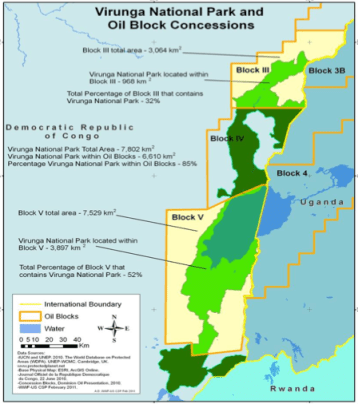
Map of Virunga National Park and World Heritage site showing Block V owned by Soco and the overlap with Lake Edward.
Soco is a FTSE 250 listed company that operates in the DRC Congo under the subsidiary, Soco Exploration and Production DRC Sprl (Soco). It has a license to explore for oil in the southern part of the park : Block V (see map) covers 2/3rds of the area of Lake Edward (the remaining 3rd is in Uganda). WWF is calling for Soco to pull out of Virunga and to publicly commit to stop oil exploration and exploitation in Virunga and to respect the Park’s current boundaries, in addition to publicly commit to respecting all World Heritage Sites and appropriate buffer zones. Following successful campaigning by WWF France, Total – who hold the Block III concession, which overlaps with the north of Virunga NP – have committed to stay outside the current boundaries of Virunga National Park, but have not made the wider commitment to respecting the boundaries of all WHS. The only major oil company that has made such a global commitment is Shell. We want Soco to act responsibly and do the same.
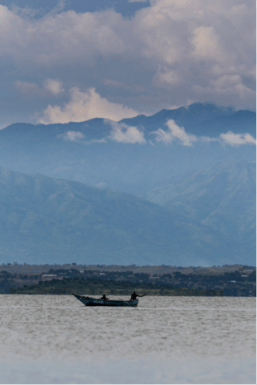
© naturepl.com/Christophe Corteau/WWF-Canon
I am appealing to freshwater scientists, policy makers and managers to support us in this campaign. Lake Edward together with Lake Albert feeds the White Nile. It is a Ramsar site, Important Bird Area and Key Freshwater Biodiversity Area. Lakes Malawi and Tanganyika are the most species rich areas in the Eastern African region with a maximum of 382 species recorded within a single 28 x 28 km grid cell, but Lakes Victoria, Albert, George, and Edward are close behind with up to 160 species recorded within a single 28 x 28 km grid cell.
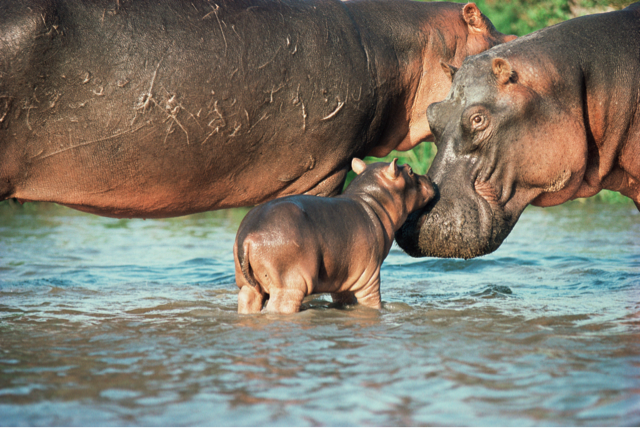
Lake Edward’s productivity fell following the decimation of its 25,000 strong hippopotamus herd (the largest in Africa) during the civil unrest (1990-2007) but the hippo population and the lake’s fisheries upon which 28,000 jobs depend are recovering. The WWF-commissioned report ‘The Economic Value of Virunga” puts the current fisheries value at US$ 30m possible, which could rise to as much as US$ 90m with better management and restored hippo populations. Lake Edward and its wetlands are an irreplaceable part of our global natural heritage they deserve to be restored not damaged further.
© naturepl.com/Karl Amann/WWF-Canon
Generally speaking lakes are more bounded than, for example, the marine environment and thus the impacts of spills and other accidents could be serious and long lasting. This is particularly the case in the African Great Lakes due to long water retention times and low flushing rates, making them particularly vulnerable to pollution. Oil exploration involves seismic surveys from ships followed by test drilling. Seismic booms –generated with the use of explosives – are reported to cause localised fish kills and may have wider impacts on ecosystems and livelihoods. Industry insiders have told WWF that test drilling without leaks of oil or injected chemicals would be very difficult to achieve.
If Soco finds commercial viable oil reserves then it is likely to proceed to exploration or may sell the asset on to another oil company. Eastern DRC has a history of conflict involving multiple rebel factions, financing their operations from, so called, conflict minerals (diamonds, gold, coltan). Oil would potentially be adding another conflict resource, as pointed out by the International Crisis group’s 2012 report, Black Gold in the Congo. The building and operating of an oil infrastructure in this unstable context would be reckless from both environmental and human rights perspectives.
© naturepl.com/Edwin Giesbers/WWF-Canon
Lake Edward is not an isolated case. The string of Rift Valley lakes are in the spotlight for oil exploration: Lakes Albert, Tanganyika and Malawi all have active exploration concessions. As well as flagging wider threats to African freshwater biodiversity, WWF’s campaign highlights the bigger issues of apparently growing pressure to extract oil and minerals from within the boundaries of natural world heritage sites – see for example the threats to the Great Barrier Reef from plans for a huge port development to export coal.
You can support our campaign in several ways. By signing the petition on our campaign web-site, by re-tweeting us – #SOSvirunga, by adding comment to on-line news reports and by briefing yourself on WWF’s calls to Soco, governments and investors in our campaign advocacy report. In addition I would be grateful for comments on this post that could help strengthen the freshwater arguments of our campaign.
Thanks in advance.
What rivers do for us
In this latest contribution to our special feature on freshwater biodiversity and ecosystem services, Dr Christian Feld reviews the services provided by river ecosystems
River ecosystems encompass river channels and its floodplains and form a diverse mosaic of habitats with the riparian area at the transition zone between the land and water. During flood events, water and sediment are transported onto the floodplain and provide the nutrients that render river ecosystems highly productive. Conversely, floodplains (and other wetlands) constitute important sinks of river nutrients and sediments and, hence, contribute substantially to a river’s self-purification. They act as a sponge and regulate the water volume, as they cut off flood peaks and release water during low-flow conditions. Floodplains, especially the riparian areas, provide the river channel with carbon (organic matter) which is essential for sustaining riverine plant, animal and micro-organism communities in many regions of Europe.
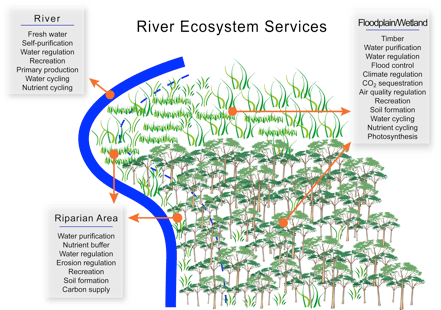
Looking more precisely at the specific services provided by river ecosystems, their important role for human well-being becomes obvious. Nearly everywhere on Earth, people depend on rivers for fresh water supply and sanitation purposes. But there are many more services linked with rivers and floodplains besides these fundamental human needs. This schematic provides an overview of the major provisioning (e.g. fresh water and timber supply), regulatory (e.g. water and erosion regulation, self-purification), cultural (recreation and ecotourism) and supporting (e.g. soil formation, nutrient and water cycling) services provided by freshwater ecosystems.
Major ecosystem services provided by rivers, riparian areas and floodplains/wetlands in Europe.
Harrison, P.A., Gary W. Luck, G.A., Feld, C.K & M. T. Sykes (2010) Assessment of Ecosystem Services. In: Settele, J., Penev. P., Georgiev.T., Grabaum, R., Grobelnik, V., Hammen, V., Klot.S., Kotarac, M., & IKuhn (Eds): Atlas of Biodiversity Risk. Pensoft, Sofia, pp 8-9.
Ecosystem services are sometimes valued in monetary terms for use in policy- and decision-making. This is relatively straightforward for provisioning services such as water and timber supply where market values exist. However, it is more difficult and often controversial for many regulatory and supporting services for which the direct benefits to people are not as clear. Nevertheless, several studies have provided values for river and floodplain ecosystem services. The Danube floodplain and wetlands, especially their regulatory role as a nutrient sink, have been valued at 650 Million Euro per year (Gren et al. 1995). On a global scale, an annual total value of 4,879 Trillion US$ has been estimated for wetlands and 3,231 Trillion US$ for floodplains (including swamps) or, altogether, around 24 % of the total annual ecosystems services’ value on Earth (Costanza et al. 1997).
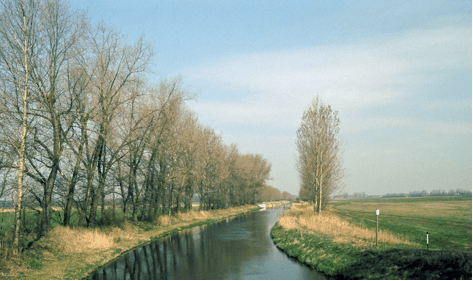
In agricultural landscapes, mixed riparian buffers composed of trees and grass strips can effectively retain sediment from surface run-off and nutrients from the upper groundwater layer (Dosskey 2001). Photo of River Nuthe in Brandenburg, Germany taken by Christian Feld.
Read other articles in our Special Feature on Freshwater Biodiversity and Ecosystem Services
Details of the scientific papers mentioned
Costanza, R., d’Arge, R., groot, R.d., Farber, S., Grasso, M., Hannon, B., Limburg, K., Naeem, S., O’Neill, R.V., Paruelo, J., Raskin, R.G., Sutton, P., & Belt, M.v.d. (1997). The value of the world’s ecosystem services and natural capital. Nature, 387, 253-260.
Dosskey, M.G. (2001) Toward quantifying water pollution abatement in response to installing buffers on crop land. Environmental Management, 28(5), 577-598.
Gren, I.-M., Groth, K.-H., & Sylvén, M. (1995). Economic values of Danube floodplains. Journal of Environmental Management, 45, 333-345.
Meet the team: Christian Feld
In our latest addition to our meet the team series, Christian Feld took some time out from his usual work assessing the health of rivers a to tell us about his work and inspirations. Christian is an aquatic biologist at the University of Duisberg-Essen and has expertise in river assessment, multivariate statistics, hydromorphology, and the analysis of biodiversity patterns.

1. What is the focus of your work for BioFresh, and why?
In BioFresh, me and my workpackage partners are interested in the effects of human ecosystem alteration on aquatic biodiversity. The team consists of experts in the realm of river, lake, wetland and groundwater biodiversity, which is why we are able to compare the response patterns of biodiversity among these different systems. With response patterns, we refer to changes in species richness or the dominance structure of species within a community. For example, plant or insect species richness are supposed to decline under human impacts from agricultural or urban land uses. That is why we use a tremendous amount of data from different freshwater ecosystems to seek for the relationship between species richness on the one hand and intensive human land uses on the other. But it is not only land use we are interested in. Human alteration (often referred to as “stress“) is manifold and may include pollution, habitat degradation or even temperature effects due to climate change.
2. How is your work relevant to policy makers, conservationists and/or the general public?
As the aim is to identify response patterns of biodiversity to human impact on rivers, lakes, wetlands and groundwaters, the outcome of our studies can inform policy makers and conservationists about the threat that these “stressors“ impose on aquatic diversity. We know that biodiversity continues to decline rapidly, worldwide and particularly in freshwater ecosystems. Thus, we need to urge, but also help decision makers halt the loss of diversity. If we can inform them about the main threats of biodiversity, they shall be able to initiate measures that can mitigate biodiversity loss. Our results show, for instance, that intensive agriculture is linked to the loss of river fish and insect diversity. Consequently, we suggest that such intensive forms of land use be buffered by riparian vegetation – trees, shrubs and grassland. Such buffers reduce the adverse effects of agriculture on the river ecosystem and can help improve the riverine organisms diversity.
3. Why is the BioFresh project important?
BioFresh is an excellent initiative that brings together the key experts in European freshwater science and beyond. But more importantly, our team involves the applied sector, that is organisations such as the International Union on the Conservation of Nature (IUCN). I think that our project is a strong example of how scientists and practitioners can collaborate from the very beginning. Another strength of BioFresh is the data portal, which offers a great opportunity for scientists around the world to access and analyse global biodiversity data. This data will also be visualised through the BioFresh Atlas, so that our website has potential to become a future hot spot of freshwater biodiversity information.
4. What inspired you to become a scientist? 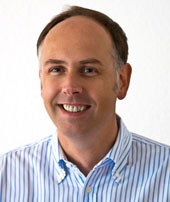
This is a good question. And a difficult one. I’ve never thought about before., but probably it was my mentor during the diploma phase at the end of my studies at the University of Marburg in Germany. He is retired now, but used to be one of the “old-school“ limnologists. He was a brilliant teacher and showed me how we can make use of the tiny organisms in streams and rivers to let them tell us about their living conditions. In other words, he taught me river assessment using biological indicators. This was linked to my Diploma thesis and later on became the focus of my dissertation at the University of Duisburg-Essen, Germany. I’m still working on bioassessment systems and I love it.
5. What are your plans and ambitions for your future scientific work?
I think my most ambitious plan is to fully understand my research. I’m not kidding. During the many projects and studies I was involved in during the past thirteen years, I generated data, analysed data and published the outcome. But with each publication, there were new questions raised. With each analysis, new ideas arose. This, of course, is important as it is what drives science forward. But every once in a while, we scientists need to step back and think for a while. Think about how the bits and pieces may come together. Think about how our results could help practitioners doing their job more effectively. This is my ambition for the future.
A tour of EU-commissioned research on ecosystem services
In the second part of her guest video post, Dr Paula Harrison takes us on a brief and highly informative tour of the landscape of EU-commissioned biodiversity and ecosystem research.
Here are links to the projects mentioned by Paula
OpenNESS -Operationalisation of Natural Capital and Ecosystem Services
OPERAs -Operational Potential of Ecosystem Research Applications
RUBICODE – Rationalising Biodiversity Conservation in Dynamic Ecosystems
BESAFE – Biodiversity and Ecosystem Services: Arguments for our Future Environment
SPIRAL- Science Policy Interfaces for Biodiversity Research, Action and Learning
KNEU – Developing a Knowledge Network for European Expertise on Biodiversity and Ecosystem Services to Inform Policy Making in Economic Sectors
PRESS – PEER Research on EcoSystem Services
CLIMSAVE – Climate Change Integrated Assessment Methodology for Cross-sectoral Adaption and Vulnerability in Europe
LIASE – an Interdisciplinary Community of IA Researchers and Practitioners
STEP – Status and Trends of European Pollinators
Motive – Models for Adaptive Forest Management
ALARM – Assessing Large Scale Risks for Biodiversity with Tested Methods
Ecochange- Biodiversity and Ecosystem Changes in Europe
Read other articles in our Special Feature on Freshwater Biodiversity and Ecosystem Services
Operationalising the ecosystem services concept: Dr Paula Harrison introduces two major new EU projects
Dr Paula Harrison has been involved in EU-commissioned biodiversity research for over twenty years. In this short video interview she outlines the aims and activities of two major new projects – OpenNESS and OPERAs – that aim to operationalise the concept of ecosystems services by applying it to a range of management problems. Together these two projects involve researchers from over 60 institutions across Europe and represent a five-year, Euro 18 million investment in ecosystem services research.
In the second part of this interview Paula will take us on a tour of EU-commission biodiversity and ecosystem research projects.
Read other articles in our Special Feature on Freshwater Biodiversity and Ecosystem Services
In this guest post Martin Sharman opens up a rich area of debate by arguing that as a policy concept, ecosystem services puts human wants first and foremost and undermines moral-aesthetic value arguments for conservation that are widely held in society.
A “resource” is something that is useful to someone. A “natural resource” is something in the natural environment that a human can use to satisfy want or increase wellbeing.
To adopt this vocabulary is to adopt a forthright utilitarian view of the natural environment, and implicitly to accept that human benefit is the only good. Not only is human benefit the only good, but it is quantifiable – for if not, then we can never agree on what constitutes a resource, or who has the greater right to it. Thus someone who speaks of natural resources accepts, again implicitly, that happiness and wellbeing can be quantified. The vocabulary also requires that this quantified human benefit remains, if not constant, then comparable over cultures and generations.
More than this: the wellbeing of the “resource” is insignificant. It is only by setting concern for the wellbeing of the resource to zero that one can regard it as merely something to satisfy human want. Human benefit is the only good. This is the First Commandment; in the limpid words of the King James version of the bible, thou shalt have no other gods before me.
 In this observation lies much of the moral argument against the concept of ecosystem services: just as oranges are not the only fruit, so humans are not the only species.
The concept of ecosystem services is one thing; the premise of its proponents is another. It is, in short, that conservation based on intrinsic value of biodiversity has failed to stop the loss of species, ecosystems, and the complex web of interactions between them. Since an ethical argument has failed, then we should try self-interest. By demonstrating that human wellbeing is increased by the services rendered by ecosystems, we can motivate people to protect the source of the service – biodiversity.
We know that conservation is not working because we continue to lose biodiversity. Oh yeah? This is the equivalent of me deciding that my accelerator is not working because my car is losing speed. Why is such a daft non-sequitur accepted by otherwise intelligent people? You immediately thought of many reasons my car might be losing speed – I have the brakes on, I’m going up a hill, I’ve run out of fuel, I’ve run into sand, I’ve hit an oncoming truck. The obvious reason that we are losing biodiversity is the memento mori that stares at us from our looking glass – biodiversity loss is the inevitable result of our debt-based economic system and our swelling population’s unsustainable demands on nature. We all know that. Why do we mutely accept the dangerously diversionary nonsense that “biodiversity is being lost because conservation is not working”?
Ecosystem services takes the utilitarian logic of natural resources one important step further. A “service” by definition benefits humans. If we are to protect services only if they benefit humans, then what happens to the useless ecosystems? Are they simply to be cemented over?
I recently heard a discussion in which one person said “most people are useless”, meaning that they are surplus to requirement. The outrage that this provoked was spearheaded by someone saying that you can never prove that anyone is useless, because you can never know enough about their contribution to their social fabric. So does this mean that you can never show that an ecosystem is useless? If so that leaves the ecosystem services argument saying that because some ecosystems benefit humans, we have to protect every ecosystem.

Which may be the right answer, but why reach it by such objectionable means?
For those of us with a reverence of nature, the ecosystem services rhetoric and mindset are abhorrent, being fundamentally immoral and unethical. They take the most ecologically damaging invasive species in the history of life, and place it above all other species on Earth. They cast all other – voiceless – species in the role of consumables. This mindset might have worked for Homo habilis. It will not work for Homo sapiens.
Martin was the policy offer responsible for biodiversity and ecosystems in the European Commission’s DG Research & Innovation up until his retirement last November. During his career he made an enormous contribution to biodiversity research and policy, including the initiation of the BioFresh project. The opinions expressed in this post are, of course, his own and are not intended to represent a position of either the Commission or BioFresh.
Read other articles in our Special Feature on Freshwater Biodiversity and Ecosystem Services
Five things to do on Danube Day
Today is International Danube Day – a day to celebrate this great trans-European river and the achievements of 18 years of international collaboration that has lead to a cleaner and safer river.

If you live within reach of the Danube or one of its tributaries there is really only one thing to do – turn off your PC or put away your mobile device and head out to spend the afternoon with the flow of the Danube. Once there you’ll easily find five things to do. Before you do log-off you may want to check out if there is a celebration happening near you.

The Schloegen double bend of the Danube river in Upper Austria. Source Wikimedia Commons: Author Techcollector
If, like me, the Danube is out of reach physically why not spend of few minutes engaging with the river though the wonderful networks of cyberspace. You might like to:
- Fire up Google Earth and follow the Danube along its 2,872 km journey from Donaueschingen in Germany’s Black Forest to the Black Sea where it’s delta forms the boundary between Romania and Ukraine.
- Open up Flickr, type ‘River Danube’ into the search box and browse through the myriad photos of the river uploaded by the community.
- Google ‘Sturgeon’ and brief yourself on the ecology, plight and cultural history of these fantastic but endangered life forms. “Get active for the sturgeons” is the slogan of today’s Danube Day.
- Explore the web-site of the International Commission for the Protection of the Danube River. Brief yourself on what’s going on and what needs to be done to better conserve the biodiversity, traditions and economies that the river supports. Watch the video message from EU Commissioner for Regional Development Johannes Hahn.
- Lastly, and perhaps mostly importantly, do something however small to contribute to efforts to conserve and restore this special river. This might be as simple as tweeting a reflection (don’t forget to #Danube) or posting a comment on this or another blog or something, or something a little more substantive such as emailing your MEP expressing your support for activities to protect the Danube. Nowadays, most countries have web-portals that make it easy to write to MEPs such as this one for the UK.
Today, find some time to be with the Danube where-ever you are!
Paul Jepson
In this latest addition to our ecosystem services special feature, we highlight the LIVING RIVERS Foundation, an organisation that is working to protect and promote the amazing array of ecosystem services that our rivers provide.

Fishing boats on the Niger River Delta. Photo: Living Earth.
Rivers are a key part of our landscape. In their natural form they are a source of beauty. They provide us with places of recreation and they host a great variety of fascinating freshwater plants and animals. However, natural river landscapes are under threat from pollution and changes in land use. In addition, all over the world rivers are straightened, embanked and backed-up. As a result diverse river systems become homogeneous, wetlands disappear and water birds, fish, amphibians and other water depending organisms become fewer or even extinct.
 The LIVING RIVERS Foundation is a small and young non-governmental organisation that is working protect our natural river landscapes and help rehabilitate degraded rivers. They do so by gathering, developing and exchanging information around river ecology and management. The intention is to network and bring experts, professionals and all those who feel committed to healthy river ecosystems together. They conduct event that bring people together, develop online educational material, and produce policy papers to influence the political discussion on river ecosystem conservation.
The LIVING RIVERS Foundation are currently focusing on the topic of ecosystem services of rivers. Lisa Schülting from the foundation told BioFresh that ‘as a small NGO we want to bring those experts together to address crucial scientific and political questions about [the ecosystem services of rivers].” “Which are the actual benefits of a natural ecosystem? Which services of a river may be monetised? What are the costs for the society if natural river processes and functions are altered? And can the concept be used to measure sustainability of a river? And, finally, which benefits are gained by river restorations and how can the concept be helpful regarding the Water Framework Directive, where might be conflicts?” asks Ms. Schülting.
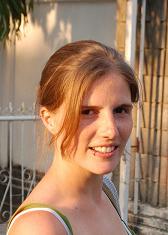
Lisa Schülting from the LIVING RIVERS Foundation
Earlier this year, the LIVING RIVERS Foundation hosted a workshop discussing these and other questions with researchers and experts from governmental and non-governmental organisations working in this field. According to Schülting, the main findings of the workshop were that “the [ecosystem services] concept can help people to understand the importance of river protection. It won’t substitute other concepts, but will serve as an additional communication instrument. The concept can be helpful to show how valuable natural river ecosystems are and what costs society has to carry if they get destroyed.” In addition, Schülting believes that in the context of the Water Framework Directive, the ecosystem services concept “might offer the option to better understand the services lost if there is a deterioration from a good status. However, a lot of open questions have to be answered.”
Based on the outcomes of the workshop the Foundation will host a symposium on ecosystem services of rivers on October 23-24 with approximately 100 researchers and professionals to participate. You can find out more about the LIVING RIVERS Foundation and their work on their website and for any questions or suggestions you can contact them at info@living-rivers.org.
Read other articles in our Special Feature on Freshwater Biodiversity and Ecosystem Services







 The Freshwater Blog