BioFresh policy briefs: biodiversity-conscious priority setting
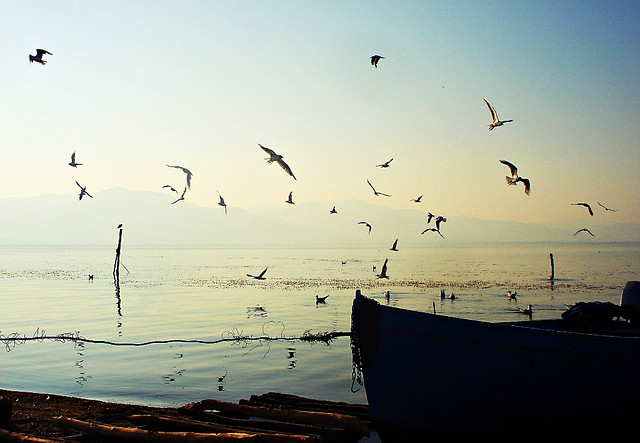
Image Source: UNDP in Europe and Central Asia (CC BY-NC-SA 2.0)
Prior to the EU strategic dialogue workshop on the science-policy interface being held this week, participants (including BioFresh) were asked to supply responses and proposals addressing key research needs identified by policy-makers. This will provide the focus for discussion as BioFresh and other participating organisations meet in Brussels for the workshop. Researchers and policy-makers will work together to identify ways to achieve better collaboration between EU-funded research projects and to direct research activities towards concrete policy needs, as well as helping communication at the science-policy interface. BioFresh is publishing its set of three policy briefs (Numbers 3, 4, and 5) on research and policy priorities for protecting freshwater ecosystems and biodiversity. These briefs present BioFresh’s contribution to the workshop and draw attention to the need for long-term, large-scale research into the full range of services that freshwater ecosystems provide. Freshwater ecosystems are under threat in the EU and freshwater biodiversity continues to decline, failing to meet the objectives of the Habitats and Water Framework Directives. This is in part because current policy focuses on provisioning services and basic, immediate human needs, such as energy production through hydropower, at the expense of freshwater habitats and species. Instead, the EU needs integrated policymaking with a long-term, holistic outlook to tackle the continuing loss of biodiversity and the conflict between resource development and biodiversity directives. The key points of the briefs are summarised below.
‘By the Dam.’ Author: Vilseskogen (CC BY-NC 2.0)
Issue No. 3: Is biodiversity being left behind? Freshwater ecosystems hold unparalleled species diversity, but are amongst the most threatened in Europe. Prioritizing short-term, often localized benefits in ecosystem provisioning services (such as hydropower) is degrading habitats and damaging cultural and regulatory services such as carbon storage, making it impossible for Europe to meet policy goals under the Habitats and Water Framework Directives. The brief calls for ‘biodiversity-conscious priority setting,’ considering the full range of services that freshwater ecosystems provide, as well as improving the knowledge of ecosystems’ status and threats, to use EU funding resources to the greatest advantage.
Issue No. 4: Alleviating stress on freshwater biodiversity. Freshwater ecosystems in Europe need stronger protection, having been neglected in recent conservation activity. Major stressors are the continuing modification of rivers for hydropower installations, as well as massive abstraction of water in the Mediterranean and the uncontrolled spread of invasive species, which to some extent result from misled or incoherent policy. Aligning policy on agriculture, water, energy, biodiversity, and other related issues can help ease the pressure on freshwater systems, and will require wider participation from regional and local stakeholders.
Issue No. 5: The water-food-energy security nexus: Where do freshwater ecosystems fit in? Water has a ‘hybrid identity’ as both a medium for all life and a resource for humanity. Policy-makers need to look beyond the current focus on providing basic human needs, such as food and security, to considering all human needs, including cultural, aesthetic and cognitive needs. This requires large-scale design experiments and research on water-dependent sectors as well as communication and engagement to reframe public perceptions of water.
BioFresh to participate in EU Science-Policy Interface Workshop
This month, BioFresh will take part together with several other FP7-funded projects in a science-policy interface workshop organised by the European Commission’s Directorate General for Research and Innovation (DG-RTD). The workshop, “Biodiversity and Ecosystem Services: A Strategic Dialogue between Science and Policy,” will try to develop ways in which the EU can promote effective communication between EU research projects and policy, as well as encouraging “science-science dialogue” between different FP7-funded projects on biodiversity and ecosystem services.
The workshop will address a number of goals:
* Achieving better communication between research and EU policy,
* Helping EU-funded projects to maximize their contribution to developing and implementing policy, in the context of current instruments such as the EU Biodiversity Strategy to 2020 and other policy needs
* Identifying areas in which research projects can collaborate – on scientific and technical issues, but also communication and science-policy strategies
* Looking ahead to future EU research priorities – especially in the areas of ecosystem services and natural capital, with a focus on innovation under the nascent Horizon 2020.
Photo: Zach Stern [CC BY-NC-ND 2.0]
http://www.flickr.com/photos/zachstern/87431231
Such “co-production” of questions is a critical step in developing policy-relevant research, and this pre-workshop activity in itself is a valuable move to aid science-policy dialogue. During the workshop, participants will take part in interactive sessions such as plenary talks and round table discussions, to make the most of the wide range of expertise present, and to work on obtaining concrete results.
In fact, it is hoped that the workshop will provide the groundwork to promote ongoing exchanges not only between policymakers and project coordinators, but also amongst project coordinators themselves. Particularly in light of increasing global interest in ecosystem services, the workshop sets an important objective in exploring how best to integrate research on biodiversity and ecosystem services.
Effective science-policy communication is a perennial challenge, but DG RTD is well-placed to showcase the benefits of such a strategic dialogue. Its broad reach into various arenas of research and policy means that effective integration has both a greater urgency and a potentially higher payoff. Having both the science and the policy concerned within the same European frameworks also lowers some of the barriers to successful collaboration. The workshop can point to models for the wider science-policy interface and can encourage more efficient use of scientific research to answer the questions that need to be asked for effective policy.
Burtynsky creates art from the human-water relationship, written large on the landscape

Colorado River Delta #2, ©Edward Burtynsky. www.edwardburtynsky.com
Describing his newest subject, Canadian photographer Edward Burtynsky comes right to the point. “Water is not optional,” says Burtynsky on his website. “It is the ultimate thing that provides for life, and if humans don’t have it, they have to leave the area, it’s as simple as that.” A fairly self-evident statement, it seems. But the truth is, that we forget water’s presence almost completely, on a daily basis. Western infrastructure pushes water out of sight, to the background, below-ground – often so effectively we don’t even notice how it permeates our lives, never mind think about not having enough water for the asking.
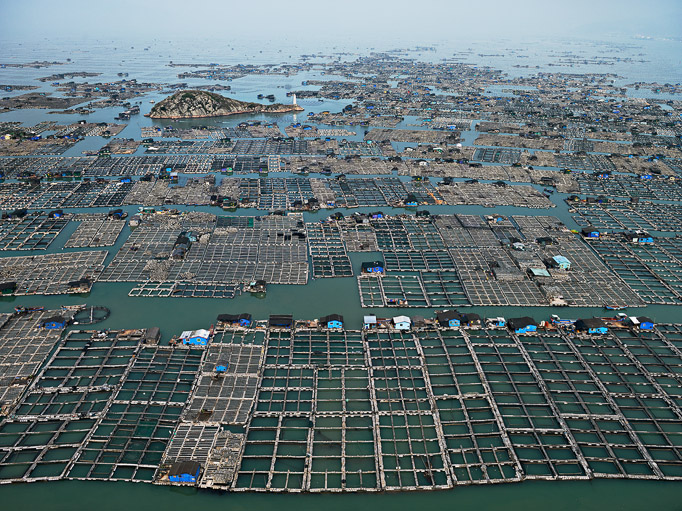
Marine Aquaculture #1, ©Edward Burtynsky. www.edwardburtynsky.com
Burtynsky’s five-year odyssey, the “Water Project,” aims to change that. Burtynsky takes as his subject not only water – in all its forms – but also its lack, inscribed on the physical landscape. “Water is intermittently introduced as a victim, a partner, a protagonist, a lure, a source, an end, a threat and a pleasure,” writes Russell Lord, curator at NOMA. “Water is also often completely absent from the pictures. Burtynsky instead focuses on the visual and physical effects of the lack of water, giving its absence an even more powerful presence.”
The project divorces us from our normal viewpoint – peering over a dam wall, gazing across a field – to sweep us up and deposit us in the skies, looking down sometimes thousands of feet to the world below. Whether this celestial perspective is godlike or humbling depends on the viewer, but it certainly allows us to appreciate the weird, unsettling beauty in our footprint as a species. Burtynsky’s austere geometry and very subtle use of color strips away any comforting insulation we might have, but equally makes no overt claims as we see the results of our handywork – pivot irrigation in the deserts of the Southwest United States or winter dryland farming in Spain, the fragile grid of abalone aquaculture or titanic dam projects in China, the soft mosaic of oil on the waves in the Deepwater Horizon disaster.
Alongside the photography, the Water Project includes the film Watermark, and a book, Burtynsky – Water. The film, a feature documentary from Burtynsky, Jennifer Paichwal and Nick de Pencier, is their second collaboration after Manufactured Landscapes in 2006, and was selected for the Toronto Film Festival. To achieve the sweeping aerial shots that are the hallmark of his style, Burtynsky uses all the tools at his disposal, from a 50-foot pneumatic pole to fixed-wing planes and remote-controlled helicopters.
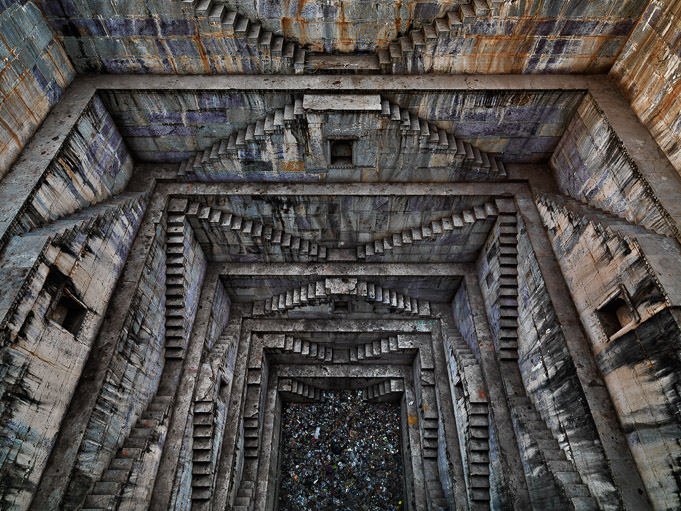
Stepwell #4, ©Edward Burtynsky. www.edwardburtynsky.com
Some of his subjects celebrate beauty without apology – the impressionist swathe of a pristine Icelandic river, a kaleidoscope of colors as 30 million people gather in Allahabad to bathe during the Kumbh Mela. But there are turns where art blossoms in unexpected, unsettling subjects – such as “Stepwell #4” in Rajasthan, India, or the desert delta of the Colorado River, cut off from the sea. Burtynsky’s view from his perch is detached, austere – almost clinical. Yet there is an uncomfortable beauty here that raises equally uncomfortable questions. Does aesthetic appreciation of the almost extinct Colorado River make us newly complicit in its demise? Or does it merely draw attention to the fact that we have been complicit all along? Whatever the answer, the Water Project invites questions on a grand scale, revealing how our dance with our most fundamental resource sculpts the landscapes around us. The link between art and activism can be fraught, and Burtynsky states on his website that his goal is simply to provoke thought: “My hope is that these pictures will stimulate a process of thinking about something essential to our survival; something we often take for granted—until it’s gone.”
Burtynsky: Water is showing in London at the Flowers Gallery through November 23, as well as in Cologne at the Galerie Stefan Röpke. Watermark is not yet showing in Europe.
Biodiversity and conservation have long borrowed concepts and approaches from public health: consider the term ecosystem health or evidence-based conservation which applies systematic review methods pioneered in the medical sciences. One consequence of the failure to achieve targets associated with international environmental treaties is new investments in strengthening science-policy interfaces. The IPBES is a key development at the international level and two EU F7 projects SPIRAL and Biodiversity Knowledge initiative are developing structures and principles in an effort to improve the interaction of science with policy makers in DG RI and DG Environment.
Twitter, launched in 2006, is transforming information flows in society. In this video post, Dr Ruth Jepson of the Scottish Collaboration for Public Health Research & Policy, Edinburg University shares her experiences of creating a successful twitter feed: a knowledge brokering service building community among public health researchers, policy makers, politicians and members of interested publics.
Values in action: NWF Report on freshwater fish, thousands of jobs and angling heritage at risk from climate change
![Brook trout. Photo by Eric Engbretson, U.S. Fish and Wildlife Service [Public domain], via Wikimedia Commons](https://freshwaterblog.net/wp-content/uploads/2013/10/brook_trout_swims_in_native_stream_underwater_fish_image.jpg)
In the National Wildlife Federation’s recent report, “Swimming Upstream: Freshwater Fish in a Warming World,” the ecological, economic, and cultural costs of climate change go hand in hand. “For generations, Americans have taken their children and grandchildren to their local fishing hole, lake or stream for some low-cost, outdoor family fun,” the report begins. “But in recent decades, warming temperatures have begun to threaten our freshwater fish and the thousands of outdoor recreation jobs that depend on them.”
The report outlines the risks stacking up against freshwater fish with grim efficiency – suitable habitat for cold-water species may decline by 50 percent across the United States by the end of the century. Aside from warmer water, increased oxygen depletion and poorer mixing, more extreme weather and drought, and receding waters can all harm fish. In addition, climate change can exacerbate indirect threats – more frequent, intense wildfires increase the likelihood of erosion, while warmer temperatures can favor parasites like the sea lamprey and diseases such as Columnaris, which is becoming the “new normal” in hot years for some rivers. The report also draws attention to the southeastern United States’ value as a global aquatic hot spot (for example, the 290-mile long Duck River in Tennessee has more fish species than all of Europe) and shows how the range of brook trout may collapse under a business-as-usual emissions scenario in 2050.
This plays upon the biospheric area of what Israeli sociologist Shalom Schwartz terms “value clusters,” groups of individual values that describe people’s priorities. (For a more in-depth look at value clusters, see Common Cause’s summary here.) Value in the same cluster tend to be prioritized in similar ways, whereas values in widely distanced clusters are typically more likely to come into conflict. Traditionally, research suggests that environmental beliefs and actions are related to “self-transcendent values,” such as universalism, which encompasses social justice, as well as unity with nature. More recently, environmental psychologists have suggested that biospheric values, which stress the intrinsic worth of nature and the environment, as a separate cluster within self-transcendent values. In this report, NWF highlights such intrinsic value in American freshwater systems, by stressing its unique biodiversity as a freshwater hotspot and the fact that climate change will seriously harm fish and freshwater invertebrate species.
![Photo by Oregon Department of Fish & Wildlife [CC-BY-SA-2.0], via Wikimedia Commons](https://freshwaterblog.net/wp-content/uploads/2013/10/480px-flickr_-_oregon_department_of_fish__wildlife_-_5648_kobus_family_fishing_swart_odfw.jpg)
Photo by Oregon Department of Fish & Wildlife [CC-BY-SA-2.0], via Wikimedia Commons
Appealing to values that are all over the map – tradition and self-direction, altruism and stimulation – may serve to tie different constituencies together to achieve common goals. The report also brings in the economic case, citing a study that claims recreational freshwater fishing could face a loss of up to $6.4 billion annually by 2100, with thousands of fishing-dependent outdoor recreation jobs at stake. Certainly NWF isn’t the only organization to cite a range of reasons to tackle environmental issues, nor to add valuation to values by counting the possible economic costs. But it’s worth noting the values – and publics – that such documents address, as they make the case for particular policies. How effective is wedding such a range of values in promoting freshwater biodiversity? And what happens when values – preserving that family angling tradition versus protecting dwindling stocks, for example – come into conflict?
Data-sharing and “classical conservation:” Jörg Freyhof on ECOCASD in Kerala, India
![Sunrise over Agasthyakoodam Biological Park, Western Ghats. By Planemad [CC-BY-SA-3.0] via Wikimedia Commons](https://freshwaterblog.net/wp-content/uploads/2013/10/sunrise_over_agasthyakoodam_biological_park_western_ghats.jpg)
Sunrise over Agasthyakoodam Biological Park, Western Ghats. By Planemad [CC-BY-SA-3.0] via Wikimedia Commons
 Freyhof’s talk focused on the need for larger, holistic datasets to prioritize conservation action, and he says that the conference attendees clearly saw a need for open-access databases with quality-controlled data. This is an area where BioFresh could play a major role. By sharing expertise and infrastructure, the project can help partner organizations establish such platforms for other continents. Freyhof hopes that India can be a first step: the University of Kerala is interested in partnership, and can benefit from BioFresh’s existing infrastructure and adapt it to their own needs, creating a national platform.
For BioFresh, this is also an opportunity. Despite being a global project, the initiative has very few global partners, says Freyhof, and most of the data is from Europe. However, India already has not only enormous freshwater biodiversity, but has already collected a great deal of data about it. “They have huge programs to go to the field to assess biodiversity in all the national parks,” says Freyhof. “There are environmental impact assessments for some projects. There is a huge amount of data that’s available.”
As a country, India has unique needs and opportunities for conservation. The Western Ghats, which reach their southernmost extent in Kerala, are a biodiversity hotspot, and Freyhof noted that the focus on endemic species is strong: “They are very much aware that they are living in a hotspot and that it’s important for conservation.” He says that India maintains a much more classical outlook on conservation. “In Europe we have the impression that conservation is something from yesterday; now we only go for ecosystem services, and question everything reached in the last decades,” says Freyhof. “There, I had the impression that conservation has a real importance and they have an awareness that freshwater is in massive trouble.”
![Tehri Dam on the Bhagirat, one of the largest dams in the world. By Lingaraj, G. J. [CC-BY-2.0], via Wikimedia Commons](https://freshwaterblog.net/wp-content/uploads/2013/10/tehri_dam_on_the_bhagirathi_garhwal_india.jpg)
Tehri Dam on the Bhagirat, one of the largest dams in the world. By Lingaraj, G. J. [CC-BY-2.0], via Wikimedia Commons
Perspective: How long can biodiversity baselines be shifted?
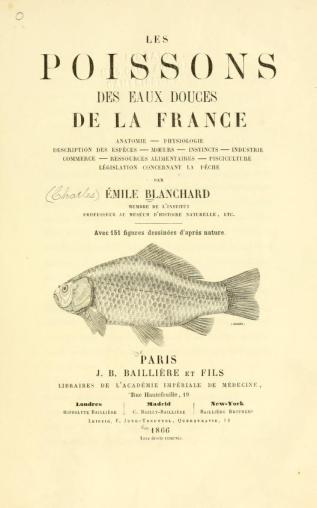
In this perspective, Nicolas Bailly, Biodiversity Informatics Scientist at WorldFish and BioFresh team member points to discussions of modern scientific concepts in an 1866 book on French fishes. He asks readers of the BioFreshblog if they know of other old literature discussing similar topics.

Charles Émile Blanchard
Reading through some old literature on freshwater fishes, I found a book published in 1866 on the freshwater fishes of France by Émile Blanchard, a professor at the Muséum National d’Histoire Naturelle in Paris.
I must admit I had never encountered it before, but it was well worth a read. The first pages have an extraordinary and strangely modern flavor in the context of BioFresh – and the sad reality of freshwater ecosystems worldwide. In particular, Blanchard discusses three very current concepts.
-
The shifting baseline concept
“[…] old fishermen remember a time when their nets brought heavier loads, when fishing provided better livelihood.”
-
The ecological foot print of cities
“Finally, there was not [in the remote past] these large cities that attract people and consume much of what is produced afar.”
-
The lack of long-term monitoring and data series
“We cannot, in truth, judge with absolute certainty the degree of fish abundance in ancient Gaul.”
-
Shifting baseline
The “shifting baseline” concept was developed by Pauly (1995): when we try to reconstruct past biodiversity, to draw a baseline for measuring biodiversity losses, we always think about the biodiversity status when we were young, or at the most, as described by our (great-)grand-parents. But previous generations have done the same thing. So the baseline we try to set up is constantly being redefined by successive generations, because no one actually succeeds in restoring biodiversity to their baseline. The text of Blanchard written 150 years ago is a perfect illustration.
Now the question that comes immediately in mind is: if there were the same complaints 150 years ago, perhaps started well before (there are texts on regulation of continental water fisheries known from the 15th century), how is it possible that there are still fish in our (European) rivers? Are scientists wrong when they foresee the loss of most of our biodiversity? Are their forecasts reliable?
The answer is not that simple, and requires hundreds of thousands if not millions of data (for example, the global fishery catch reconstruction performed by the Sea Around Us Project). It is the aim of the BioFresh portal to make these data available to scientists so they can improve their models, interpretations and predictions.
-
 Ecological footprint
Developed by Rees (1992), this is a measure of society’s demand on natural resources and ecosystem services. While we can actually see the demand in the countryside where villages are closely surrounded by nature, it remains virtual for citizens in megacities. Almost all what is consumed is seen only in human-built artifacts (food in supermarkets, water in pipes, power in wires, etc.). BioFresh has not directly addressed ecosystem services, but all the work done in this area can be used to help in valuing freshwater ecosystems.
-
Lack of long-term data series
When a young biodiversity scientist starts to search for data to build or test hypotheses, it is always a shock to discover that 1) very little is available; and 2) very few long-term monitoring programmes exist. There are particularly few long-term data series available for freshwater (e.g., Allan et al 2005).
Past generations have not managed to set up long-term observatories of biodiversity (in part because it’s hard to automate, unlike physical oceanography or meteorology). My generation hasn’t either, and some good initiatives like LTER (Long-Term Ecological Research) are drops in the ocean…or rather, in freshwater lakes, from a BioFresh perspective!
One of the results of BioFresh data gap analysis is that to make clear that these data must be acquired under planned activities: gathering data from a lot of sources is not usually enough to constitute a proper dataset for models that need many records, close together in space and time.
 I would propose the concept of “shifting responsibility” to describe the fact that no generation so far had the vision (and/or the courage) to set up such long-term biodiversity monitoring for the future. Or perhaps our generation could succeed with a proper organization of citizen science (science participative in French).
Are there other such concerns published in documents before the 20th century?
Is this just one book – an idea of a single man in those times, or did it express the concerns of a community of scientists or other visionaries?
I would like to hear about other concerns expressed before the 20th century in books, articles and reports, and from other countries. Please share and comment such references in the blog if you know about them (or send the reference to me by email). If there are enough, it could be worth opening a group in a reference management system such as Mendeley or Zotero. For my translation of the first section of Blanchard’s work, see the PDF file here.
References
Allan J.D., Abell R., Hogan Z., Revenga C., Taylor B.W., Welcomme R.L. and Winemiller K. 2005. Overfishing of Inland Waters. BioScience 55(2):1041-1051.
doi: 10.1641/0006-3568(2005)055[1041:OOIW]2.0.CO;2
Blanchard, Émile, 1866. Les poissons des eaux douces de la France : anatomie, physiologie, description des espèces, mœurs, instincts, industrie, commerce, ressources alimentaires, pisciculture, législation concernant la pêche. Paris: J.B. Baillière & Fils.
http://www.biodiversitylibrary.org/item/26728#page/7/mode/1up
Pauly, D. 1995. Anecdotes and the shifting baseline syndrome of fisheries. Trends in Ecology & Evolution. 10(10):430.
http://download.cell.com/trends/ecology-evolution/pdf/PIIS0169534700891715.pdf
Rees, W.E. 1992. Ecological footprints and appropriated carrying capacity: what urban economics leaves out. Environment and Urbanisation 4(2):121–130.
doi:10.1177/095624789200400212
Cabinet of Curiosities: Axolotl
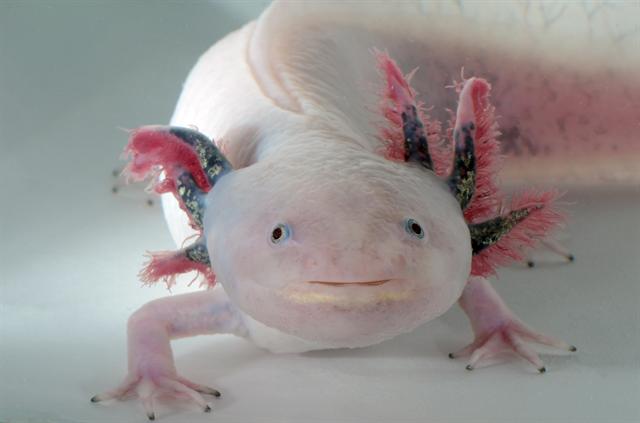
Ambystoma mexicanum by Biopix: N Sloth – CC-BY-NC
Lifelong tadpole, critically endangered, possessing “superhealing” abilities that could answer some of medicine’s greatest questions: the axolotl has a truly fascinating story. With rare exceptions, it seems to have lost interest in metamorphosis – unlike other amphibians, it stays in a larval stage for its entire life, keeping its plumage of external gills and never leaving the water. In the wild, it survives only in isolated parts of canals that once formed Lake Xochimilco, now almost completely subsumed by Mexico City. But it lives all over the world in captivity, as a popular aquarium pet and a research subject.
The axolotl’s “superhealing” has probably made it one of the most studied amphibians on earth: individuals are able to heal massive amounts of damage, regenerate entire lost limbs without scarring, and even regrow portions of their central nervous systems. This gives biomedical scientists hope that the species can provide clues for human medicine, with applications from burn treatment to cancer recovery. But even as its value to science grows, the its populations are shrinking: a team from the National Autonomous University of Mexico has estimated that there may be only 700 to 1200 axolotls left in the wild. Even as its regenerative abilities offer hope for science, how to save the axolotl from habitat loss, pollution and introduced competitors and diseases remains a question without an answer.
To find out more about this unique species, head over to its feature in the BioFresh Cabinet of Freshwater Curiosities!
First IRF European Riverprize awarded to River Rhine
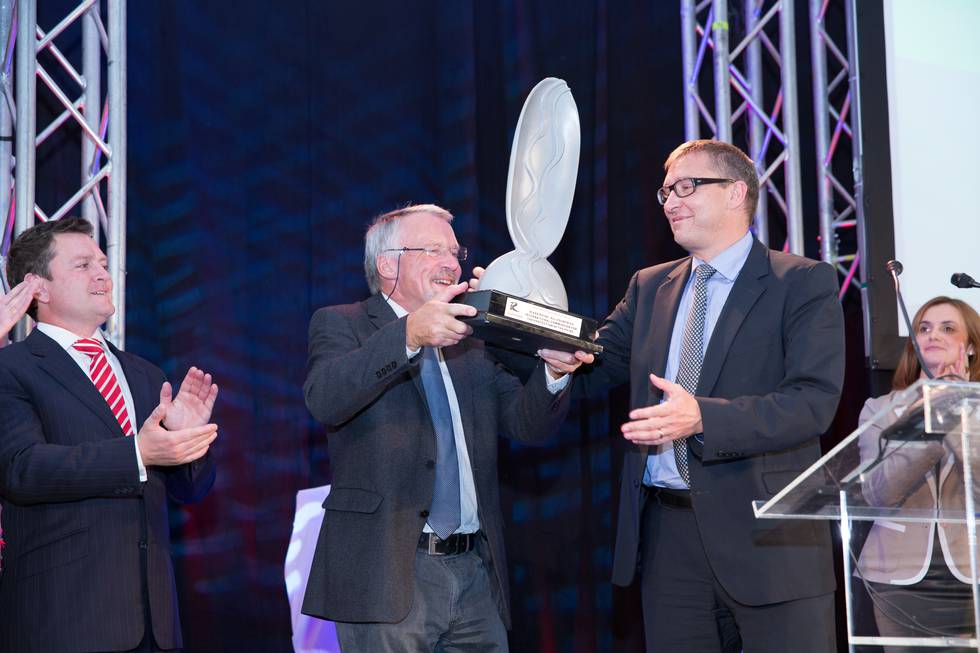
Awarding of the inaugural IRF European Riverprize to the River Rhine.
Photo courtesy of ICPR.
This September, the first IRF European Riverprize went to the River Rhine, during the 5th European River Restoration Conference (ERRC). The International Commission for the Protection of the Rhine (ICPR), has worked with other stakeholders to radically improve the river’s health as well as that of its biodiversity, after 50 years of river degradation and the catastrophic Sandoz chemical spill in 1986.
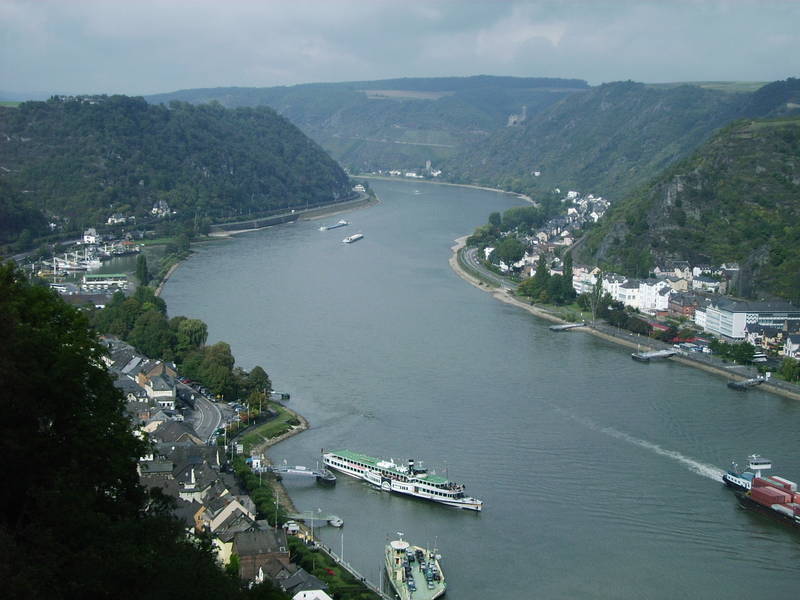
© Klaus Wendling, LUWG Rheinland-Pfalz, photo courtesy of ICPR
The European Riverprize event was initiated by the International River Foundation (IRF), along with the International Commission for Protection of Danube Basin (ICPDR) and the European Centre for River Restoration (ECRR). The prize is worth €40,000 and is sponsored by Coca-Cola Europe.
The European experts who made up the judging panel chose the Rhine because of its leadership and sophistication as well as its integrated approach. ICPR and other stakeholders have worked to change wastewater management and improve water quality, and have also adopted integrated policies to restore large floodplains in the Rhine delta. “As someone who was heavily involved in the successful Thiess International Riverprize bid by the Thames in 2010, I have to say that I was mightily impressed by the achievements of the Rhine,” said Alastair Driver, National Conservation Manager at the England’s Environment Agency and one of the judges. “To have achieved such dramatic improvements in the ecological quality of such a huge river through multi-national co-operation in just a few decades is truly remarkable.”

© Ulrich Haufe, photo courtesy of ICPR
For ICPR, this is a major waypoint along a path towards restoring the river to good ecological status. “Winning the prize underlines once more the vision of Rhine-Ministers in 1987, when they agreed upon the ambitious goal aimed at restoring the open sewer the Rhine was in the seventies into a living river where the salmon would return,” says Ben van de Wetering, ICPR’s General Secretary. “Indeed, this agreement marked for the ICPR the beginning of the development of an integrated river management for which we are now rewarded.” The prize, says van de Wetering, encourages his organisation to continue its work, as the river still has a way to go. One of the ICPR’s efforts is to restore upstream connectivity for a stable salmon population; it has helped restore upriver access to bypass about 480 obstacles since 2000. With its work programme Rhine 2020, the ICPR aims to put the Water Framework Directive requirements into concrete terms – such as making the river clean enough to swim in – as well as addressing other pan-European regulations such as the Flood directive.
By winning the prize, the Rhine will automatically be considered as a finalist for next year’s Thiess International Riverprize, which this year was awarded to the Mara River in Kenya, the first African river to win the prize in its 15-year history. The Rhine and the Mara now have the opportunity to participate in a “Twinning” program, to share their expertise with a peer river basin management organisation.
“Personally I think the IRF and its partners should be commended for creating this prize,” says Paul Jepson, who leads the communication work package of BioFresh. “In corporate and entertainment sectors, awards and prizes are part of professional sound practice. They showcase and reward best practice and create a culture of aspiration, pride and success that appeals to others. Faced with declines in freshwater biota, it is easy for scientists and river managers to convey a sense of doom and gloom. We need more such prizes to generate an outlook of positive environmentalism.”
Special issue of Hydrobiologia makes the case for unique Mediterranean-climate streams
Mediterranean-climate streams and rivers are ecologically unique, getting their distinctiveness from the double risk of both flood and drought. According to BioFresh partners Núria Bonada and Vincent Resh, they are also some of the most stressed rivers in the world. Bonada and Resh overview August’s special issue of Hydrobiologia, where the focus is all on such “med-rivers.” Their paper, a meta-assessment of over 20 review articles published in the issue, covers the unique qualities of these rivers and their threats, both natural and human-caused, as well as what management and research need to do about them.
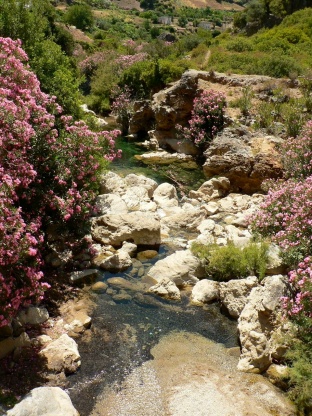
Mediterranean rivers and streams are unique both in their climatic conditions and their biodiversity. Photo courtesy Núria Bonada
Med-climate regions are found far beyond the Mediterranean basin itself. Rivers with a similar climate run through central Chile, coastal California, the Cape region of South Africa, and southwestern and southern Australia. These regions are unique because they fall in the middle the continuum between temperate climates and deserts, so life has to exist under special conditions. The signature of the Mediterranean climate is its strongly defined seasons, with hot, dry summers and cooler, rainy winters. Both flooding and drought are regular events for species living in med-rivers; however, as Bonada and Resh point out, the intensity of those events is not so predictable.
The swing from flood to drought and back again means that in order to survive in such varying conditions, species need a unique set of adaptations. Inhabitants of med-rivers, says Resh, “must be able to cope with dry-season droughts that result in reductions and sometime even loss of habitat, coupled with wet-season flooding,” and the adaptations for each extreme are very different. These adaptations echo across widely separated regions – explorers in the mid-1700s to the Cape, Chile, and Australia all noticed plants that strongly resembled Mediterranean species. Even species communities change as the seasons wax and wane, so visiting a med-river in the dry season, you might find different species dominating than in winter. “Mediterranean-climate rivers, especially small streams, are among the most stressful aquatic environments for organisms to live in,” says Resh.
Being used to extreme, but predictable disturbances means that these systems are especially vulnerable to human disruption. People have been changing the Mediterranean landscape since Neolithic times, and today agriculture, industry and growing human populations create a whole host of pressures, from decreasing water flow and changing temperature and light conditions to causing pollution, habitat fragmentation and biological invasions. Climate change is also expected to challenge med-climate streams as drought conditions worsen and extreme floods and heat waves become more common. All Mediterranean regions are expected to experience more warming than the global average, while precipitation decreases. Human competition for scarcer water may profoundly change natural communities in these rivers.
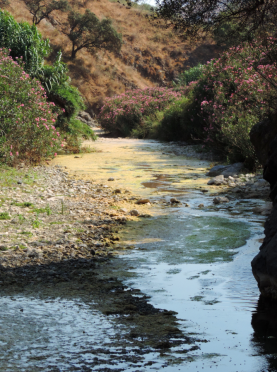
Human competition for scarce water resources is expected to have an increasing influence on med-rivers and the species that inhabit them. Photo courtesy Núria Bonada
To tackle these challenges, Bonada and Resh point to several critical areas for future research. While some med-climate streams have established baseline knowledge and grounded policy such as the EU’s Water Framework Directive to improve their ecological status, rivers in Chile, North African and Middle Eastern countries are less studied. Even basic ecological information is often lacking. Med-regions are freshwater biodiversity hotspots, but “in most regions the knowledge of this biodiversity is scarce and fragmented,” says Bonada. “Therefore, many species will move from being unknown to being lost under the current threats they are facing.” The colleagues suggest that international research programs should be encouraged, to exchange scientists between these med-regions and to fund research in med-regions worldwide. They also emphasize the importance of platforms such as BioFresh, whose role in collecting data from museums and researchers increases our knowledge about biodiversity and distributions in vulnerable areas such as med-regions.









 The Freshwater Blog