Notes from the water’s edge: how MERLIN is helping bring Europe’s freshwaters back to life

Plans for environmental restoration are gathering pace across Europe as we move closer to the adoption of the EU Nature Restoration Law. This planning is supported by four major European projects which aim to develop new approaches to help restore the continent’s freshwaters, forests, wetlands and coastlines.
These four projects – MERLIN, SUPERB, WaterLANDS and REST-COAST – were funded by the EU’s big environmental policy, the Green Deal. As they all have around a year left to run, the four projects are rapidly producing guidance, tools and support to help environmental managers bring Europe’s environments back to life.
The four Green Deal projects will present their work at an EU webinar next month – sign up here.
MERLIN Academy and Innovation Awards
MERLIN has been particularly busy in recent months. The latest newsletter showcases the breadth of work taking place across the project, including the developments of the MERLIN Academy, an online platform which aims to support practitioners, students, and policymakers in implementing effective restoration projects.
The MERLIN Academy – which consists of free online modules covering both theoretical and practical themes around freshwater restoration – is now looking for people to help shape its future. An online survey is available for the rest of the month, asking how the Academy can be better tailored to meet the needs of those implementing the Nature Restoration Law. You can access it here.
The annual MERLIN Innovation Awards are now open for submissions. The awards celebrate the products and services which are making ground-breaking contributions to global freshwater restoration. You can read about the past winners here, and make your entry by 13th December 2024 here.
Exploring case studies and deliverables
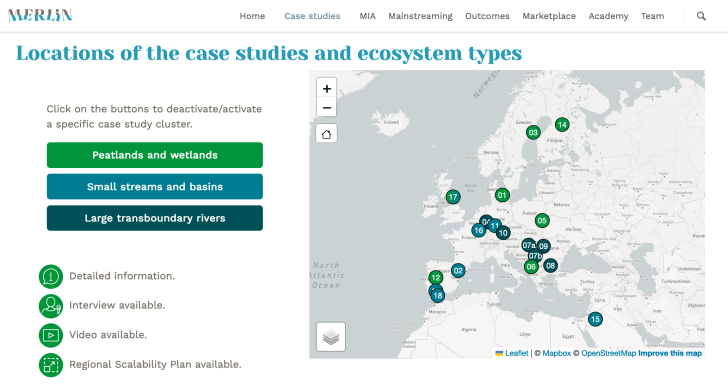
MERLIN’s work is based on the experiences and findings from 18 restoration case studies across Europe, from large rivers to tiny streams; from urban wetlands to remote peatlands. Stories and data from these amazing places can now be explored through the Case Study portal.
If you haven’t been keeping up with the MERLIN podcast, you can explore all our episodes here. The latest episode, released earlier this month, focuses on the crucial role of communities in driving positive change. From Israel to Germany, we learn how diverse groups of people are coming together to restore their local waterways.
A key part of big projects like MERLIN is publishing so-called ‘deliverables’, which provide cutting-edge information to policy makers, environmental managers and scientists to help share new findings. Four new deliverable reports have been published this autumn, covering topics including just transformations in implementing nature-based solutions, economic value analysis, and how to ‘upscale’ restoration from small sites to entire landscapes. You can read them all here.

Simulating ‘digital twins’ of real-world environments
One particularly fascinating deliverable covers the stories from the four ‘digital twin’ case studies in MERLIN. Digital twins are dynamic, virtual copies of real-world systems. Essentially, they are computer models of real environments which look and behave like a natural system.
Following the boom in ‘big data’, digital twins have become increasingly popular in replicating complex human-made systems like aircrafts and buildings. In so doing, they allow designers to predict their behaviour under different scenarios.
The MERLIN scientists saw significant potential for this approach to be applied to freshwater restoration. As we well know, freshwaters are hugely complex systems which change over seasons and years, and are vulnerable to human-made pressures. Being able to better predict their dynamics over long timescales is thus a valuable opportunity for environmental managers and policy makers seeking to mainstream their restoration.
In an engaging ‘StoryMap’, the MERLIN team lead viewers through four key elements of digital twinning: big data, computer modelling, supporting decision making, and boosting wider engagement. You can explore the world of digital twinning here.
///
This article is supported by the MERLIN project.








 The Freshwater Blog
Comments are closed.