Online marketplaces create new routes for the spread of invasive crayfish species

Growing global networks of online trade are creating new pathways for invasive crayfish species to spread across Europe, a new study has found. Freshwater crayfish are popular pets amongst aquarium hobbyists, but their release into rivers and lakes can cause significant damage to the health and functioning of ecosystems.
Writing in Conservation Biology, Julian D. Olden and Francisco A.C. Carvalho highlight how national biosecurity measures which tackle such invasive alien species widely struggle to keep pace with the growth of online platforms for buying and selling exotic species. This ‘clicks-not-bricks’ transition away from physical retail outlets has created opportunities for new long-distance trade routes for live organisms, and in so doing increased the potential for the spread of invasive species.
The authors’ study provides the first global assessment of the online trade in ornamental crayfish. “By systematically examining e-commerce marketplaces in multiple languages, we show that the online global crayfish pet trade involves hundreds of online marketplaces and thousands of sale listings in thirty-three countries across five continents, involving sixty different species and representing a selling value of around US$1.5 million,” explains Professor Olden. “We found that close to half of the listings were selling species considered globally invasive, and we subsequently map the geography of invasion risk across the world.”

One species highlighted by the study is the marbled crayfish. This remarkable creature – Procambarus virginalis – did not exist three decades ago. The original marbled crayfish was born in a German pet shop to a male and female slough crayfish, but had an additional set of chromosomes. This mutation gave the marbled crayfish the extraordinary ability to reproduce without a mate, leading to a population which now consists entirely of females. The species is highly prized by aquarium owners, not least for its diversity of colouration: individuals raised alone in captivity are blue, whilst those raised with others tend to be more grey.
Now found in waterways across Germany, the rapidly-reproducing marbled crayfish can outcompete native crayfish species for habitat, and help spread a fungal disease often called the “crayfish plague”. Despite the European Union instituting a total ban of the possession and trade of the marbled crayfish in the wild, the authors found the species widely available online to be shipped to Europe. They highlight research which suggests that the spread of the marbled crayfish across Europe is entirely driven by demand from the aquarium trade, increasingly facilitated by online trade.
Olden and Carvalho’s study – part of a wider special issue on the global wildlife trade – prompts significant questions for the conservation and restoration of Europe’s freshwaters. In particular, it highlights the need for joined-up policy decisions to monitor and regulate the online trade of invasive species across borders. The authors demonstrate that whilst the EU has a strategic coordinated joint plan across all Member States to reduce the availability of high-risk invasive species, two of the prohibited species (red swamp crayfish and marbled crayfish) are widely available in European-based online marketplaces.
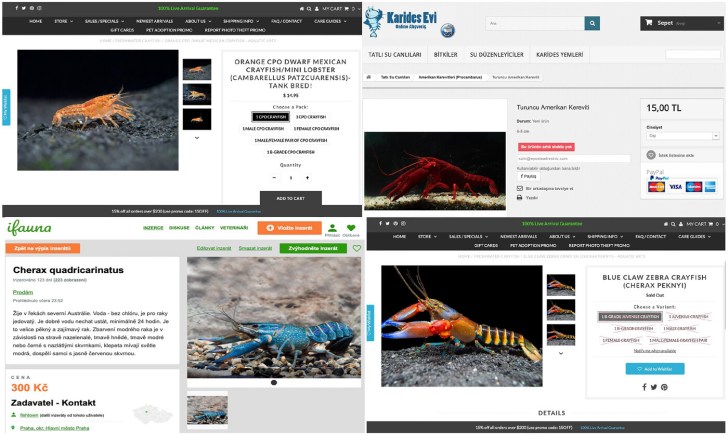
“Importantly the internet is not purely the cause of the problem; rather it also offers solutions that help prevent trade-related invasions of crayfish,” states Professor Olden. “Internet public forums and discussion groups provide opportunities for regulators to track consumer preferences, including through surveying popular social media platforms. The internet may also lend insight into how often and where illegal dumping of aquarium animals occurs, such as through the monitoring of online video postings.”
“Early warning systems can leverage the massive amounts of data on the Internet to support real-time surveillance of online marketplaces to detect new non-native species in trade, Olden continues. “Internal retailers represent the major, and perhaps the only, point of contact between the supply chain and the hobbyist. Online marketplaces are uniquely positioned to influence and educate ornamental owners about what to do with unwanted aquarium organisms, although forging these new relationships to increase awareness of the risks associated with invasive species remains uncommon.”
“Our work illustrates how continued growth in international trade and the burgeoning transition from brick-and-mortar stores to online marketplaces to purchase pets may necessitate a paradigm shift in the way in which nations seek to safeguard their borders against alien invasive species, both today and in the future,” Olden concludes.
///
This article is supported by the MERLIN project.










 The Freshwater Blog
Comments are closed.