Ringing the doorbell to help fish migration in the Netherlands

It’s well known that barriers to fish migration are a major issue in rivers across Europe. An innovative scheme in the Netherlands has harnessed the power of online citizen scientists to alert ecologists in Utrecht when fish are congregating behind a boat lock between the rivers Kromme Rhine and Vecht.
Visitors to the ‘fish doorbell’ website can then press a button to tell the lock keeper to open the gate to allow the fish through. This scheme – which allows fish such as carp, bream and eels to move upstream and avoid predators such as grebes and cormorants – has been extremely popular, with over a million visitors this year alone.
The fish doorbell scheme is particularly important in spring, when the water warms up and fish in the river become more active ahead of spawning. However, boat activity at this time of year is often quiet so the lock is rarely opened for passing traffic. As a result, the fish doorbell website – run between March and June since 2021 – has become a vital resource to allow fish to migrate between the Kromme Rhine and Vecht.
More broadly, the scheme has become a hugely effective citizen science engagement tool, reaching public audiences and acheiving press coverage across the world. In a time of rapid freshwater biodiversity declines, it offers a hopeful vision of how new technologies can give the public tools to help protect and restore aquatic life.
To find out more about the fish doorbell project, we spoke to co-founder Mark van Heukelum.
Tell us about the fish doorbell project: when did it start, and why?
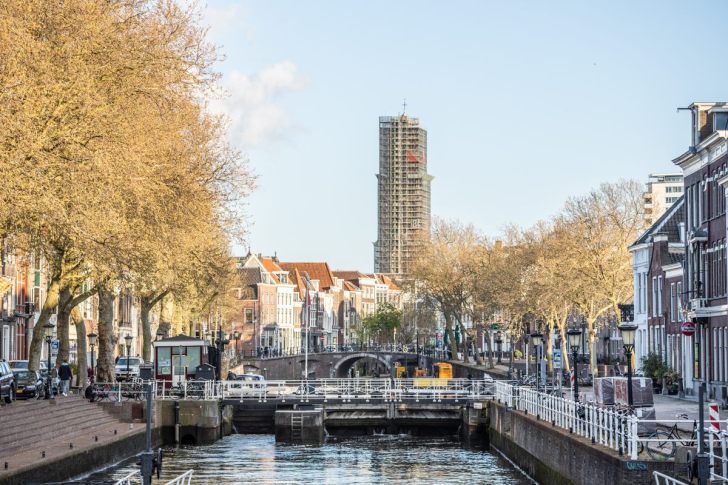
The idea started over four years ago. I was living near the boat lock and noticed large school of fish gathering before the lock doors. You have to understand that the City of Utrecht has a special water system; from the south water flows into the city channels from the River Kromme Rhine. The iconic city channels transport this water all the way to the north.
There it passes the boat lock into the River Vecht. So the city connects these two rivers. Fish want to migrate between these rivers especially in spring, to spawn and reproduce. But the boat lock is closed for the most part of spring, meaning that fish are trapped. Fish will wait for an opportunity to pass, losing energy as they wait. Some fish will turn around. Other fish will get eaten by predatory birds and fish, who know fish cannot go anywhere.
How did you come up with the idea for the fish doorbell?
I discussed the situation with the lock operator and told him that I wanted to contact the city and water authority to see if we could do something about it. But he said, why not open the lock this evening? And so we did. He was willing to open the lock for the fish. But since it is a monumental lock that is still operated by hand, it takes a lot of effort (on cycle takes an hour) and he wanted to do this only if there were fish waiting.
That’s how I came up with the idea of a camera with a live stream. But since it would take too much time for me to watch it continuously, we asked people to help out. And to our surprised they did – thousands of them! Until now millions of people all over the world have helped us to open the lock for fish!
What has its impact been? How has it resonated with people, and what have been the impacts on the fish who are ‘ringing the bell’?
We know that because of the fish doorbell, thousands of fish can pass the lock every spring. Especially for species like pike and ide, it has been essential, because they migrate early in spring.
Still, we also ‘miss’ species that we would expect. Particularly fish species that prefer clear and plant-rich waters. The conclusion that we can draw from this is that many of our city waters are still empty and lack underwater habitat. So after opening the lock for fish, out new challenge is to create a better home for them.

Do you see this idea being rolled out to other rivers, whether in Europe or globally? What would it take for this to happen?
Yes! Of course, the situation at this lock is quite unique, but the essence of people helping fish to continue their journey is applicable in many situations. Beside helping the fish through the lock, creating awareness and introducing the hidden world under the water surface is just as important.
We have a saying: ‘Onbekend maakt onbemend’. Which means something like: ‘if you don’t know it, you don’t care about it‘. That accounts as well for our rivers and the submerged world. Once we get to know it and appreciate it, we will take better care of it. And if you have the opportunity to really do something for fish this easily, it will for sure make an impact!









 The Freshwater Blog
Comments are closed.