Water, climate and farming: making space for stream restoration in Portugal
Last week, researchers from the MERLIN project working on the restoration of small streams across Europe met in Lisbon, Portugal to discuss progress and visit case study sites. Following exchanges at the University of Lisbon, the group visited restoration projects in the Sorraia and Ervidel catchments.
With the MERLIN project at the half-way point, discussions centred on how to measure the impacts of restoration projects, and how to gain support from policy makers and financiers to upscale their use across Europe.
Working with the concept of nature-based solutions, the indicators of restoration impact used by MERLIN are not only environmental, but also social and economic. This means that researchers are not only monitoring how restoration is affecting factors like biodiversity and greenhouse gas emissions at their sites, but also how it impacts things like green job creation and private finance mobilisation. The idea is to help build a convincing case for upscaling freshwater restoration across Europe by showing that it can benefit people as well as nature.

As a result, there were also in-depth discussions around leveraging new funding sources for freshwater restoration. Many of these exchanges focused on the potential of private – or non-governmental – sources of funding, whether through donations, in-kind contributions, restoration services or commercial activities such as tourism or insurance.
The plan is to better integrate nature-positive approaches into European economies to help address the growing ecological and climate emergencies. As a result, MERLIN researchers are developing a model to allow restoration managers to map their financial needs, and to provide guidance on the range of funding and revenue options available to them.
This ambitious vision also needs the support of policy makers and industry stakeholders, and MERLIN researchers are working to ensure that the value of nature-based solutions in restoration is widely understood. This means working to develop new governance and participation approaches and fostering a more enabling European policy environment, whether in the application of existing policies like the Common Agricultural Policy, or the development of new ones, such as the Nature Restoration Law.
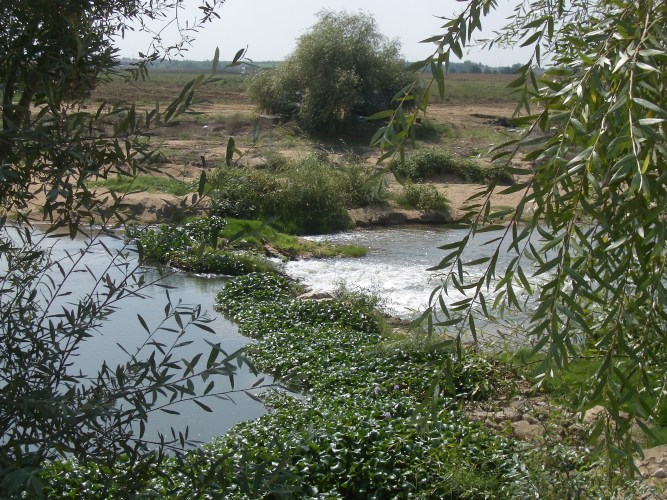
The MERLIN case studies have a vital role in providing the evidence for this transformative vision, and researchers travelled south from Lisbon to see two Portuguese examples. The Sorraia catchment is intensively managed for agriculture, with upstream reservoirs storing and allocating water to farmers for irrigation using a range of responsive new technologies.
Much of the restoration management along the Sorraia is focused on the riparian zones around the catchment’s streams. Here, invasive species such as the exotic giant reed are being cleared, and native trees and flowers are being planted to improve the habitat for biodiversity. In addition, streams in the Sorraia catchment are bisected by numerous river crossings, weirs and fords, which can impede the movement of fish across the catchment. As a result, fish passes are being installed in some of these barrier structures.
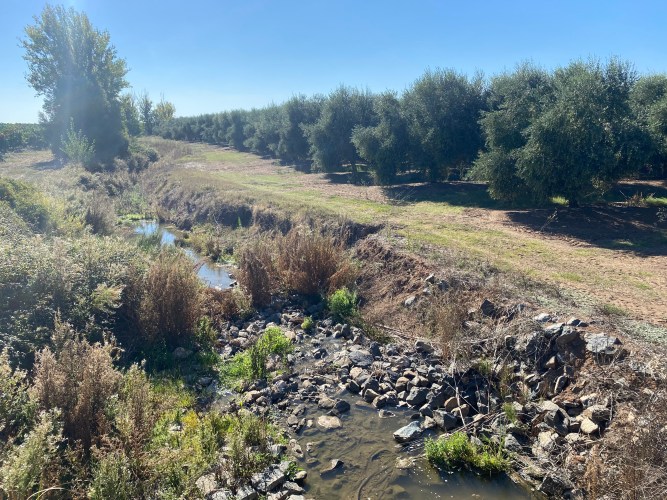
Further south, the Ervidel catchment is similarly dominated by the water needs of farmers. Between crop fields and olive plantations, researchers visited small streams flowing along courses heavily altered for drainage. The streams here are temporary and can be dry for between two and six months each year. Here, restoration focuses on the rehabilitation of river bed habitats, and the maintenance of minimum water flows throughout the year, alongside the replanting of riparian zones. As in the Sorraia catchment, this work requires close collaboration with agriculture and hydropower sectors to make a convincing case for the need for ambitious restoration.

Reflecting on the week, Professor Teresa Ferreira, leader of the Sorraia case study, from the University of Lisbon said: “Transformative change in restoration means sharing experiences and feelings for improving the way we see, use and protect nature. It means understanding different points of view and interests, potentially conflictual, but being able to address such divergences and still find common ground for something better than what already exists. Understanding different perspectives is a powerful tool for transformation, and we need it to break our cocoons of thought and create a stronghold of willingness to change.
“The MERLIN meeting and the trip to the Sorraia case study was such an experience. Mediterranean floodplains are often spoken about, but seldom perceived by other Europeans. Shaped by agricultural activities, the floodplains need restorative actions that ecologists are well aware of in order to get a proper ecological functioning and natural biodiversity, but these actions are constrained by the needs of crops and the limitations of water and space. Understanding such limitations is a key factor for successful restoration, while innovative solutions must be shown to the farmers, such as nature-based solutions and retro-innovations, something they can understand and use, and help them cross legislative obstacles and knowledge gaps.
“We’ve also been seeing intensive agricultural systems in the Mediterranean where water availability plays a key role. In the southernmost region of Ervidel, environmental constraints, climatic drought and water demand for crops, are extreme. Water management and agriculture compete over riverine territory to the point that protective riparian structures often are missing. Transformation towards higher agricultural productivity in this region came with constant water supply from reservoirs, and nature-based solutions or freshwater restoration are not top priorities. We need MERLIN to demonstrate the alternatives.
“I believe with the Sorraia case study visit and landscape observations, we got richer both as restoration practitioners and as humans,” Prof. Ferreira concluded.
///
This article is supported by the MERLIN project.









 The Freshwater Blog
Comments are closed.